Notes on four naturalized weeds in Morocco: extended distribution and new record
DOI :
https://doi.org/10.24310/abm.50.2025.21796Mots-clés :
xenophytes, weed survey, new records, floristics, North AfricaRésumé
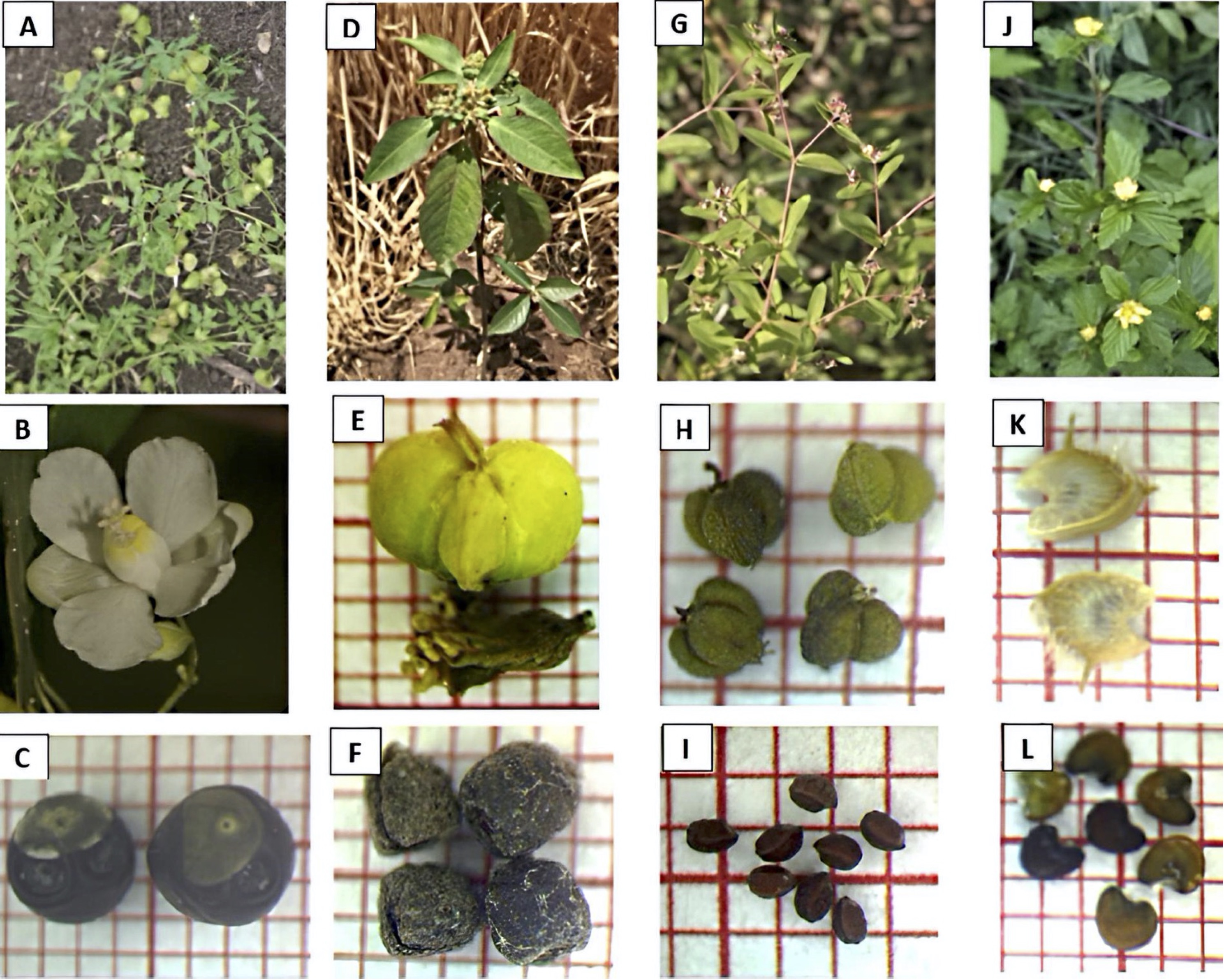
This contribution deals with the record of four alien naturalized plants in Morocco due to field surveys conducted in 2023 and 2024, with special emphasis on weeds occurring in farmlands (agricultural regions of Chaouia, Gharb, Haouz, Loukkos, Sous, and Tadla). Among these reported plants, three are here presented as new national distributional records namely, Euphorbia heterophylla L., E. nutans Lag. (Euphorbiaceae) and Malvastrum coromandelianum (L.) Garcke subsp. coromandelianum (Malvaceae) whereas Cardiospermum microcarpum (Kunth) Blume (Sapindaceae) is here reported for the first time in the country. Photographic evidence, distribution maps, and taxonomic notes are provided for each taxon. In addition, voucher herbarium specimens were prepared and deposited at the national herbarium (RAB) of the Scientific Institute in Rabat.
Téléchargements
Références
Araf, M., Kumar, S., Parihar, J. & Hamal, I.A. (2009). Seed biology of an invasive weed–Euphorbia geniculata Ortega from Northwest Himalaya (India). Indian Journal of Weed Science, 41(1&2), 85-87.
Arianoutsou, M., Bazos, I., Delipetrou, P. & Kokkoris, Y. (2010). The alien flora of Greece: taxonomy, life traits and habitat preferences. Biological Invasions, 12(10), 3525-3549. http://doi.org/10.1007/s10530-010-9749-0 DOI: https://doi.org/10.1007/s10530-010-9749-0
Barina, Z., Rakaj, M., Somogyi, G., Eros–Honti, I.Z. & Pifko, D. (2014). The alien flora of Albania: history, current status and future trends. Weed Research, 54(2), 196-215. http://doi.org/10.1111/wre.12061 DOI: https://doi.org/10.1111/wre.12061
Ben Ghabrit, S., Bouhache, M., Birouk, A. & Bon, M.C. (2019). Quand les plantes exotiques envahissantes menacent l’agriculture et les écosystèmes. In Association Marocaine de Protection des Plantes (Eds.), La protection des plantes: face aux défis actuels et en perspective (Proceedings) (pp. 26–27). Rabat, Morocco: March.
Boulos, L. (2000). Flora of Egypt. (Geraniaceae–Boraginaceae), 2. Cairo: Al Hadara Publishing.
Calero, C.A.M, Rodríguez, J.R.Y., Fernández, Y.A., Marrero, D. F., & Fernandes, P. (2023). Euphorbia heterophylla Linn. (Wild poinsettia), a weed that deserves to be tamed and not eliminated. Horticulture International Journal, 7(2), 70-71. https:// 10.15406/hij.2023.07.00278 DOI: https://doi.org/10.15406/hij.2023.07.00278
Chambouleyron, M. (2023). Cotula australis, a new alien species for the flora of Morocco and continental North Africa. Acta Botanica Malacitana, 48, 147-149. https://doi.org/10.24310/abm.v48i.16905 DOI: https://doi.org/10.24310/abm.v48i.16905
Dobignard, A. & Chatelain, C. (2011). Index synonymique de la flore d’Afrique du Nord. Dicotyledoneae: Acanthaceae-Asteraceae, 2. Genève: Conservatoire et Jardin botaniques de la Ville de Genève, ECWP.
Dobignard, A. & Chatelain, C. (2012). Index synonymique de la Flore d'Afrique du Nord. Dicotyledoneae: Fabaceae-Nymphaeaceae, 4. Genève: Conservatoire et Jardin botaniques de la Ville de Genève, ECWP.
Dressler, R. L. (1961). A synopsis of Poinsettia (Euphorbiaceae). Annals of the Missouri Botanical Garden, 329-341. DOI: https://doi.org/10.2307/2395121
El Mokni, R. (2023). Non-native shrubby species of Euphorbia (Euphorbiaceae) in Tunisia. Flora Mediterranea, 33, 17-29. https://doi.org/10.7320/FlMedit33.017 DOI: https://doi.org/10.7320/FlMedit33.017
EPPO (2025). European and Mediterranean Plant Protection Organization. Accessed on 2 April 2025.
Ferrara, L. (2018). Cardiospermum halicacabum Linn.: food and drug. International Journal of Medical Reviews, 5(4), 146-150. http://doi.org/10.29252/IJMR-050404 DOI: https://doi.org/10.29252/IJMR-050404
Ferrucci, M.S. (1991). Sapindaceae. In R. Spichiger & L. Ramella (Eds.), Flora Del Paraguay, 16 (pp. 1–144). Conservatoire et Jardin botaniques de la Ville de Genève & Missouri Botanical Garden. St. Louis: Heliographia SA.
FNA (2025). Flora of North America Editorial Committee, Eds. http://floranorthamerica.org. Accessed on 2 April 2025.
Foxcroft, L.C., Henderson, L., Nichols, G.R. & Martin, B.W. (2003). A revised list of alien plants for the Kruger National Park. Koedoe, 46(2), 21–44. http://doi.org/10.4102/koedoe.v46i2.54 DOI: https://doi.org/10.4102/koedoe.v46i2.54
Friedmann, F. (2011). Cardiospermum. In IRD (Eds.), Flore des Seychelles, Dicotylédones (p. 413). Marseille, France: Publications Scientifiques du Muséum, Collection Faune et Flore Tropicales 44.
Ghani, A.S.A., El-Toumy, S.A., El-Dougdoug, W.I.A., Badr, W.H. & Hassan, H.M. (2020). New acetyl triterpenoidal and biological activities of Euphorbia paralias and Euphorbia geniculata (Euphorbiaceae) from Egypt. Egyptian Journal of Chemistry, 63(10), 3583-3595. http://doi.org/10.21608/ejchem.2020.20211.2215 DOI: https://doi.org/10.21608/ejchem.2020.20211.2215
Gildenhuys, E., Ellis, A.G., Carroll, S.P. & Le Roux, J.J. (2013). The ecology, biogeography, history and future of two globally important weeds: Cardiospermum halicacabum Linn. and C. grandiflorum Sw. NeoBiota,19, 45-65. http://doi.org/10.3897/neobiota.19.5279 DOI: https://doi.org/10.3897/neobiota.19.5279
Hadjikyriakou, G., Christodoulos, M., Yiannis, C. & Gabriel, A. (2004). Additions to the flora of Cyprus. Le Journal de Botanique, 27, 31-46. https://doi.org/10.3406/jobot.2004.1985 DOI: https://doi.org/10.3406/jobot.2004.1985
Hill, S.R. (1982). A monograph of the genus Malvastrum. Rhodora, 84(837), 1-83. https://biostor.org/reference/137938
Homrani-Bakali, A. & Peltier, J. (2020). Gypsophila struthium L. nouvelle espèce pour la flore du Maroc. Bulletin de l’Institut Scientifique, 42, 59-62.
Huang, Q.Q., Wang, G.X., Hou, Y.P. & Peng, S.L. (2011). Distribution of invasive plants in China in relation to geographical origin and life cycle. Weed Research, 51(5), 534-542. http://doi.org/10.1111/j.1365-3180.2011.00868.x DOI: https://doi.org/10.1111/j.1365-3180.2011.00868.x
Khamar, H., Benkhnigue, O. & Zidane, L. (2021). Euphorbia hirta (Euphorbiaceae): a new naturalized xenophyte in the vascular flora of Morocco. Flora Mediterranea, 31, 199-206. https://doi.org/10.7320/FlMedit31.199 DOI: https://doi.org/10.7320/FlMedit31.199
Khamar, H., Benkhnigue, O., Douira, A., Zidane, L. & Touhami, A.O. (2022). Phyllanthus tenellus Roxb. (Phyllanthaceae), a newly naturalising species in Morocco. Check List, 18(2), 411-417. https://doi.org/10.15560/18.2.411 DOI: https://doi.org/10.15560/18.2.411
Khamar, H. & El Bakhouch, H. (2024). Senecio angulatus L. (Asteraceae) a new addition to the Moroccan alien flora. Acta Botanica Malacitana, 49, 168-174. https://doi.org/10.24310/abm.49.2024.19692 DOI: https://doi.org/10.24310/abm.49.2024.19692
Khamar, H., Dallahi, Y. & Homrani Bakali, A. (2024a). New records of three alien Solanum species in Morocco. Check List, 20(2), 544–552. https://doi.org/10.15560/20.2.544 DOI: https://doi.org/10.15560/20.2.544
Khamar, H., Boudik, S., Benkhnigue, O. & Zidane, L. (2024b). Euphorbia hypericifolia (Euphorbiaceae): a new addition to the vascular flora of Morocco. Collectanea Botanica, 43, 1-9. https://doi.org/10.3989/collectbot.2024.v43.0002 DOI: https://doi.org/10.3989/collectbot.2024.v43.0002
Kigel, O.J., Lior, E., Zamir, L. & Rubin, B. (1992). Biology of reproduction in the summer annual weed Euphorbia geniculata Ortega. Weed Research, 32(4), 317-328. https://doi.org/10.1111/j.1365-3180.1992.tb01892.x DOI: https://doi.org/10.1111/j.1365-3180.1992.tb01892.x
Leopardi-Verde, C.L., Guzmán-González, S., Carnevali, G., de Stefano, R.D. & Tapia-Muñoz, J.L. (2021). Weeds of commercial crops in Colima, Mexico. Revista Mexicana de Biodiversidad, 92, e923622. https://doi.org/10.22201/ib.20078706e.2021.92.3622 DOI: https://doi.org/10.22201/ib.20078706e.2021.92.3622
Otto, R. & Verloove, F. (2016). New xenophytes from La Palma (Canary Islands, Spain), with emphasis on naturalized and (potentially) invasive species. Collectanea Botanica, 35, e001. https://doi.org/10.3989/collectbot.2016.v35.001 DOI: https://doi.org/10.3989/collectbot.2016.v35.001
POWO (2025). Plants of the World Online. https://powo.science.kew.org. Accessed on 2 April 2025.
Rankins, A., Byrd, J.D., Mask, D.B., Barnett, J.W. & Gerard, P.D. (2005). Survey of soybean weeds in Mississippi. Weed Technology, 19(2), 492–498. https://doi.org/10.1614/WT-04-197R2 DOI: https://doi.org/10.1614/WT-04-197R2
Sakkir, S., Al Mansoori, M. & Soorae, P. (2022). Malvastrum coromandelianum subsp. capitato-spicatum (Malvaceae), a new record for United Arab Emirates (UAE). Feddes Repertorium, 133(2), 215-219. https://doi.org/10.1002/fedr.202100026 DOI: https://doi.org/10.1002/fedr.202100026
Saxena, S. & Rao, P.B. (2018). GC-MS screening of bioactive constituents and antioxidant profiling in an invasive weed, Malvastrum coromandelianum (L.) Garcke. The Pharma Innovation Journal, 7(4), 738–746. https://www.researchgate.net/publication/324950952
Smithi, R., Bharathi, K. & Rani, D.J. (2024). Phytochemical and nutrient composition of fresh and dried Cardiospermum halicacabum leaves. Journal of Food Science and Nutrition, 10, 185. https://doi.org/10.24966/FSN-1076/100185 DOI: https://doi.org/10.24966/FSN-1076/100185
Steinmann, V. W., Morawetz, J. J., Berry, P. E., Peirson, J. A. & Yang, Y. (2016). Euphorbia Linnaeus sect. Anisophyllum Roeper. In Flora of North America Editorial Committee (Ed.), Flora of North America North of Mexico 12, New York and Oxford. http://www.efloras.org/florataxon.aspx?flora_id=1&taxon_id=318097. Accessed on 18 June 2025.
Sukhorukov, A.P., Léger, J.F. & Chambouleyron, M. (2023). Two new species alien to the flora of Morocco: Amaranthus spinosus (Amaranthaceae) and Cardamine occulta (Brassicaceae). Flora Mediterranea, 33, 31-38. https://doi.org/10.7320/FlMedit33.031 DOI: https://doi.org/10.7320/FlMedit33.031
Sukhorukov, A.P., Wen, Z., Krinitsina, A.A., Fedorova, A.V., Verloove, F., Kushunina, M., Léger, J.F., Chambouleyron, M., Tanji, A. & Sennikov, A.N. (2025). A revised taxonomy of the Bassia scoparia complex (Camphorosmoideae, Amaranthaceae s.l.) with an updated distribution of B. indica in the Mediterranean region. Plants, 14, 398. https://doi.org/10.3390/plants14030398 DOI: https://doi.org/10.3390/plants14030398
Suresh, A.P., Paramakrishnan, N., Basavaraju, M. & Mruthunjaya, K. (2023). A Comprehensive review on Cardiospermum halicacabum. Journal of Natural Remedies, 23(2), 283-293. https://doi.org/10.18311/jnr/2023/29382 DOI: https://doi.org/10.18311/jnr/2023/29382
Taleb, A. (2015). Guide des principaux adventices des cultures du Ma¬ghreb (Maroc, Algérie et Tunisie). Rabat, Morocco: Dow AgroSciences.
Taleb, A. & Bouhache, M. (2006). État actuel de nos connaissances sur les plantes envahissantes au Maroc. In G. Preston, C. Brown & E. van Wyk (Eds.), Invasive plants in Mediterranean type regions of the world (pp. 99–107). Cape Town : South African National Biodiversity Institute.
Tanji, A. (2020). Notes about two summer annual grass weeds in Morocco: Dinebra retroflexa and Cenchrus longispinus (Poaceae). Flora Mediterranea, 30, 113-119. https://doi.org/10.7320/FlMedit30.113 DOI: https://doi.org/10.7320/FlMedit30.113
Tanji, A. (2023a). Two new annual weeds in Morocco: Amaranthus palmeri and Chenopodium ficifolium subsp. ficifolium (Amaranthaceae). Flora Mediterranea, 33, 91-99. https://doi.org/10.7320/FlMedit33.091 DOI: https://doi.org/10.7320/FlMedit33.091
Tanji, A. (2023b). Two new weeds in Morocco: Ambrosia psilostachya (Asteraceae) and Datura ferox (Solanaceae). Flora Mediterranea, 33, 225–232. https://doi.org/10.7320/FlMedit33.225 DOI: https://doi.org/10.7320/FlMedit33.225
Tanji, A. & Taleb, A. (1997). New weed species recently introduced into Morocco. Weed Research, 37(1), 27–31. https://doi.org/10.1111/j.1365-3180.1997.tb01819.x DOI: https://doi.org/10.1111/j.1365-3180.1997.tb01819.x
Thiers, B. (2025). Index herbariorum: a global directory of public herbaria and associated staff. New York Botanical Garden’s virtual herbarium. http://sweetgum.nybg.org /science/ih/. Accessed on 02 April 2025
Traoré, H. & Maillet, J. (1992). Flore adventice des cultures céréalières annuelles du Burkina Faso. Weed Research, 32(4), 279-293. https://doi.org/10.1111/j.1365-3180.1992.tb01888.x DOI: https://doi.org/10.1111/j.1365-3180.1992.tb01888.x
Turner, I.M. (1999). Euphorbia heterophylla and E. cyathophora (Euphorbiaceae) in the Malay Peninsula. Gardens' Bulletin Singapore, 51, 99-102.
Vázquez Pardo, F.M. & Márquez García, F. 2018. 112(1). -Euphorbia nutans Lag. & 112(2). -Euphorbia hypericifolia L. Folia Botanica Extremadurensis, 12, 137-141.
Verloove, F., Chambouleyron, M. & Léger, J.F. (2022). Rumex chalepensis (Polygonaceae), a new species for Morocco and Africa. Mediterranean Botany, 43, e74654. https://doi.org/10.5209/mbot.74654 DOI: https://doi.org/10.5209/mbot.74654
Vibrans, H. (1998). Native maize field weed communities in south-central Mexico. Weed Research, 38(2), 153-166. https://doi.org/10.1046/j.1365-3180.1998.00082.x DOI: https://doi.org/10.1046/j.1365-3180.1998.00082.x
WOA (2025). Weeds of Australia. https://keyserver.lucidcentral.org/weeds/data/media/Html/index.htm#E. Accessed on 2 April 2025.
Téléchargements
Publiée
Comment citer
Numéro
Rubrique
Licence
(c) Copyright Abbes, Hamid Khamar 2025

Ce travail est disponible sous licence Creative Commons Attribution - Pas d’Utilisation Commerciale - Partage dans les Mêmes Conditions 4.0 International.
Toutes les informations concernant la licence d'utilisation des travaux publiés dans Acta Botanica Malacitana et les droits d'auteur sont disponibles dans notre Politique Éditoriale.



1.png)