On the occurrence of Ipomoea imperati (Vahl) Griseb. (Convolvulaceae, Ipomoeeae) within coastal dunes of Tunisia, the lost piece of the puzzle fell into place!
DOI:
https://doi.org/10.24310/abm.50.2025.22192Palabras clave:
Corología, Convolvulus, dunas costeras, Norte de África, SolanalesResumen
Sobre la presencia de Ipomoea imperati (Vahl) Griseb. (Convolvulaceae, Ipomoeeae) en las dunas costeras de Túnez, ¡la pieza perdida del rompecabezas encajó!
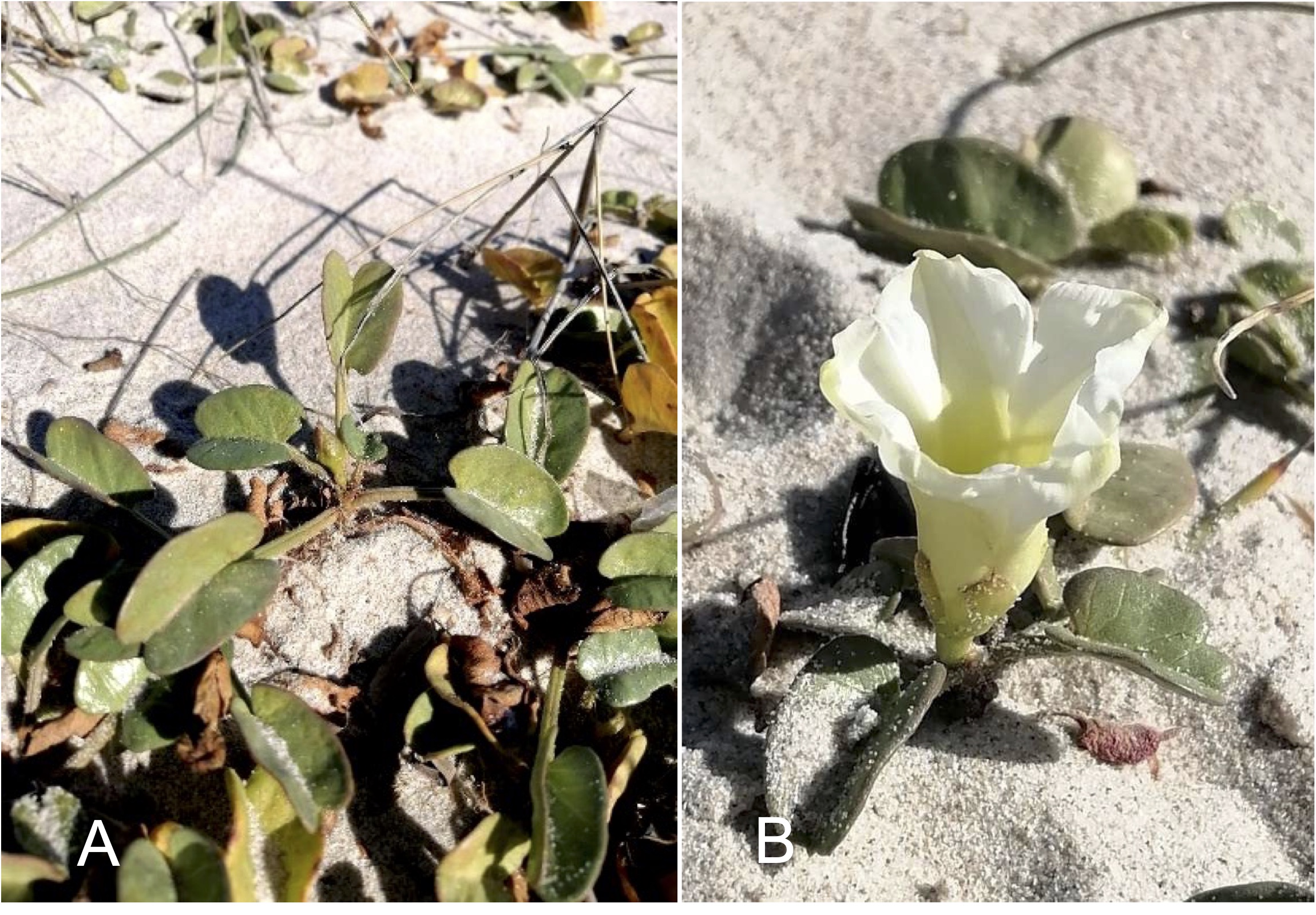
La presencia de Ipomoea imperati (Vahl) Griseb. se confirma y documenta claramente por primera vez en Túnez tras estudios botánicos realizados recientemente en las dunas costeras del noroeste y centro-este del país. Se proporcionan características generales y fotografías originales del material tunecino. Se presentan la fenología, el hábitat y las notas ecológicas de la especie en Túnez. Además, se propone una clave de discriminación para las especies conocidas del género en Túnez.
Descargas
Referencias
APD [African Plant Database] (2025). Ipomoea imperati (Vahl) Griseb. https://africanplantdatabase.ch/en/nomen/specie/8928/ipomoea-imperati-vahl-griseb. Accessed on 30 July 2025.
Caldarella, O., La Rosa, A. & Di Trapani, E. (2021). New data about the distribution of Ipomoea imperati (Vahl) Griseb. (Convolvulaceae) in Sicily. Biodiversity Journal, 12(4), 899-903. DOI: https://doi.org/10.31396/Biodiv.Jour.2021.12.4.899.903
Cennamo, P., Del Guacchio, E., Paino, L., De Castro, O., Menale, B., Vasquez-Torres, M. & Caputto, P. (2013). Genetic structure of Ipomoea imperati (Convolvulaceae) in the Mediterranean region and implications for its conservation. Phytotaxa, 141, 40-54. DOI: https://doi.org/10.11646/phytotaxa.141.1.3
Da Silva, R.M. (2002). Uma nova planta para o Arquipé - lago da Madeira. Bocagiana, 207, 1-7.
El Mokni, R. (2024). Four new alien lianas for Tunisia and new distributional records of Anredera cordifolia (Basellaceae), Ipomoea indica and I. purpurea (Convolvulaceae). Flora Mediterranea, 34, 325-336. https://doi.org/10.7320/FlMedit34.325 DOI: https://doi.org/10.7320/FlMedit34.325
Fang, R.C. & Staples, G. (1995). Convolvulaceae. In Y. Wu & P.T. Raven (Eds.), Flora of China, 16 (pp. 271-325). Beijing and St. Louis, Science Press and Missouri Botanical Garden.
García-de-Lomas, J., Dana, E.D., Sánchez-Gárcía, Í., Sánchez, J., Hernández, J., Vasallo, F. & Ceballos, G. (2015). Ipomoea imperati (Vahl) Griseb. (Convolvulaceae): Nuevo xenófito invasor en la provincia de Cádiz (Sur de España). Acta Botanica Malacitana, 40, 89-94. DOI: https://doi.org/10.24310/abm.v40i0.2508
GBIF [Global Biodiversity Information Facility] (2025). Ipomoea imperati (Vahl) Griseb. https://www.gbif.org/species/2928596. https://doi.org/10.15468/39omei. Accessed via GBIF.org on 30 July 2025.
Hansen, A. & Sunding, P. (1993). Flora of Macaronesia. Checklist of vascular plants. 4, revisited edition. Sommerfeltia, 17, 1-295. DOI: https://doi.org/10.2478/som-1993-0003
iNaturalist (2025). Ipomoea imperati, observations. https://www.inaturalist.org/. https://doi.org/10.15468/dl.g68ppk. Accessed on 09 November 2025.
La Valva, V. & Sabato, S. 1983. Nomenclature and typification of Ipomoea imperati (Convolvulaceae). Taxon, 32, 110-114. DOI: https://doi.org/10.2307/1219862
Lonard, I. & Judd, W.F. (1999). The biological flora of coastal dunes and wetlands. Ipomoea imperati (Vahl) Griseb. Journal of Coastal Research, 15, 645-652.
Mabberley, D.J. (2008). The plant-Book: A portable dictionary of plants, their classification and uses. Third edition. Cambridge: Cambridge University Press.
McDonald, A. (1991). Origin and diversity of Mexican Convolvulaceae. Anales del Instituto de Biologia de la Universidad Nacional Autónoma de México, Série Botánica, 62, 65-82.
Naik, Ch.M., Singh, L.J. & Ekka, G.A. (2019). Ipomoea imperati (Convolvulaceae): an addition to flora of India from Andaman and Nicobar Islands. Journal of Asia-Pacific Biodiversity, 12, 713-717. DOI: https://doi.org/10.1016/j.japb.2019.09.005
Omezine, A. (2011). Introduction récente de certaines espèces adventices des cultures en Tunisie. Bulletin OEPP/EPPO Bulletin, 41, 77-84. DOI: https://doi.org/10.1111/j.1365-2338.2010.02435.x
POWO [Plants of the World Online] (2025). Ipomoea imperati (Vahl) Griseb. Plants of the World Online. Facilitated by the Royal Botanic Gardens, Kew. https://powo.science.kew.org/taxon/urn:lsid:ipni.org:names:60442184-2. Accessed on 30 July 2025.
Raab-Straube, E. von (2018). Convolvulaceae. In: Euro+Med Plantbase - the information resource for Euro-Mediterranean plant diversity. https://europlusmed.org/cdm_dataportal/taxon/84676c8d-180f-45bf-83a6-2c09b28efc88. Accessed on 30 July 2025.
Sanz Elorza, M., Dana, E. & Sobrino, E. (2001). Aproximación al listado de plantas alóctonas invasoras reales y potenciales en España. Lazaroa, 22, 121-131.
Sanz Elorza, M., Dana Sánchez, E.D. & Sobrino Vesperinas, E. (Eds.) (2004). Atlas de las plantas alóctonas invasoras en España. Madrid: Dirección General para la Biodiversidad.
Silvestre, S. (2012). Ipomoea L. In Castroviejo S. & al. (Eds.), Flora Iberica, 11 (pp. 279-286). Madrid: Real Jardín Botánico, CSIC.
Thiers, B.M. (2025). Index Herbariorum: A global Directory of Public Herbaria and Associated Staff. New York Botanical Garden’s Virtual Herbarium. http://sweetgum.nybg.org/ih/. Accessed on 06 November 2025.
Williams, B.D., Francisco, R.C., Mewded, B, Oppong, C.P., Bosomtwi-Ayensu, C, Masinde, C.W., Chukwuma, D. M., Gadisa, D.A., Yeboah, D.D., Ahossou, E.O.D., Rasaminirina, F., Precious, I-O.U., Korir, M.J., Antwi-Boasiako, K.B., Mfodwo, R.A., Musa, M.A.S., AttaAdjei, P-Jr., Akomatey, P.K., Kumordzie, S, Borosova, R., Tang, C., Asase, A., Ameka, G. & Simões A.R.G. 2024: Advancing knowledge of West African morning glories: a taxonomic revision of Ipomoea L. (Convolvulaceae) from Ghana. https://doi.org/10.1101/2024.04.02.587553 DOI: https://doi.org/10.1101/2024.04.02.587553
Wood, J.R.I, Muñoz-Rodríguez, P., Williams, B.R.M & Scotland, R.W. (2020). A foundation monograph of Ipomoea (Convolvulaceae) in the New World. PhytoKeys, 143, 1-823. https://doi.org/10.3897/phytokeys.143.32821 DOI: https://doi.org/10.3897/phytokeys.143.32821.figure143
Descargas
Publicado
Cómo citar
Número
Sección
Licencia
Derechos de autor 2025 Ridha El Mokni

Esta obra está bajo una licencia internacional Creative Commons Atribución-NoComercial-CompartirIgual 4.0.
Toda la información relacionada con la licencia de uso de los trabajos publicados en Acta Botanica Malacitana y con los derechos de autor se pueden consultar en nuestra Política Editorial.



1.png)