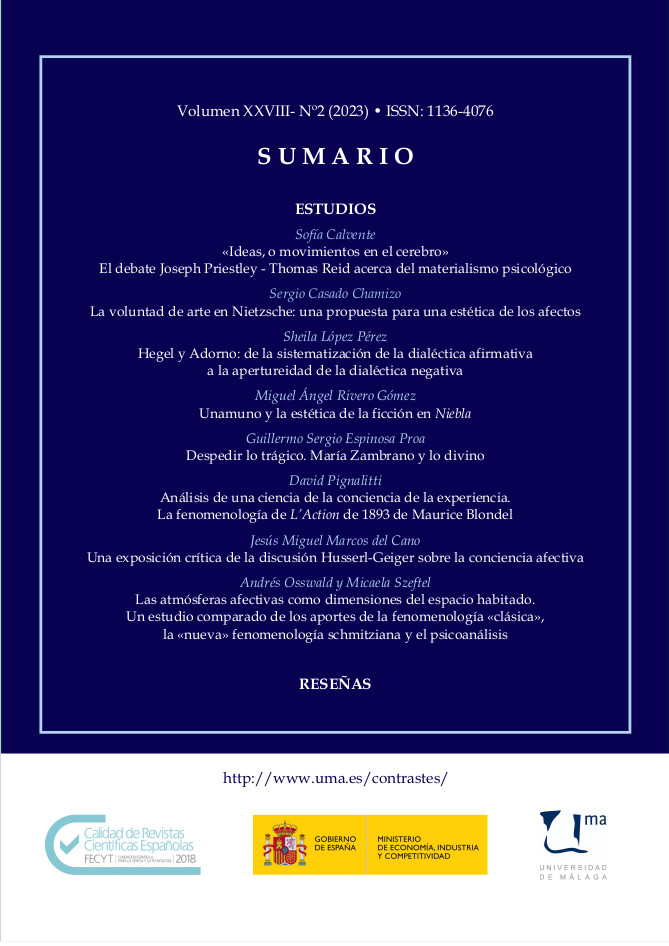
«Ideas, o movimientos en el cerebro»
El debate Joseph Priestley - Thomas Reid acerca del materialismo psicológico
DOI:
https://doi.org/10.24310/Contrastescontrastes.v28i2.14372Palabras clave:
Método experimental, Dualismo, Materialismo, Interacción cuerpo-mente, Omnipresencia divinaResumen
En la segunda mitad del siglo XVIII tuvo lugar un debate entre Thomas Reid y Joseph Priestley acerca de la naturaleza de la mente y su interacción con el cuerpo. En el marco de la defensa de la religión cristiana y en nombre de principios metodológicos experimentalistas y newtonianos, los autores defienden propuestas radicalmente diferentes acerca de la relación entre la mente y la materia. Sus divergencias se vinculan con la interpretación del método newtoniano y su concepción de la materia, lo que delineará dos actitudes: una dualista, de carácter más conservador por parte de Reid y una materialista, heterodoxa e innovadora por parte de Priestley.
Descargas
Referencias
Copenhaver, R. (2006), «Is Thomas Reid a Mysterian?», Journal of the History of Philosophy, 44 (3), pp. 449-466.
Fruchtman Jr., J. (1989), « Common Sense and the Association of Ideas: the Reid-Priestley Controversy », en M.
Dalgarno y E. Matthews (eds.), The Philosophy of Thomas Reid. Dordrecht: Kluwer Academic Publishers, pp. 421-431.
Garrett, A. (2004), «In Defense of Elephants. Priestley on Reid on How to be a Newtonian of the Mind», The Journal of Scottish Philosophy, 2 (2), pp. 137-153.
Guzzardi, L., 2020: Ruggiero Boscovich’s Theory of Natural Philosophy. Points, Distances, Determinations. Cham: Birkhäuser.
Haakonssen, K. y James, H. (2010), «Editors’ Introduction», en T. Reid [1788] (2010), Essays on the Active Powers of Man. Edimburgo: Edinburgh University Press, pp. Ix-xxii.
Locke, J. [1690] 1975: An Essay concerning Human Understanding, editado por P. H. Nidditch. Oxford: Clarendon Press.
Newton I. [1687] 2016, Mathematical Principles of Natural Philosophy, traducido al ingles por I. Bernard Cohen y A. Whitman. Oakland: University of California Press. Versión en español de Antonio Escohotado. Madrid, Alianza: 1995.
Nichols, R. (2007), «Natural Philosophy and its Limits in the Scottish Enlightenment», The Monist, 90 (2), pp. 233-250.
Priestley, J. 1774: An Examination of Dr. Reid’s Inquiry into the Human Mind, on the Principles of Common Sense; Dr. Beattie’s Essay on the Nature and Immutability of Truth; and Dr. Oswald’s Appeal to Common Sense in Behalf of Religion [E]. Londres: J. Johnson.
Priestley, J. 1777: Disquisitions Relating to Matter and Spirit [DME]. Londres: Pearson and Rollason.
Priestley, J. 1780: Letters to a Philosophical Unbeliever [LPU]. Bath: Cruttwell. Citado por número de carta y número de página.
Reid, T. [1764] 1997, An Inquiry into the Human Mind on the Principles of Common Sense [IHM], editado por D. Brookes. Edimburgo: Edinburgh University Press. Versión en español de E. Duthie. Madrid: Trotta, 2004.
Reid, T. [1785] 2002, Essays on the Intellectual Powers of Man [EIP], editado por D. Brookes. Pennsylvania: The Pennsylvania State University Press.
Reid, T. 1995: Thomas Reid on the Animate Creation: Papers relating to the Life Sciences [AC], editado por P. Wood. Edimburgo: Edinburgh University Press.
Sher, R. (1990), «Professors of Virtue: The Road to Adam Ferguson in the Edinburgh Moral Philosophy Chair», en M. A. Stewart (ed.), Studies in the Philosophy of the Scottish Enlightenment. Oxford: Oxford University Press, pp. 87-126.
Tapper, A. (1982), «The Beginnings of Priestley’s Materialism», Enlightenment and Dissent, 1, pp. 73-81.
Tapper, A. (2003), «Reid and Priestley on Method and the Mind», Philosophical Quarterly, 52 (209), pp. 511-525.
Wolfe, Ch. (2020), «From the logic of ideas to active-matter materialism: Priestley’s Lockean problem and early neurophilosophy», Intellectual History Review, 30 (1), pp. 31-47.
Wood, P. (1985), «Thomas Reid's Critique of Joseph Priestley: Context and Chronology», Man and Nature, 4, pp. 29-45.
Wood, P. (2004), «Thomas Reid and the Tree of Science», The Journal of Scottish Philosophy, 2 (2), pp. 119-136.
Wood, P. (2015), «Thomas Reid and the Common Sense School», en A. Garrett y J. Harris (eds.), Scottish Philosophy in the Eighteenth-Century, vol. I. Oxford: Oxford University Press, pp. 404-452.
Wunderlich, F. (2020), «Priestley on Materialism and the Essence of God», Intellectual History Review, 30 (1), pp. 49-64.
Publicado
Dimensions
Citations




Número
Sección
Licencia
Esta revista provee acceso libre inmediato a su contenido bajo el principio de hacer disponible gratuitamente la investigación al público. Todos los contenidos publicados en Contrastes. Revista internacional de Filosofía, están sujetos a la licencia Creative Commons Reconocimento-NoComercia-Compartirigual 4.0 cuyo texto completo puede consultar en <http://creativecommons.org/licenses/by-nc-sa/4.0>
Es responsabilidad de los autores/as obtener los permisos necesarios de las imágenes que están sujetas a derechos de autor.
Los autores/as cuyas contribuciones sean aceptadas para su publicación en esta revista conservarán el derecho no exclusivo de utilizar sus
contribuciones con fines académicos, de investigación y educativos,
incluyendo el auto-archivo o depósito en repositorios de acceso abierto de cualquier tipo.
La edición electrónica de esta revista esta editada por la Editorial de la
Universidad de Málaga (UmaEditorial), siendo necesario citar la procedencia en cualquier reproducción parcial o total.




5.png)