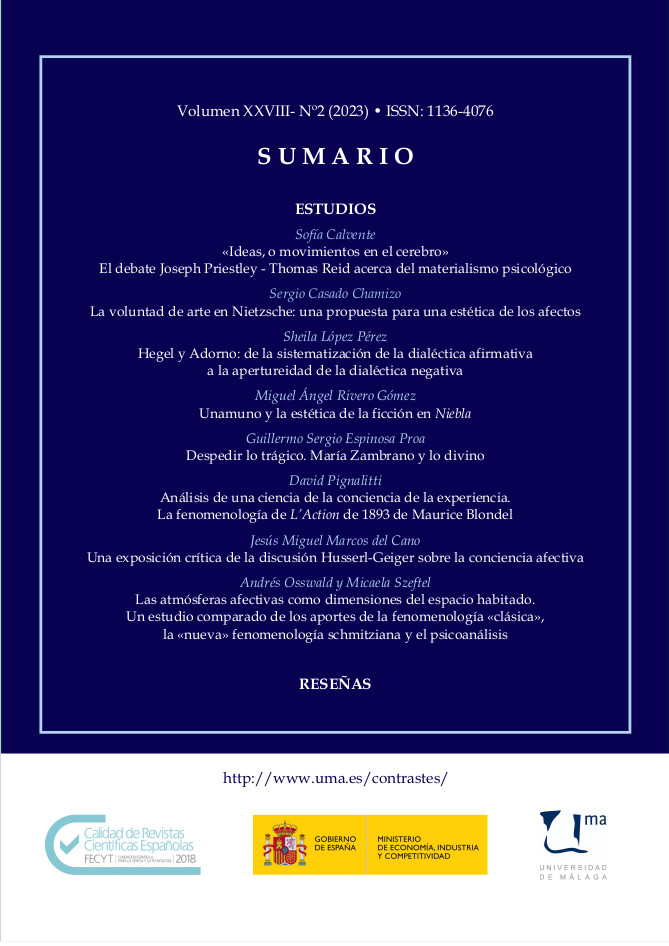
Las atmósferas afectivas como dimensiones del espacio habitado
DOI:
https://doi.org/10.24310/Contrastescontrastes.v28i3.15222Palabras clave:
espacio habitado, atmósferas, espacio no-extensional, fenomenología, psicoanálisisResumen
En esta investigación fenomenológica nos proponemos caracterizar las dimensiones del espacio habitado (el mundo familiar, el mundo extraño y el espacio intersticial entre ambos, desarrollado por la teoría psicoanalítica) a partir de la categoría schmitziana de atmósfera como fenómeno afectivo. Esta tarea revelará la ontología de los espacios no-extensionales que constituyen un aspecto esencial de la experiencia del habitar. En particular, nos concentraremos en la descripción positiva de las atmósferas del espacio intersticial, buscando resaltar su naturaleza productiva.
Descargas
Referencias
CLAESGES, U. (1964). Edmund Husserls Theorie der Raumkonstitution. Den Haag: Martinus Nijhoff.
DONOHOE, J. (2014), Remembering places: a phenomenological study of the relationship between memory and place. London: Lexington Books.
FREUD, S. (2007), «Más allá del principio del placer», en Obras completas, Volumen XVIII (1920-1922). Trad. J. L. Etcheverry. Buenos Aires: Amorrortu Editores.
FREUD, S. (2013), «Lo ominoso», en Obras completas, Volumen XVII (1917-1919). Trad. J. L. Etcheverry. Buenos Aires: Amorrortu Editores.
FUCHS, Th. (2011), «Das Unheimliche als Atmosphäre», en K. Andermann y U. Eberlein (eds.), Gefühle als Atmosphäre. Neue Phänomenologíe und philosophische Emotionstheorie. Deutsche Zeitschrift für Philosophie, 29. Berlin: Akademie Verlag.
GIBBS, A. (2010), «After Affect. Sympathy, Synchrony, and Mimetic Communication», en M. Gregg y G. J. Seigworth, The Affect Theory Reader. Durham/London: Duke University Press.
GRIFFERO, T. (2019), «Is There Such a Thing as an ‘Atmospheric Turn’? Instead of an Introduction», en T. Griffero y M. Tedeschini (eds.), Atmospheres and Aesthetics. A Plural Perspective. Cham: Palgrave Macmillan.
HATFIELD, E., J. RACIOPPO y R. RAPSON (1994), Emotional Contagion. New York: Cambridge University Press.
HEIDEGGER, M. (2007), Los conceptos fundamentales de la metafísica. Mundo. Finitud. Soledad. Trad. A. Ciria. Madrid: Alianza Editorial.
HUSSERL, E. (1973), Zur Phänomenologie der Intersubjektivität. Texte aus dem Nachlass. Dritter Teil. 1929-35. Den Haag: Martinus Nijhoff.
HUSSERL, E. (2005), Ideas relativas a una fenomenología pura y una filosofía fenomenológica. Libro segundo: Investigaciones fenomenológicas sobre la constitución. Trad. A. Zirión Quijano. Ciudad de México: Fondo de Cultura Económica.
HUSSERL, E. (2008), La crisis de las ciencias europeas y la fenomenología trascendental. Trad. J. V. Iribarne. Buenos Aires: Prometeo.
LEVINAS, E. (2002). Totalidad e infinito. Un ensayo sobre la exterioridad. Trad. D. E. Guillot. Salamanca: Sígueme.
LIPPS, Th. (1906). Ästhetik. Psychologie des Schönen und der Kunst. Segundo Tomo. Hamburg/Lipzig: Verlag von Leopold Voss.
OSSWALD, A (2017), «Fenomenología de la sensación. Un estudio sobre los Analysen zur passiven Synthesis de Husserl», Themata. Revista De Filosofía, 56, pp. 61-82.
OSSWALD, A (2018), «El hogar y lo extraño. Una aproximación sobre el habitar: entre la fenomenología y el psicoanálisis», Revista NUFEN [online], 10/3, pp. 64-87.
OSSWALD, A. y MC NAMARA, R. (2021), «Towards a Transcendental Philosophy of Spatiality: Husserl, Paliard, and Deleuze on Non-Extensional Spaces», Comparative and Continental Philosophy, 13/1, pp. 34-46.
PAPACHARISSI, Z. (2015), Affective publics: Sentiment, technology, and politics. Oxford: Oxford University Press.
RIEDEL, F. (2019), «Atmosphere», en J. Slaby y Ch. Von Scheve (eds.), Affective Societies. Key Concepts. London/New York: Routledge.
SCHMITZ, H. (1964), System der Philosophie. Tomo III, 1: «Der leibliche Raum». Bonn: Bouvier Verlag.
SCHMITZ, H. (1981), System der Philosophie. Tomo III, 2: «Der Gefühlsraum». Bonn: Bouvier Verlag.
SCHMITZ, H. (1997), Höhlegänge. Berlin: Akademie Verlag.
SCHMITZ, H. (2011a), Der Leib. Berlin: De Gruyter.
SCHMITZ, H. (2011b), «Entseelung der Gefühle». En: Andermann, K. y Eberlein, U. (Eds.), Gefühle als Atmosphäre. Neue Phänomenologíe und philosophische Emotionstheorie. Deutsche Zeitschrift für Philosophie, 29. Berlin: Akademie Verlag.
SCHMITZ, H. (2014), Kurze Einführung in die Neue Phänomenologie. Freiburg im B.: Karl Alber Verlag.
SLABY, J. (2011), «Möglichkeitsraum und Möglichkeitssinn. Bausteine einer phänomenologischen Gefühlstheorie», K. Andermann y U. Eberlein (eds.), Gefühle als Atmosphäre. Neue Phänomenologíe und philosophische Emotionstheorie. Deutsche Zeitschrift für Philosophie, 29. Berlin: Akademie Verlag.
SLOTERDIJK, P. (2009), Terror from the Air. Trad. A. Patton y S. Corcoran. Los Angeles: Semiotext(e).
STEINBOCK, A. (1995), Home and Beyond. Generative Phenomenology after Husserl. Evanston: Northwestern University Press.
STERN, W. (1935), Allgemeine Psychologie auf personalistischer Grundlage. Den Haag: Martinus Nijhoff.
WALTON, R. (2019), Horizonticidad e historicidad. Cali: Aula de Humanidades.
WINNICOTT, D.W. (2013), Realidad y juego. Trad. F. Macía. Barcelona: Gedisa.
Publicado
Dimensions
Citations




Número
Sección
Licencia
Esta revista provee acceso libre inmediato a su contenido bajo el principio de hacer disponible gratuitamente la investigación al público. Todos los contenidos publicados en Contrastes. Revista internacional de Filosofía, están sujetos a la licencia Creative Commons Reconocimento-NoComercia-Compartirigual 4.0 cuyo texto completo puede consultar en <http://creativecommons.org/licenses/by-nc-sa/4.0>
Es responsabilidad de los autores/as obtener los permisos necesarios de las imágenes que están sujetas a derechos de autor.
Los autores/as cuyas contribuciones sean aceptadas para su publicación en esta revista conservarán el derecho no exclusivo de utilizar sus
contribuciones con fines académicos, de investigación y educativos,
incluyendo el auto-archivo o depósito en repositorios de acceso abierto de cualquier tipo.
La edición electrónica de esta revista esta editada por la Editorial de la
Universidad de Málaga (UmaEditorial), siendo necesario citar la procedencia en cualquier reproducción parcial o total.




5.png)