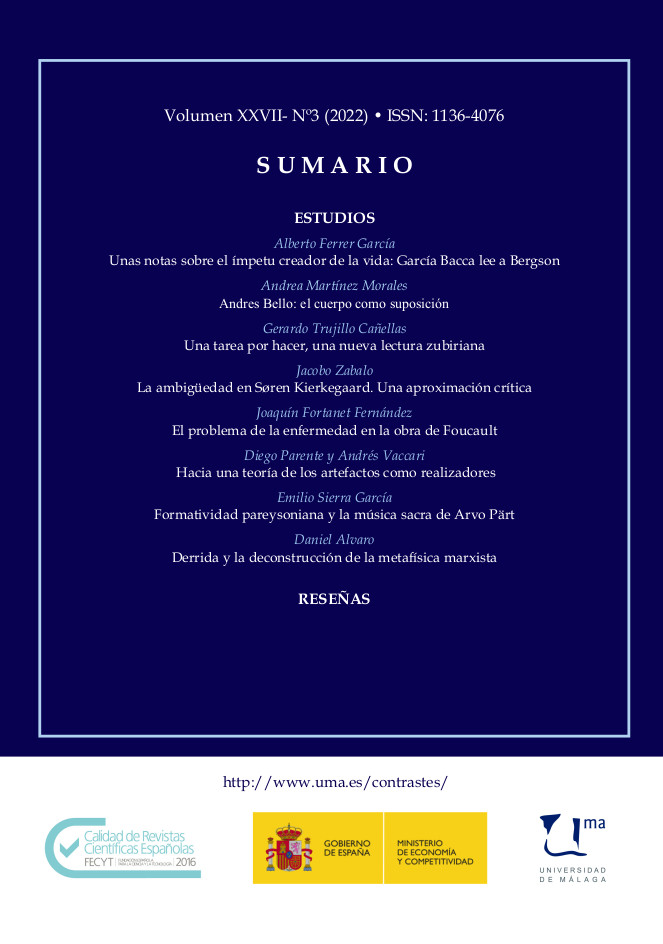
Towards a theory of artifacts as realizers
DOI:
https://doi.org/10.24310/Contrastescontrastes.v27i3.13975Keywords:
artifact, realizers, materialism, technical function, dualismAbstract
This paper presents the basic outline of a “theory of realizers”, a programmatic proposal that aims to establish an alternative to the dominant model in current debates on the ontology of artifacts. Our position is that we can better understand the artificial world if we approach artifacts in terms of “realizers” and their corresponding “realizations,” rather than as essentially “functional” objects. With this objective in mind, the article firstly develops the characterization of artifacts as "realizers" and, secondly, defends the idea in the context of the ontology of artifacts and other discussions in the philosophy of technology. The last section reconstructs our intellectual adversaries; a series of dualisms that structure present debates, such as materiality-function, material-symbolic, structure-function. We argue that the theory of realizers/realizations can surmount these prevailing dualisms and offer a much richer account on the life of artifacts.
Downloads
References
AKRICH, M y LATOU R, B. (1992. «A summary of a Convenient Vocabulary for the Semiotics of Human and Nonhuman Assemblies», en: BIJKER, W. y LAW, J., Eds., Shaping Technology-Building Society. Studies in Sociotechnical Change, Cambridge: MIT Press.
BAYSAN, U. (2015). «Realization Relations in Metaphysics», Minds and Machines, 25.3: 247–260. DOI: https://doi.org/10.1007/s11023-015-9366-x
BREY, P. (2005). «Artifacts as social agents», en: H. HARBERS, ed. Inside the Politics of Technology. Agency and Normativity in the Co-Production of Technology and Society, Amsterdam University Press, pp. 30-59. DOI: https://doi.org/10.1515/9789048503841-004
BRONCANO, F. (2000). Mundos artificiales. Filosofía del cambio tecnológico. México: FCE.
BRYANT, L. (2014). Onto-cartography. An ontology of machines and media. Edimburgh: Edimburgh University Press. DOI: https://doi.org/10.1515/9780748679980
ELDER, C. (2007). «On the place of artifacts on ontology», en: E. MARGOLIS y S. LAURENCE (eds.). Creations of the mind. Theories of artifacts and their representation, New York: Oxford University Press.
FERRARIS, M. (2005). Dove sei? Ontologia del telefonino, Milano: Tascabili.
HARMAN, G. (2015). Hacia el realismo especulativo. Buenos Aires: Caja negra.
HILPINEN, Risto (1992). «On Artifacts and Works of Art», Theoria, 58 (1): 58-82. DOI: https://doi.org/10.1111/j.1755-2567.1992.tb01155.x
HILPINEN, Risto (1993). «Authors and Artifacts», Proceedings of the Aristotelian Society, 93: 155-178. DOI: https://doi.org/10.1093/aristotelian/93.1.155
HÖRL, E., ed. (2017). General Ecology. The New Ecological Paradigm. New York: Bloomsbury.
HUTCHINS, E. (2010). «Cognitive ecology», Topics in Cognitive Science 2(4): 705-715. DOI: https://doi.org/10.1111/j.1756-8765.2010.01089.x
JUVSHIK, T. (2021). «Function essentialism about artifacts». Philosophical Studies 178(2): 1-22, doi 10.1007/s11098-020-01594-w. DOI: https://doi.org/10.1007/s11098-020-01594-w
KROES, Peter (2012). Technical artifacts. Creations of mind and matter, New York: Springer. DOI: https://doi.org/10.1007/978-94-007-3940-6
KROES, Peter and MEIJERS, Anthonie (2002). «The dual nature of technical artifacts: presentation of a new research programme», Techné, (6), 2: 4-8. DOI: https://doi.org/10.5840/techne2002626
KROHS, U. y KROES, P. (eds.) (2009). Functions in biological and artificial worlds, Londres: MIT Press. DOI: https://doi.org/10.7551/mitpress/9780262113212.001.0001
LATOUR, B. (1992). «Where are the missing masses? Sociology of a few mundane artefacts», en: BIJKER, W. y LAW, J., Eds., Shaping Technology-Building Society. Studies in Sociotechnical Change, Cambridge: MIT Press.
LEMONNIER, P. (1993). Technological choices. Transformations in material cultures since the Neolithic. Londres: Routledge.
MALAFOURIS, Lambros (2008). «At the Potter’s wheel: an argument for material agency», en: KNAPPET, Carl y MALAFOURIS, L. (Eds), Material Agency. Towards a non-anthropocentric approach. Berlin: Springer. DOI: https://doi.org/10.1007/978-0-387-74711-8_2
MCGRAIL, R. (2008). «Working with Substance: Actor—Network Theory and the Modal Weight of the Material,» Techné, vol. 12, no 1, pp. 65-84. DOI: https://doi.org/10.5840/techne200812115
MEILLASSOUX, Q. (2010). After Finitude: An Essay on the Necessity of Contingency. Londres: Oxford University Press.
MILLIKAN, Ruth (1999). «Wings, Spoons, Pills and Quills: A Pluralist Theory of Function», The Journal of Philosophy, 96, (4): 191-206. DOI: https://doi.org/10.5840/jphil199996428
MINKOWSKI, H. (2012). Space and Time: Minkowski’s papers on relativity. Montreal: Minkowski Institute Press.
PARENTE, D. (2016). «Los artefactos en cuanto posibilitadores de acción. Problemas en torno a la noción de agencia material en el debate contemporáneo», Revista Colombiana de Filosofía de la Ciencia, vol. 16, num 33, pp. 34-58. DOI: https://doi.org/10.18270/rcfc.v16i33.1937
PARENTE, D. y CRELIER, A. (2015). La naturaleza de los artefactos. Intenciones y funciones en la cultura material. Buenos Aires: Prometeo. DOI: https://doi.org/10.25009/s.2016.13.2026
PRESTON, Beth (1998). «Why is a wing like a spoon? A pluralist theory of function», The Journal of Philosophy, (95), 5: 215-254. DOI: https://doi.org/10.2307/2564689
PRESTON, Beth (2009). «Philosophical Theories of Artifact Function», en: MEIJERS, A. y otros, Eds., Philosophy of Technology and Engineering Sciences (Handbook of the Philosophy of Science, Volume 9, Amsterdam: Elsevier. DOI: https://doi.org/10.1016/B978-0-444-51667-1.50013-6
PRESTON, Beth (2013). A philosophy of material culture. Action, function, and mind, New York: Routledge. DOI: https://doi.org/10.4324/9780203069844
SCHIFFER, M. (2011). Technological change. A behavioural approach. Salt Lake City: University of Utah Press.
SIMONDON, G. (2008). El modo de existencia de los objetos técnicos. Buenos Aires: Prometeo.
SLOTERDIJK, P. (2017). Esferas I, Madrid: Siruela.
THOMASSON, Amie (2007), «Artifacts and Human concepts», en: MARGOLIS, E. y LAURENCE, S. (Eds.). Creations of the mind. Theories of artifacts and their representation. New York: Oxford University Press.
THOMASSON, Amie (2009), «Artefacts in metaphysics», en: MEIJERS, A. (ed.), Philosophy of technology and engineering sciences. Amsterdam: Elsevier B.V. DOI: https://doi.org/10.1016/B978-0-444-51667-1.50012-4
TOMASELLO, Michael (1999). The cultural origins of human cognition. Londres: Cambridge University Press. DOI: https://doi.org/10.4159/9780674044371
VEGA, J. (2020). «Artifactual affordances within taskscapes», Límite| Interdisciplinary Journal of Philosophy & Psychology (2020) 15: 23
Downloads
Published
Dimensions
Issue
Section
License
This journal provides immediate free access to its content under the principle of making research freely available to the public. All content published in Contrastes. Revista Internacional de Filosofía, are subject to the Creative Commons Attribution-NonCommercial-ShareAlike 4.0 license whose full text can be found at <http://creativecommons.org/licenses/by-nc-sa/4.0>
It is the responsibility of the authors to obtain the necessary permissions of the images that are subject to copyright.
Authors whose contributions are accepted for publication in this journal will retain the non-exclusive right to use their contributions for academic, research and educational purposes, including self-archiving or repository in open access repositories of any kind.
The electronic edition of this magazine is edited by the Editorial Service of the University of Malaga (Uma Editorial), being necessary to cite the origin in any partial or total reproduction.
How to Cite








5.png)