
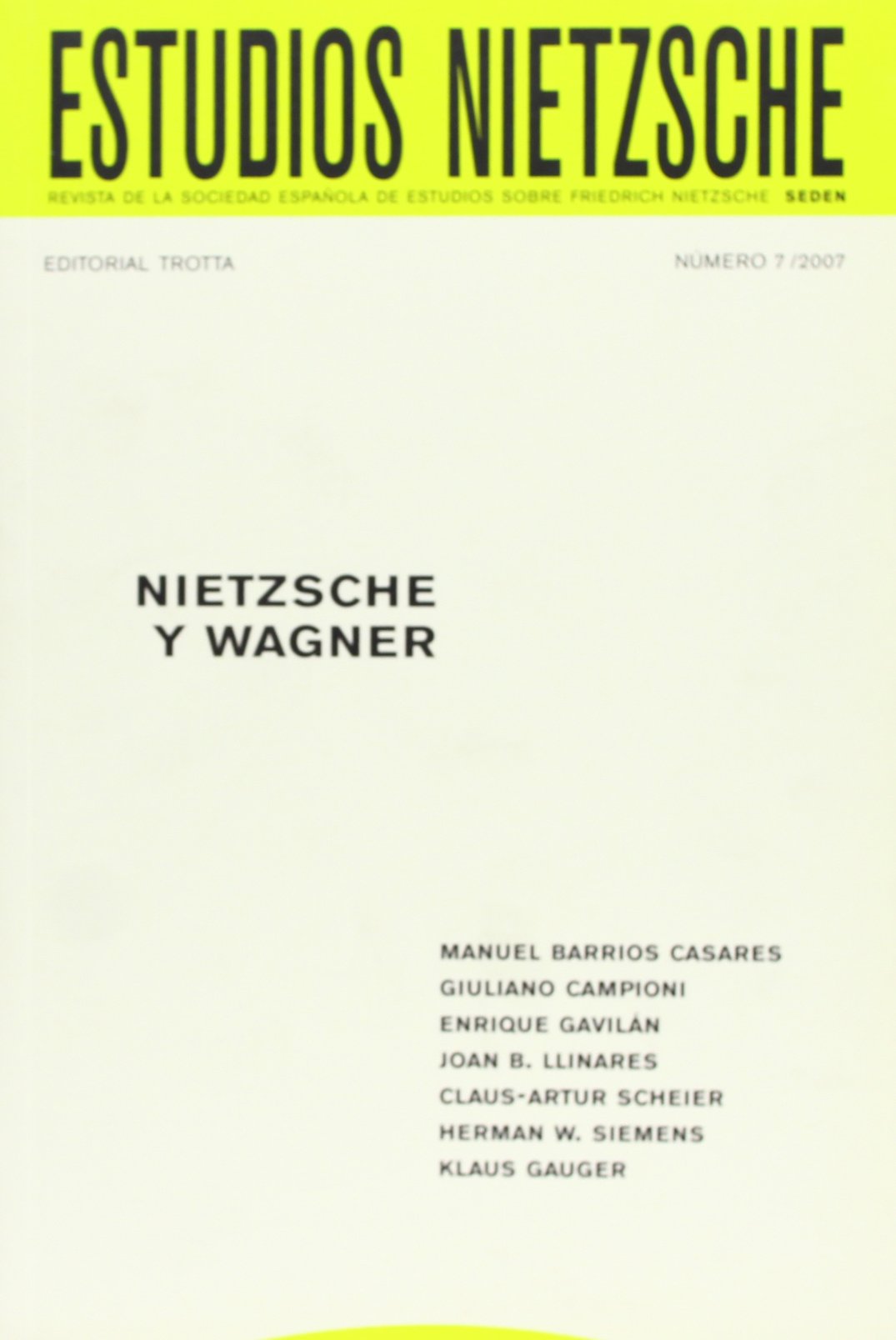
Nietzsche sobre el genio: Schopenhauer y el desplazamiento del genius por el «espíritu libre» en los años posteriores a 1870
DOI:
https://doi.org/10.24310/EstudiosNIETen.vi7.10269Palabras clave:
genio, espíritu libreResumen
Este artículo examina la destrucción del concepto metafísico de genio en la mitad de la década de los años setenta del siglo xix , entendido como una compleja diatriba con los conceptos de genio de Schopenhauer y Wagner. Las tensiones entre ellos relativas a la verdad y afirmación de la vida son lo que lleva a Nietzsche a reemplazar «genio» por «espíritu libre» (Freigeist) como su icono filosófico. Con el Freigeist, se arguye, Nietzsche finalmente rechaza el genio wagneriano en un movimiento que recupera y transforma características del genio de Schopenhauer.
Descargas
Referencias
Allison, D. 1985: «Nietzsche Knows No Noumenon», en D. O'Hara, Why Nietzsche Now?, Bloomington: Indiana Univ. Press, pp. 295-310.
Aydin, C. 2003: Zijn en Worden. Nietzsches omduiding van het substantiebegrip, Maastricht: Shaker.
Barbera, S. 1992/93: «Anmerkungen zu Schopenhauer und Goethe: Vom Augenblick zum Urphänomen», Philosophisches Taschenbuchkalender, II (1992/93), pp. 58-77.
Barbera, S. 1994: «Ein Sinn und unzählige Hieroglyphen», en T. Borsche, T. – F. Gerratana – A. Venturelli (eds.), «Centauren-Geburten». Wissenschaft, Kunst und Philosophie beim jungen Nietzsche, Berlin & New York: De Gruyter, pp. 217-233.
Bogaard, M. 2001: "Schopenhauer and music: a musician's approach" in Davison, Peter (ed.), Reviving the muse - essays on music after modernism, Brinkworth: Claridge Press, 2001, pp. 31-55.
Bogaard, M. 2007: «The reinvention of Genius: Wagner’s transformation of Schopenhauer and its traces in Nietzsche’s The Birth of Tragedy» (unpublished manuscript).
Borchmeyer, D. 1982: Das Theater Richard Wagners: Idee – Dichtung – Wirkung, Stuttgart: Reklam.
Bruse, K. D. 1984: «Die griechische Tragödie als ‘Gesamtkunstwerk’. Anmerkungen zu den musikästhetischen Reflexionen des frühen Nietzsche», Nietzsche-Studien, 13(1984), pp. 157-176.
Chytry, J. 1989: The Aesthetic State: a Quest in Modern German Thought, Berkeley: University of California Press.
Dinger H., 1892: Versuch einer Darstellung der Weltanschauung Richard Wagners, Leipzig: Hüber.
Frauenstädt, J. 1863: Arthur Schopenhauer. Von ihm. Über ihn, Berlin: Hayn.
Heller, P. 1972: «Von den ersten und letzten Dingen». Studien und Kommentar zu einer Aphorismenreihe von F. Nietzsche, Berlin & New York: De Gruyter.
Janz, C. P. 1981: Friedrich Nietzsche. Biographie, München: Deutscher Taschenbuch Verlag, 3 vols.
Kloss, E., 1910: Briefwechsel zwischen Wagner und Liszt, Leipzig, 2 vols.
Kropfinger, K. 1985: ‘Wagner’s Musikbegriff und Nietzsches ‘Geist der Musik’’, Nietzsche-Studien, 14(1985), pp. 1-12.
Mittasch, A. 1952: Nietzsche als Naturphilosoph, Stuttgart: Kröner Verlag.
Ottmann, H. 1987/ 21999: Philosophie und Politik bei Nietzsche, Berlin & New York: De Gruyter.
Politycki, M. 1989: Umwertung aller Werte? deutsche Literatur im Urteil Nietzsches, Berlin & New York: De Gruyter.
Schopenhauer, A. 1985: Metaphysik des schönen. Philosophische Vorlesungen III, ed. V. Spierling, München.
Siemens, H. W., 2006: «Nietzsche contra Liberalism on Freedom», en K. Ansell-Pearson, A Companion to Nietzsche, Oxford & Malden (MA): Basil Blackwell, pp. 437-454.
Stein, J. M. 1960: Richard Wagner and the Synthesis of the Arts, Westport, Conn.: Greenwood Press.
Tongeren, P.J.M. van, Schank, G., Siemens, H. W. et al. 2004: Das Nietzsche-Wörterbuch, vol. I: Abbreviatur - Einfach, Berlin & New York: De Gruyter.
Vogel, M. 1966/21984: Apollinisch und Dionysisch. Geschichte eines genialen Irrtums, Regensburg: Gustav Bosse Verlag.
Wagner, R. 21887: Gesammelte Schriften und Dichtungen, Leipzig: Fritzsch.
Descargas
Publicado
Dimensions
Citations




Número
Sección
Licencia
A partir del número 21 (2021) esta revista se publica únicamente en acceso abierto (ruta diamante).
Desde ese número 21, como los números anteriores publicados en ESTUDIOS NIETZSCHE, están sujetos a la licencia Creative Commons Reconocimento-NoComercia-Compartirigual 4.0 cuyo texto completo puede consultar en <http://creativecommons.org/licenses/by-nc-sa/4.0>
Es responsabilidad de los autores/as obtener los permisos necesarios de las imágenes que están sujetas a derechos de autor.
Esta obra está bajo licencia internacional Creative Commons Reconocimiento-NoComercial-CompartirIgual 4.0.
Los derechos de autoría son de dos tipos: morales y patrimoniales, los cuales Estudios de Nietzsche reconoce y respeta. Los derechos morales son los relacionados con el reconocimiento de autoría. Son prerrogativas perpetuas, irrenunciables, intransferibles, inalienables, inembargables e imprescriptibles como consecuencia del vínculo indivisible del autor/a y su obra.
Los derechos patrimoniales son aquellos que se derivan de la reproducción, distribución, adaptación o comunicación pública de la obra, entre otros. Estos derechos patrimoniales son cedidos por Estudiso de Nietzsche a la Universidad de Málaga en acceso abierto.
Los autores/as cuyas contribuciones sean aceptadas para su publicación en esta revista conservarán el derecho no exclusivo de utilizar sus
contribuciones con fines académicos, de investigación y educativos,
incluyendo el auto-archivo o depósito en repositorios de acceso abierto de cualquier tipo.
La edición electrónica de esta revista esta editada por la Editorial de la
Universidad de Málaga (UmaEditorial), siendo necesario citar la procedencia en cualquier reproducción parcial o total.

11.png)