La forma literaria y la crisis de la edad madura en «Así habló Zaratustra»
DOI:
https://doi.org/10.24310/EstudiosNIETen.vi16.10816Palabras clave:
ficción, música, Bildungsroman, edad maduraResumen
El relativo desinterés en Así habló Zaratustra entre los estudiosos de Nietzsche refleja el fracaso de reconocer lo que la forma literaria contribuye a su mensaje filosófico. La elección de la forma ficcional en sentido amplio posibilita a Nietzsche explorar sus ideas sobre las posibilidades de vivir una vida llena de sentido en el mundo contemporáneo occidental, donde el nihilismo, a raíz de la muerte de Dios, está comenzando a renacer. Así habló Zaratustra ilumina por tanto aspectos de la propia comprensión de Nietzsche de su proyecto filosófico, una concepción que contrasta con la orientación contemporánea dominante. Bosquejo alguno de estos aspectos fijándome en cuatro características inusuales de Zaratustra: 1) su planteamiento parecido a los dibujos animados de sus personajes y acción; 2) su presentación disfrazada de primera persona y el posicionamiento resultante del lector; 3) sus rasgos «musicales»; y 4) su singularidad como un Bildungsroman [no-
vela de formación] de la madurez.
Descargas
Referencias
Acampora, R. and Christa Davis Acampora, A Nietzschean Bestiary: Animality Beyond Docile and Brutal, ed. Lanham, MD: Rowman & Littlefield, 2004.
Allison, D., “Who Is Zarathustra’s Nietzsche?” New Nietzsche Studies 6-7 (2005-2006), pp. 1-11.
Allison, D., «Who Is Zarathustra’s Nietzsche?», New Nietzsche Studies 6-7 (2005-2006).
Bennholdt-Thomsen, Anke, Nietzsches “Also Sprach Zarathustra” als Literarisches Phanomen. Rev. ed. Frankfurt am Main: Athenäum, 1974.
Gooding-Williams, Robert, Zarathustra’s Dionysian Modernism, Stanford: Stanford University Press, 2001.
Graham Parkes, Graham, «Explanatory Notes,» en Friedrich Nietzsche, Thus Spoke Zarathustra, trans. Graham Parkes, Oxford: Oxford University Press, 2005), p. 305:
Higgins, Kathleen M, «Zarathustra’s Midlife Crisis: A Response to Gooding-Williams», en Journal of Nietzsche Studies 34 (2007), pp. 47-56.
Higgins, Kathleen M., “‘On the Genealogy of Morals’ Nietzsche's Gift," en Nietzsche, Genealogy, Morality: Essays on Nietzsche's “Genealogy of Morals,” ed. Richard Schacht Berkeley: University of California Press, 1994.
Higgins, Katlen, «The Whip Recalled», Journal of Nietzsche Studies 12 (1996), 1-18
Higgins, Katlen. Zaratustra, Lanham, MD: Lexington, 2010.
Jung, C. G., Nietzsche's “Zarathustra,” ed. James L. Jarrett, Bollingen Series ,Princeton: Princeton University Press, 1988.
Lampert, Lurence, Nietzsche's Teaching: An Interpretation of “Thus Spoke Zarathustra”, New Haven: Yale University Press, 1986.
Loeb, Paul, The Death of Nietzsche’s Zarathustra, Cambridge: Cambridge University Press, 2010, p. 207.
Nietzsche, F., Obras Completas, I-IV (OC ). Director ed. Diego Sánchez Meca. Madrid: Tecnos, 2011-2016
Nietzsche, F., Correspondencia I-VI. (CO). Director ed. Luis E. de Santiago Guervós. Madrid : Trotta, 2005- 2012.
Nietzsche, F., Fragmentos Póstumos I-IV (FP). Director ed. Diego Sánchez Meca. Madrid: Tecnos, 2006-2010.
Seung, T.K., Nietzsche’s Epic of the Soul: “Thus Spoke Zarathustra”, Lanham, MD: Lexington, 2005, pp. 237-359.
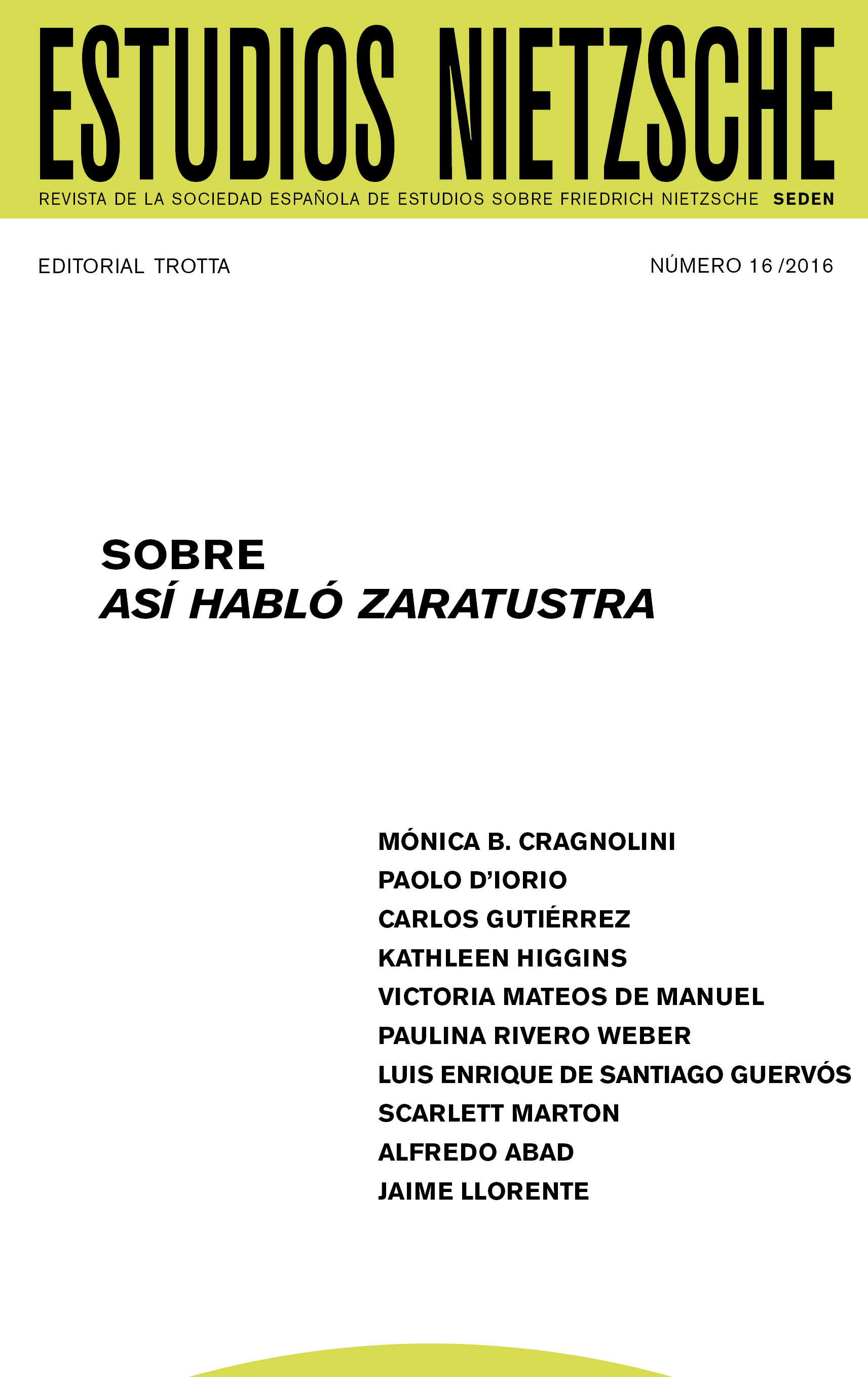
Descargas
Publicado
Dimensions
Citations




Número
Sección
Licencia
A partir del número 21 (2021) esta revista se publica únicamente en acceso abierto (ruta diamante).
Desde ese número 21, como los números anteriores publicados en ESTUDIOS NIETZSCHE, están sujetos a la licencia Creative Commons Reconocimento-NoComercia-Compartirigual 4.0 cuyo texto completo puede consultar en <http://creativecommons.org/licenses/by-nc-sa/4.0>
Es responsabilidad de los autores/as obtener los permisos necesarios de las imágenes que están sujetas a derechos de autor.
Esta obra está bajo licencia internacional Creative Commons Reconocimiento-NoComercial-CompartirIgual 4.0.
Los derechos de autoría son de dos tipos: morales y patrimoniales, los cuales Estudios de Nietzsche reconoce y respeta. Los derechos morales son los relacionados con el reconocimiento de autoría. Son prerrogativas perpetuas, irrenunciables, intransferibles, inalienables, inembargables e imprescriptibles como consecuencia del vínculo indivisible del autor/a y su obra.
Los derechos patrimoniales son aquellos que se derivan de la reproducción, distribución, adaptación o comunicación pública de la obra, entre otros. Estos derechos patrimoniales son cedidos por Estudiso de Nietzsche a la Universidad de Málaga en acceso abierto.
Los autores/as cuyas contribuciones sean aceptadas para su publicación en esta revista conservarán el derecho no exclusivo de utilizar sus
contribuciones con fines académicos, de investigación y educativos,
incluyendo el auto-archivo o depósito en repositorios de acceso abierto de cualquier tipo.
La edición electrónica de esta revista esta editada por la Editorial de la
Universidad de Málaga (UmaEditorial), siendo necesario citar la procedencia en cualquier reproducción parcial o total.

11.png)
