La lectura atenta como estrategia para analizar "fake news" y fuentes históricas sobre el Holocausto en Educación Secundaria
DOI:
https://doi.org/10.24310/isl.20.1.2025.20601Palabras clave:
Fake news, negacionismo, Holocausto, historia, educaciónResumen
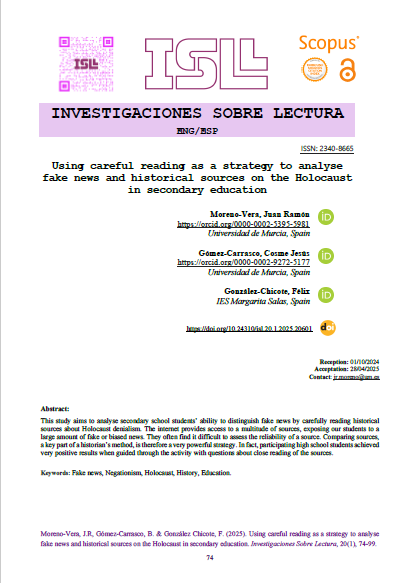
El estudio tiene como objetivo analizar la capacidad de los estudiantes de Bachillerato a la hora de distinguir las fake news a través de la lectura atenta de fuentes históricas, en este caso, sobre el negacionismo del Holocausto. El acceso a multitud de fuentes a través de internet ha provocado que nuestros estudiantes estén también expuestos a una gran cantidad de noticias falsas o sesgadas. En muchas ocasiones resulta difícil para ellos evaluar la fiabilidad de una Fuente y para ello la comparación de fuentes, propia del método del historiador, se convierte en una estrategia muy poderosa. De hecho, los estudiantes de Bachillerato participantes mostraron unos resultados muy positivos cuando la actividad está pautada y guiada a través de las preguntas de lectura atenta de las fuentes.
Descargas
Referencias
Artola, M. (1981). La burguesía revolucionaria (1808-1874). Alianza
Digital Inquiry Group. (2023). Home | Civic Online Reasoning. https://cor.stanford.edu
Gadamer, H. (1979). The Problem of Historical Consciousness. In P. Rabinow & W. Sullivan (Ed.), Interpretive Social Science: A Reader (pp. 103-160). University of California Press. https://doi.org/10.1525/9780520340343-005
Gómez Carrasco, C. J., Monteagudo, J., Moreno-Vera, J. R., & Sáinz, M. (2020). Evaluation of a gamification and flipped-classroom program used in teacher training: Perception of learning and outcome. PLoS One, 15(10), e0241892. https://doi.org/10.1371/journal.pone.0241892 PMID:33119687
González-Bailón, S., Lazer, D., Barberá, P., Zhang, M., Hunt Allcott, T., Crespo-Tenorio, A., Freelon, D., Gentzkow, M., Guess, A., Iyengar, S., Mie Kim, Y., Malhorta, N., Moehler, D., Nyhan, B., Pan, J., Velasco Rivera, C., Settle, J., Thorson, E., Tromble, R., Wilkins, A., Wojcieszak, M., De Jonge, C., Franco, A., Mason, W., Stroud, N. & Tucker, J. (2023). Asymmetric ideological segregation in exposure to political news on Facebook. Science, 381, 392-398. https://doi.org/10.1126/science.ade7138
Huber, G. L. (2013). AQUAD7-Analysis of Qualitative Data. University of Tübingen.
Mayor Ferrándiz, M.T. (2012). Los negacionistas del Holocausto. Revista de claseshistoria, 4. p. 5.
McGrew, S., Breakstone, J., Ortega, T., Smith, M., & Wineburg, S. (2018). Can students evaluate online sources? Learning from assessments of civic online reasoning. Theory & Research in Social Education, 46, 165-193. https://doi.org/10.1080/00933104.2017.1416320
McGrew, S., & Byrne, V. (2022). Conversations after lateral reading: Supporting teachers to focus on process, not content. Computers & Education, 185, 104519.
Moreno-Vera, J.R., Monteagudo-Fernández, J. & Gómez-Carrasco, C.J. (2023). Teaching history to face the world today. Socially-conscious approaches, activity proposals and historical thinking competencies. Peter Lang. https://doi.org/10.3726/b20699
Moreno-Vera, J. R., & Ponsoda López de Atalaya, S. (2021). Competencias clave y patrimonio en educación primaria. Un análisis de la concepción del profesorado en formación. Revista Interuniversitaria De Formación Del Profesorado. Continuación De La Antigua Revista De Escuelas Normales, 96, 29–46. https://doi.org/10.47553/rifop.v96i35.3.91039
Moreno-Vera, J.R. & Martínez-Leguizamo, J. (2022). Welcome Refugees! The use of cultural heritage to teach democratic values. Sustainability, 14(20), 13466. https://doi.org/10.3390/su142013466
Piqueras, J.A. (2011). Slave in Spain. Los Libros de la Catarata.
Reisman, A. (2012). Reading like a Historian: A document-based history curriculum intervention in urban high schools. Cognition and Instruction, 30(1), 86-112. https://doi.org/10.1080/07370008.2011.634081
Reisman, A., & Fogo, B. (2016). Contributions of educative document-based curricular materials to quality of historical instruction. Teaching and Teacher Education, 59, 191-202.
Rodrigo y Alharilla, M. (ed.) (2022). Del olvido a la memoria. La esclavitud en la España contemporánea. Icaria.
Świebocki, T. y Swiebocki, H. (2007). Auschwitz: residence of death. Biały Kruk.
Suárez, E. (2009). Interview with David Irving, Diario El Mundo, 5 September 2009 (not available on the internet).
United States Holocaust Memorial Museum. (2024). The ‘Night of Broken Glass’, Holocaust Encyclopedia, disponible en https://encyclopedia.ushmm.org/content/en/article/the-night-of-broken-glass , accedido el 19 de julio de 2024.
Viana, I. (2021). The ignored study of 1826 that overturned the black legend that Spain exterminated slaves in America, Diario ABC, 2 Febrero 2021: www.abc.es/historia/abci-ignorado-estudio-sobre-esclavitud-america-tumbo-leyenda-negra-contra-espana-hace-siglos-202102021846_noticia.html , consultado el 14 de julio de 2024.
Wineburg, S. (2018). Why Learn History (When It’s Already on Your Phone). The University of Chicago Press. https://doi.org/10.7208/chicago/9780226357355.001.0001
Wineburg S., & McGrew, S. (2019). Lateral reading and the nature of expertise: Reading less and learning more when evaluating digital information. Teachers College Record, 121(11).
Wineburg, S., Breakstone, J., McGrew, S., Smith, M. D., & Ortega, T. (2022). Lateral reading on the open Internet: A district-wide field study in high school government classes. Journal of Educational Psychology, 114(5), 893–909. https://doi.org/10.1037/edu0000740
Publicado
Dimensions
Citations




Número
Sección
Licencia
Derechos de autor 2025 Juan Ramón Moreno-Vera, Cosme Jesús Gómez-Carrasco, Félix ´González-Chicote
Todos los contenidos publicados en Investigaciones sobre Lectura están sujetos a la licencia Creative Commons Reconocimento-NoComercia-Compartirigual 4.0 cuyo texto completo puede consultar en <http://creativecommons.org/licenses/by-nc-sa/4.0>
Se pueden copiar, usar, difundir, transmitir y exponer públicamente, siempre que:
- Se cite la autoría y la fuente original de su publicación (revista, editorial y URL de la obra).
- No se usen para fines comerciales.
- Se mencione la existencia y especificaciones de esta licencia de uso.
Los derechos de autor son de dos clases: morales y patrimoniales. Los derechos morales son prerrogativas perpetuas, irrenunciables, intransferibles, inalienables, inembargables e imprescriptibles. De acuerdo con la legislación de derechos de autor, Investigaciones sobre Lectura reconoce y respeta el derecho moral de los/las autores/as, así como la titularidad del derecho patrimonial, el cual será cedido a la Universidad de Málaga para su difusión en acceso abierto. Los derechos patrimoniales, se refieren a los beneficios que se obtienen por el uso o divulgación de las obras. Investigaciones sobre la Lectura se publica en open access y queda autorizada en exclusiva para realizar u autorizar por cualquier medio el uso, distribución, divulgación, reproducción, adaptación, traducción o transformación de la obra.
Es responsabilidad de los/las autores/as obtener los permisos necesarios de las imágenes que están sujetas a derechos de autor.











30.png)