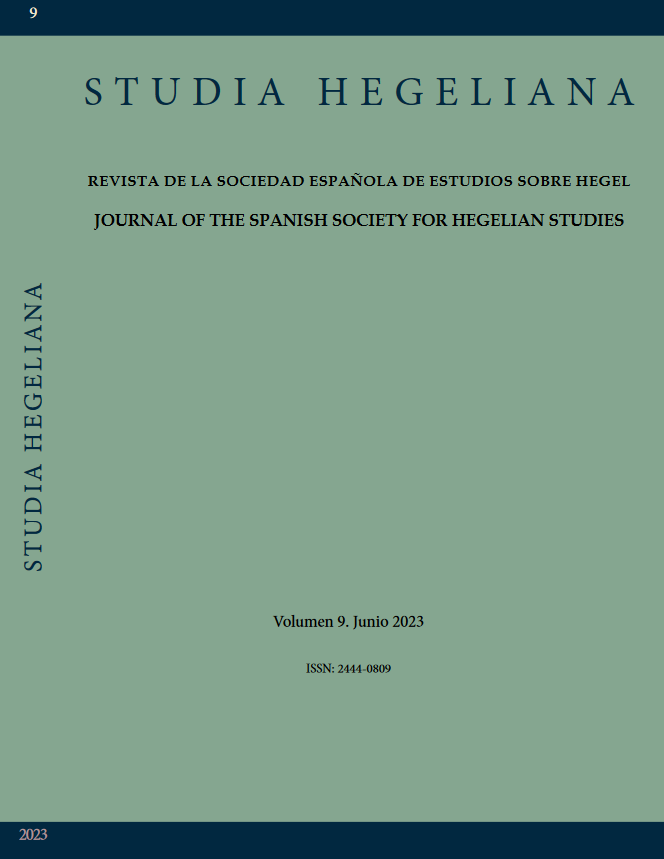
The Fractured Recognition: sociopolitical actuality of Hegel's early Jena writings
sociopolitical actuality of Hegel's early Jena writings.
DOI:
https://doi.org/10.24310/Studiahegelianastheg.v9i.16214Keywords:
Recognition, Social Conflict, Social Fragmentation, Social Pathologies, Hegel in JenaAbstract
The extensive proliferation of social conflicts of groups that claim political exclusion, institutional indifference, and underestimation of their forms of life, are evidence of the conceptual insufficiency of the end of history of Fukuyama's Hegel. These collective subjects are not perceived as part of the organic unity that is the social, but rather as cleaved fragments, unrelated to it. I suggest that we can give explanatory value and to grant a normative solution to this social fracture through the concept of recognition developed by Hegel in his Jenense period. Thus, as an update of this concept, these social conflicts can be understood as struggles for the recognition for some of its dimensions, affective, legal and/or social, that have been unjustly denied.
Downloads
References
Downloads
Published
Dimensions
Citations




Issue
Section
License
This journal provides immediate free access to its content under the principle of making research freely available to the public. All contents published in Studia Hegeliana. Journal of the Spanish Society for Hegelian Studies, are subject to the Creative Commons Attribution-NonCommercial-ShareAlike 4.0 licence (specifically, CC-by-nc-sa), the full text of which can be found at <http://creativecommons.org/licenses/by-nc-sa/4.0>. Derivative works are therefore permitted as long as they are not used for commercial purposes. The original work may not be used for commercial purposes. The journal is not responsible for the opinions expressed by the authors of the works published in it.
It is the authors' responsibility to obtain the necessary permissions for images that are subject to copyright.
Authors whose contributions are accepted for publication in this journal retain the copyright. It is non-exclusive right to use their contributions for scholarly, research and educational purposes, including self-archiving or deposit in open access repositories of any kind.
Since volume 7 of 2021 the journal Studia Hegeliana has changed the copyright. Since that year the authors have retained the copyright.
The electronic edition of this journal is published by the Editorial de la Universidad de Málaga (UmaEditorial), being necessary to cite the source in any partial or total reproduction.
244.png)