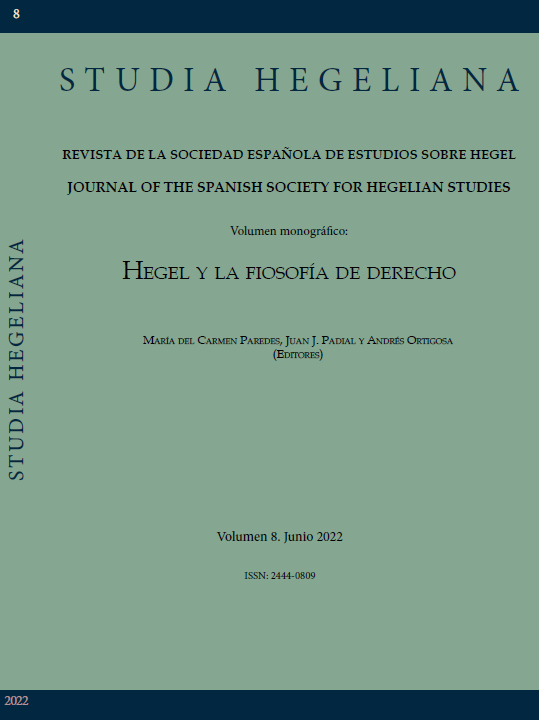
Hegel’s Cartesian Grounding of Political Philosophy
DOI:
https://doi.org/10.24310/Studiahegelianastheg.v8i.13969Parole chiave:
Hegel, Descartes, political philosophy, totality, substanceAbstract
Hegel saw modern philosophy as internally divided between its metaphysics and epistemology, on the one hand, and its political philosophy, on the other. Descartes had developed a metaphysics of totality to ground the epistemological certainty of the cogito, treating true unity as a unity of opposites (a totality). But political philosophy, in its empiricist and formalist forms, relied on an impoverished conception of unity—treating it, respectively, as a mere aggregation of parts or as formal consistency. The Philosophy of Right thus attempted to rectify the deficiencies of political philosophy by grounding it on the Cartesian concept of totality.
Downloads
Riferimenti bibliografici
Dowloads
Pubblicato
Dimensions
Citations




Fascicolo
Sezione
Licenza
Esta revista provee acceso libre inmediato a su contenido bajo el principio de hacer disponible gratuitamente la investigación al público. Todos los contenidos publicados en Studia Hegeliana. Revista de la Sociedad Española de Estudios sobre Hegel, están sujetos a la licencia Creative Commons Reconocimento-NoComercia-Compartirigual 4.0 (específicamente, CC-by-nc-sa) cuyo texto completo puede consultar en <http://creativecommons.org/licenses/by-nc-sa/4.0>. Por ello, se permite la generación de obras derivadas siempre que no se haga un uso comercial. Tampoco se puede utilizar la obra original con finalidades comerciales. La revista no se hace responsable de las opiniones vertidas por lo autores de los trabajos que en ella se publican.
Es responsabilidad de los autores/as obtener los permisos necesarios de las imágenes que están sujetas a derechos de autor.
Los autores/as cuyas contribuciones sean aceptadas para su publicación en esta revista conservarán el derecho de autor. Este es no exclusivo de utilizar sus contribuciones con fines académicos, de investigación y educativos, incluyendo el auto-archivo o depósito en repositorios de acceso abierto de cualquier tipo.
Desde el volumen 7 de 2021 la revista Studia Hegeliana ha modificado el copyright. Desde ese año, los autores son los que conservan los derechos de autor.
La edición electrónica de esta revista esta editada por la Editorial de la Universidad de Málaga (UmaEditorial), siendo necesario citar la procedencia en cualquier reproducción parcial o total.

243.png)