La educación inclusiva en España:
no está muerta, pero vamos hacia atrás
DOI:
https://doi.org/10.24310/cpe.1.1.2025.22107Palabras clave:
Educación Inclusiva, Modelos Mentales, Valoración, CambioResumen
Se realiza un análisis crítico muy personal de la situación de la educación inclusiva en España desde el punto de vista de los “modelos mentales” (Senge, 1998), o paradigmas desde los cuales se han diseñado las reformas educativas en España en los últimos 35 años, vistas desde la perspectiva de cómo se enfoca el desafío de la diversidad del alumnado en las aulas. Dichos modelos y sus implicaciones prácticas están implícitos en la propia organización administrativa, así como en sus normas, programas y acciones educativas propuestas para “atender a la diversidad”, que es la expresión utilizada genéricamente para agruparlas. A tenor de los análisis que se comparten se valora la situación como de claro estancamiento, lo que de facto significa más bien un retroceso, por cuanto si no se avanza decididamente en el proceso hacia un sistema educativo donde “todo el alumnado importa y todos importan por igual" (UNESCO, 2017), a la hora de poder acceder a la escuela común, participar y sentirse parte de una comunidad escolar acogedora y segura, así como para aprender y rendir sin límites impuestos por expectativas negativas hacia algunos es que, en efecto, se está retrocediendo.
Referencias
Ainscow, M. (2005). Developing inclusive education systems: what are the levers for change? Journal of Educational Change 6, 109–124 https://doi.org/10.1007/s10833-005-1298-4
Ainscow, M. (2025). Un giro inclusivo a la equidad. Narcea.
Álvarez, S. (2025). Orden imperial y amenazas a la paz y la democracia. Papeles de relaciones ecosociales y cambio social. 169, 9-12
Astudillo, L., Simón, C. y Fernández-Blázquez, Mª. L (2025). Current Roles of Support Teachers, Analysis of Their Contribution to Inclusive School: A Narrative. Review. Disabilities, 5(1), 1-23; https://doi.org/10.3390/disabilities5010023
Booth, T. y Ainscow. M. (2015). Guía para la educación inclusiva. Desarrollando el aprendizaje y la participación en los centros escolares. FUHEM/OEI
Calderón, I., Moreno, J. y Vila, E. (2022). Education, Power, and Segregation. The Psychoeducational Report as an Obstacle to Inclusive Education. International Journal of Inclusive Education 1–14. https://doi.org/10.1080/13603116.2022.2108512
Calderón, I. y Rascon, T. (2024). El papel de la universidad en la construcción de sistemas educativos inclusivos. Octaedro
Calderón, I. y Echeita, G. (2022). Inclusive Education as a Human Right. .Oxford Research Encyclopedia of Education. DOI: https://doi.org/10.1093/acrefore/9780190264093.013.1243
Chieppa, Mª.A., Sandoval, M., Sánchez, R. (2024). Más allá de la discapacidad. ¿El alumno con diversidad cultural y lingüística (DCL) está sobrerrepresentado en el sistema español de educación especial? Un enfoque interseccional basado en datos. Culture and Education, Cultura y Educación, 36, (4),1070-1095. https://doi.org/10.1177/11356405241290425
Cologon, K. (2019). Towards inclusive education: A necessary process of transformation. Macquarie University for Children and Young People with Disability. Australia (CYDA)
Echeita, G. (2024, a). Educación inclusiva. ¿El sueño de una noche de verano? Octaedro.
Echeita, G. (2024, b). Tribuna. Equidad e inclusión: ¿sabía que...? EDUCACIÓN 3.0. n. 55 (septiembre octubre 2024).
Echeita, G. (2025). Exclusión educativa. ¡Que la vergüenza cambie de bando! Diario de Educación, febrero 2, 2025
Echeita, G. y Fernández-Blázquez, Mª. L. (2017). Hacia una educación más inclusiva como contexto para el desarrollo de todo el alumnado. EN, B. Gutiérrez y Á. Brioso (Coord.). Desarrollos diferentes (págs. 201-215). Sanz y Torres / UNED
Etxeberria, X. (2018): Ética de la inclusión y personas con discapacidad intelectual. Revista Española de Discapacidad, 6 (I), 281-290.
Forlin, C. (ed.) (2010). Teacher Education for Inclusion. Changing Paradigms and Innovative Approaches. Routledge
Fundación Secretariado Gitano (2023). La situación educativa del alumnado gitano en España. Fundación Secretariado Gitano
Esteban Guitart, M., y Saubich, X. (2014). La práctica educativa desde la perspectiva de los fondos de conocimiento e identidad. Teoría de La Educación. Revista Interuniversitaria, 25(2), 189–211. https://doi.org/10.14201/11583
García Santesmases, A. (2023). El cuerpo deseado. La conversación pendiente entre feminismo y anticapacitismo. Kaótica
Gutierrez de Amo, P. (2025). Inciertos pasos hacia la educación inclusiva. Diario de la Educación, mayo 27, 2025.
Imbernón, F. (2024). Tendencias y retos internacionales en la formación permanente del profesorado para la innovación educativa. RECIE. Revista Caribeña de Investigación Educativa, 8(1), 215-229. https://doi.org/10.32541/recie.2024.v8i1.pp215-229
Kuhn, T.S. (1962). La estructura de las revoluciones científicas. Titivillus
Marquez, C. y Moya, L. (2024). La formación inicial docente para la educación inclusiva. Servicio de Información e Investigación Social, SIIS
Martín, E. (2015). Caminos que se Consolidan en el Desarrollo Profesional Docente. ¿Están Presentes en España? Psychology, Society & Education, 7 (3), 442-458.
Messiou, K., Bui, L. T. H., Ainscow, M., Gasteiger-Klicpera, B., Bešić, E., Paleczek, L., Hedegaard-Sørensen, L., Ulvseth, H., Vitorino, T., Santos, J., Simon, C., Sandoval, M., y Echeita, G. (2020). Student diversity and student voice conceptualisations in five European countries: implications for including all students in schools. European Educational Research Journal 21 (2),355-376.
Palomo, R., Simón, C. y Echeita, G. (2024). The role of educational psychologists in the framework of the right to inclusive education: between reality and desire. European Journal of Special Needs Education, 39 (4), 550-566, https://doi.org/10.1080/08856257.2023.2242031
Pozo, J.I. (2016). La nueva cultura del aprendizaje en la sociedad del conocimiento, En, N. Scheuer, J.I. Pozo, Mª P., Pérez Echeverría, Mª M. Mateos, E. Martin, y M. de la Cruz. Nuevas formas de pensar la enseñanza y el aprendizaje: las concepciones de profesores y alumnos (págs. 29-54). Graó.
Puig, X. (2012, Coord.). Cultura moral y educación. Graó
Rogero, J. y Turienzo, D. (2024). EducaFakes. 50 mentiras y medias verdades sobre la educación española. Capitán Swing
Sandoval, M., Alvarez, Mª, Darrretxe, L. (2022). La evolución de la escolarización del alumnado en Educación Especial en España 25 años de la Declaración de Salamanca. Aula abierta, 51, (4),385-394. https://doi.org/10.17811/rifie.51.4.2022.385-394
Senge, P., (1990). La Quinta Disciplina". Granica
Simón, C., Palomo, R y Echeita, G. (2021). The duty to promote an inclusive educational system: a phenomenological study on the assessment procedures of pupils with special educational needs in Madrid (Spain). International Journal of Inclusive Education. http://doi:10.1080/13603116.2021.1968513
Slee, R. (2012). La escuela extraordinaria. Exclusión, escolarización y educación inclusiva. Morata.
Slee, R. (2018). Inclusive education isn’t dead, it just smells funny. Routledge.
Tárraga, R., Lacruz, I., Gómez, I., y Sanz, P. (2024). La ubicación geográfica de los colegios de educación especial. Una barrera adicional para la inclusión. Siglo Cero, 55(4), 47–69. https://doi.org/10.14201/scero.31919
Tyack, D., y Cuban, I. (2001, 2ª ed.). En busca de la utopía educativa. Un siglo de reformas en las escuelas públicas. Fondo de Cultura Económica.
UNESCO, (1994). Declaración de Salamanca y Marco de Acción sobre Necesidades Educativas Especiales. UNESCO
UNESCO, (2017). Guía para asegurar la inclusión y la equidad en la educación. UNESCO
UNESCO, (2021). Reimaginar juntos nuestros futuros: un nuevo contrato social para la educación. UNESCO
UNESCO, (2025). The Salamanca Statement Anniversary: 30 Years of Progress? [Aniversario de la Declaración de Salamanca: ¿30 años de progreso?]. UNESCO
Uthus, M. y Qvortrup, A. (2024). Lessons learned from Norway: a values-based formulation of inclusive education. European Journal of Special Needs Education. 40(2),244–258. https://doi.org/10.1080/08856257.2024.2354603
Valdes, M. y Requena, M. (2025). La geografía del abandono escolar temprano en España. Fundación Ramón Areces y la Fundación Europea de Sociedad y Educación.
Publicado
Dimensions
Citations
Número
Sección
Licencia
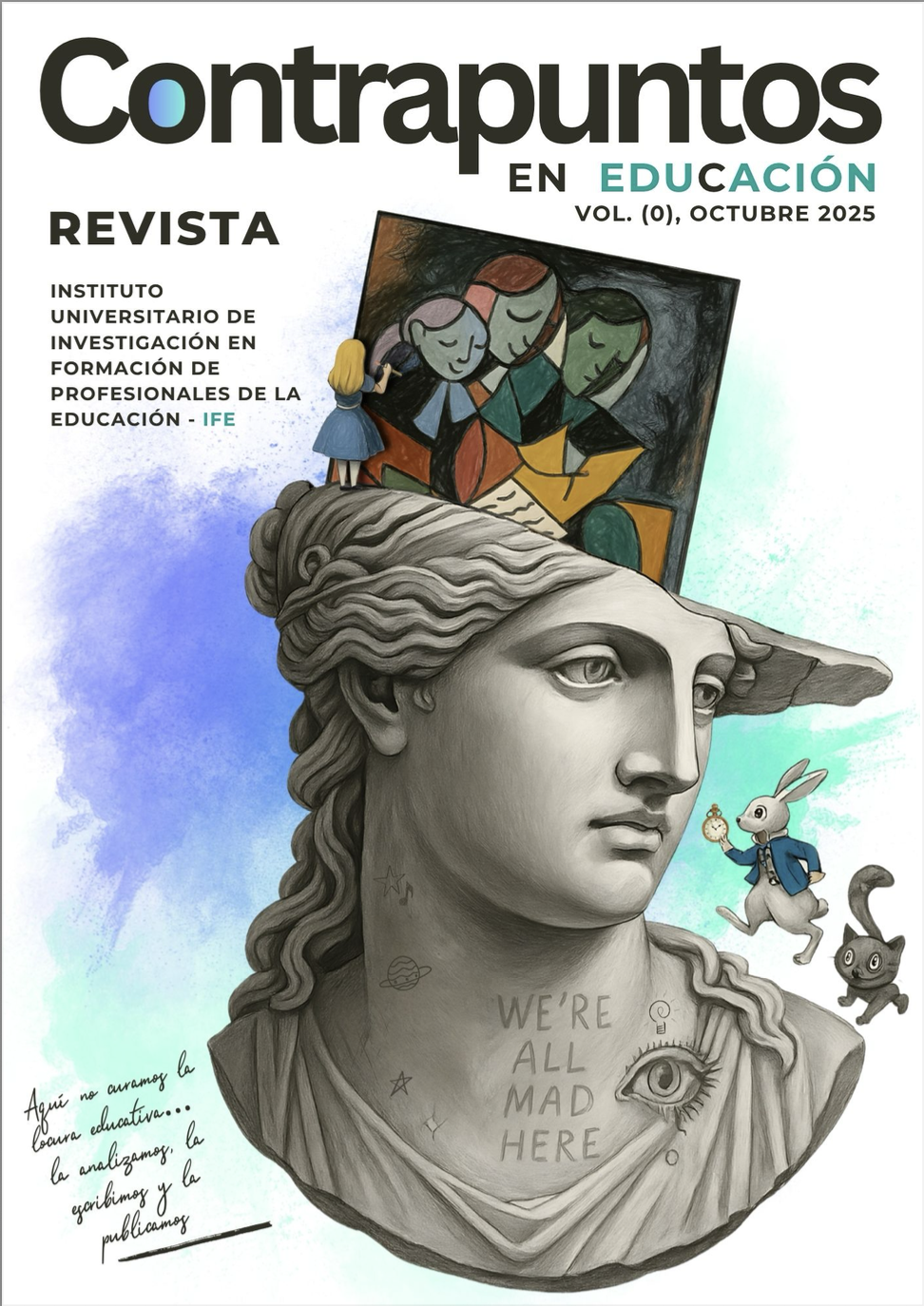
Derechos de autor 2025 Contrapuntos en Educación. Revista del Instituto Universitario de Investigación en Formación de Profesionales de la Educación. IFE-UMA.
Todos los contenidos publicados en Contrapuntos en Educación están sujetos a la licencia Creative Commons Reconocimento-NoComercia-Compartirigual 4.0 cuyo texto completo puede consultar en <http://creativecommons.org/licenses/by-nc-sa/4.0>
Se pueden copiar, usar, difundir, transmitir y exponer públicamente, siempre que:
- Se cite la autoría y la fuente original de su publicación (revista, editorial y URL de la obra).
- No se usen para fines comerciales.
- Se mencione la existencia y especificaciones de esta licencia de uso.
Los derechos de autor son de dos clases: morales y patrimoniales. Los derechos morales son prerrogativas perpetuas, irrenunciables, intransferibles, inalienables, inembargables e imprescriptibles. De acuerdo con la legislación de derechos de autor, Contrapuntos en Educación reconoce y respeta el derecho moral de los autores y autoras, así como la titularidad del derecho patrimonial, el cual será cedido a la Universidad de Málaga para su difusión en acceso abierto.
Los derechos patrimoniales, se refieren a los beneficios que se obtienen por el uso o divulgación de las obras. Contrapuntos en Educaciónse publica en open access y queda autorizada en exclusiva para realizar u autorizar por cualquier medio el uso, distribución, divulgación, reproducción, adaptación, traducción o transformación de la obra.
Es responsabilidad de los autores y autoras obtener los permisos necesarios de las imágenes que estén sujetas a derechos de autor.