Abordando el bricolage:
retazos de rigor en la investigación cualitativa crítica
DOI:
https://doi.org/10.24310/cpe.1.1.2025.22419Palabras clave:
Bricolage, Investigación cualitativa, Interdisciplinariedad, Rigor académico, Generación del conocimientoResumen
Este texto profundiza en el concepto de bricolage dentro del ámbito de la investigación cualitativa, presentándolo como una estrategia interdisciplinar y multimetodológica que integra diversas perspectivas teóricas y filosóficas. La autora sostiene que el bricolage constituye una herramienta indispensable para comprender la complejidad de la realidad contemporánea, al tiempo que posibilita la generación de formas rigurosas de producción de conocimiento que trascienden los límites impuestos por los marcos disciplinares tradicionales. Finalmente, el artículo analiza los modos de promover este trabajo de frontera, orientado a consolidar un rigor intelectual más sofisticado y crítico en el ámbito académico.
Referencias
Blackler, F. (1995). Knowledge, knowledge work, and organizations: An overview and interpretation. Organization Studies, 16, 6.
Blommaert, J. (1997). Workshopping: Notes on professional vision in discourse.
Bridges, D. (1997). Philosophy and educational research: A reconsideration of epistemological boundaries. Cambridge Journal of Education, 27, 2.
Dahlbom, B. (1998). Going to the future.
Denzin, N. and Y. Lincoln. (2000). Handbook of qualitative research (2nd edition). Thousand Oakes, Sage Publishers.
Dicks, B. and B. Mason (1998) Hypermedia and ethnography: Reflections on the construction of a research approach. Sociological Research Online, 3, 3.
Fischer, F. (1998). Beyond empiricism: Policy inquiry in postpositivist perspective. Policy Studies Journal, 26(1), 129-46.
Foster, R. (1997) Addressing epistemologic and practical issues in multimethod research: A procedure for conceptual triangulation. Advances in Nursing Education, 202 2.
Friedman, S. (1998). (Inter) disciplinarity and the question of the women's studies Ph.D. Feminist Studies, 24, 2.
Haggerson, N. (2000). Expanding curriculum research and understanding: A ourtho-poetic perspective. Peter Lang Publishing.
Karunaratne, V. (1997). Buddhism, science, and dialectics. http://humanism.org/opinions/articles.html>
Kellner, D. (1995). Media culture: Cultural studies, identity and politics between the modern and postmodern. Routledge.
Kincheloe, J., & Steinberg, S. (1993). A tentative description of post-formal thinking: The critical confrontation with cognitive theory. Harvard Educational Review, 63(3), 296-320.
Kincheloe, J., Steinberg, S. & Hinchey, P. (1999). The postformal reader: Cognition and education. Falmer Press.
Kincheloe, J., & Berry, K. (2004). Rigour and Complexity in Educational Research: Conceptualizing the Bricolage. Open University Press.
Lee, A. (1997). What is MIS? In R. Galliers and W. Currie (Eds.) Rethinking MIS. Oxford University Press.
Lester, S. (1997). Learning for the twenty-first century. <http://www.devmts.demon.co.uk/lrg21st.htm>
Levi-Strauss, C. (1966). The savage mind. University of Chicago Press.
Lutz, K., Jones, K., & Kendall, J. (1997). Expanding the praxix debate: contributions to clinical inquiry. Advances in Nursing Science, 20, 2.
McCarthy, M. (1997). Pluralism, invariance, and conflict. The Review of Metaphysics, 51, l.
McLeod, J. (2000). Qualitative research as bricolage. Paper presented at the Society for Psychotherapy Research Annual Conference, Chicago.
Madison, G. (1988). The hermeneutics of postmodernity: Figures and themes. Bloomington, Indiana University Press.
Morawski, J. (1997). The science behind feminist research methods. Journal of Social Issues, 53, 4, pp. 667-82.
Palmer, C. (1996). Information work at the boundaries of science: Linking lbrary services to research practices. Library Trends, 44(2), 165-92.
Pryse, M. (1998). Critical interdisciplinarity, women's studies, and cross-cultural insight. NWSA Journal, 10, 1-11.
Selfe, C. & R. Selfe (1994). The politics of the interface: Power and its exercise in electronic contact zones. http://www.hu.mtu.edu/~cyselfe/texts/politics.html
Steinberg, S. R. & Kincheloe, J.L. (1998). Students as Researchers: Critical Visions, Emancipatory Insights. In Students as Researchers, J.L. Kincheloe and S.R. Steinberg.
Steinberg, S.R. & Kincheloe, J.L. (2012). Employing the Bricolage as Critical Research in Science Education. In Fraser, B., Tobin, K., McRobbie, C. (eds) Second International Handbook of Science Education. Springer International Handbooks of Education, vol 24. Springer, Dordrecht.
Steinberg, S.R. (2012). What’s Critical About Qualitative Research? In Critical Qualitative Research Reader. (coords). Steinberg, S. & Cannella, G. Peter Lang Publishing.
Steinberg, S.R. & Ibrahim, A. (2016). Critically Researching Youth. Peter Lang.
Thomas, G. (1998) The myth of rational research. British Educational Research Journal, 24, 2.
Tobin, K. & Steinberg, S. (2015). Doing Educational Research: A Handbook (2nd Edition). Sense Publishers.
Vareene, H. (1996). The social facting of education: Durkheim's legacy. Journal of Curriculum Studies, 27, 373-89.
Young, T. & Yarbrough J. (1993). Reinventing Sociology: Mission and methods for postmodern sociologists. Red Feather Institute. Transforming Sociology Series, 154.
Zammito, J. (1996). Historicism, metahistory, and historical practice: The historicization of the historical subject. http://home.cc.umanitoba.ca/~sprague/zammito.htm
Descargas
Publicado
Dimensions
Citations
Número
Sección
Licencia
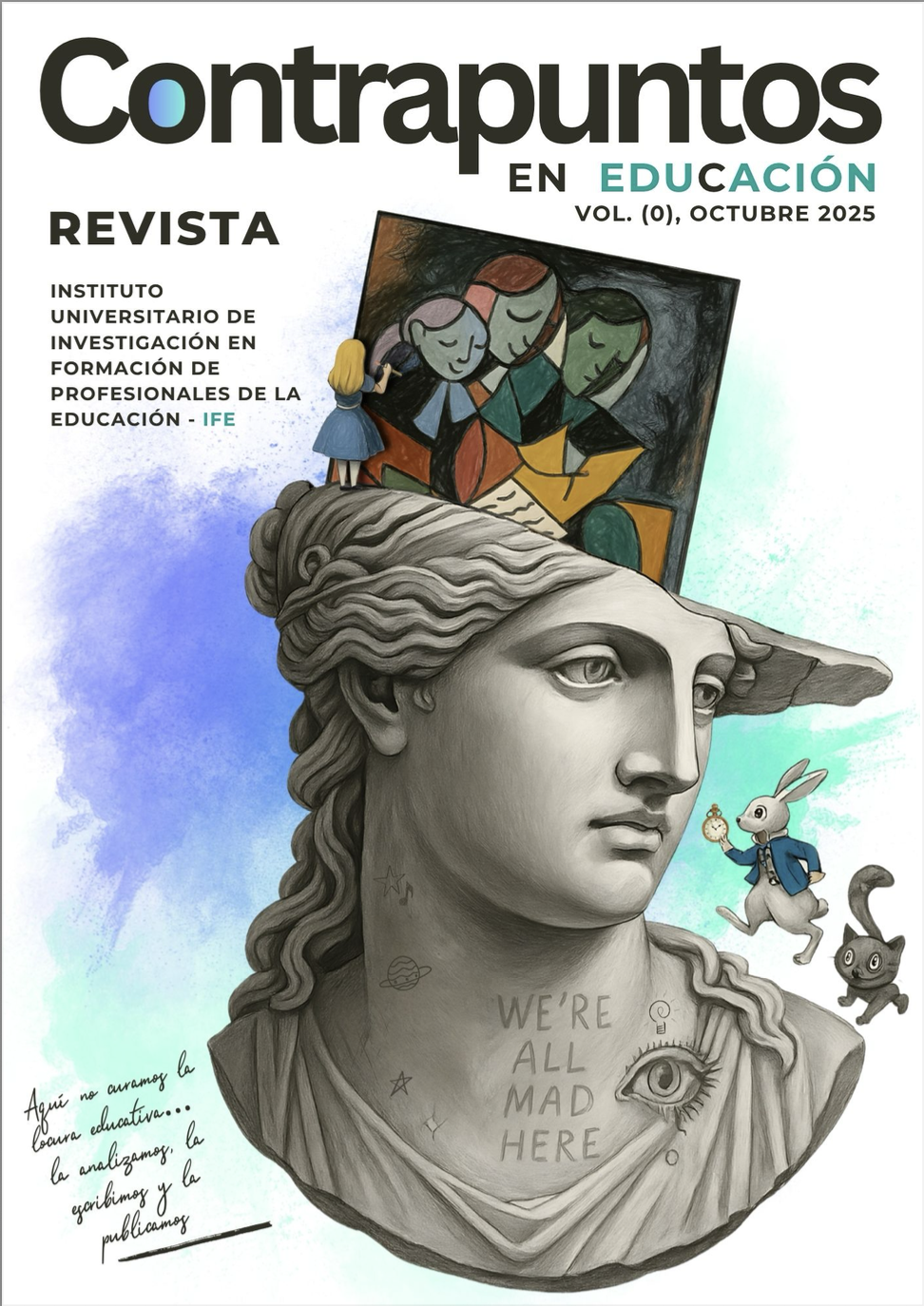
Derechos de autor 2025 Contrapuntos en Educación. Revista del Instituto Universitario de Investigación en Formación de Profesionales de la Educación. IFE-UMA.
Todos los contenidos publicados en Contrapuntos en Educación están sujetos a la licencia Creative Commons Reconocimento-NoComercia-Compartirigual 4.0 cuyo texto completo puede consultar en <http://creativecommons.org/licenses/by-nc-sa/4.0>
Se pueden copiar, usar, difundir, transmitir y exponer públicamente, siempre que:
- Se cite la autoría y la fuente original de su publicación (revista, editorial y URL de la obra).
- No se usen para fines comerciales.
- Se mencione la existencia y especificaciones de esta licencia de uso.
Los derechos de autor son de dos clases: morales y patrimoniales. Los derechos morales son prerrogativas perpetuas, irrenunciables, intransferibles, inalienables, inembargables e imprescriptibles. De acuerdo con la legislación de derechos de autor, Contrapuntos en Educación reconoce y respeta el derecho moral de los autores y autoras, así como la titularidad del derecho patrimonial, el cual será cedido a la Universidad de Málaga para su difusión en acceso abierto.
Los derechos patrimoniales, se refieren a los beneficios que se obtienen por el uso o divulgación de las obras. Contrapuntos en Educaciónse publica en open access y queda autorizada en exclusiva para realizar u autorizar por cualquier medio el uso, distribución, divulgación, reproducción, adaptación, traducción o transformación de la obra.
Es responsabilidad de los autores y autoras obtener los permisos necesarios de las imágenes que estén sujetas a derechos de autor.