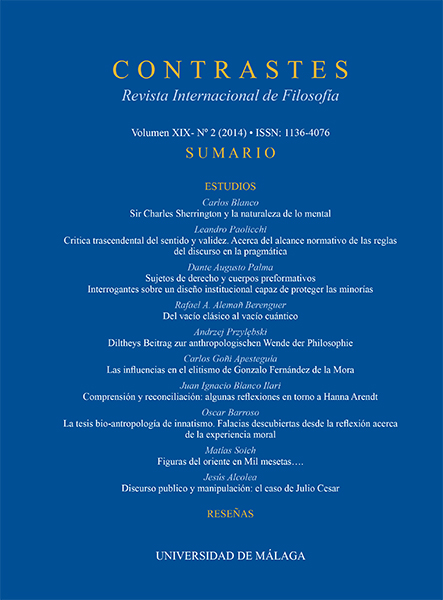
Oriental figures in A Thousand Plateaus and What Is Philosophy?: from I Ching and the Chinese painter-poet to the thinking through figures and the becoming-imperceptible
DOI:
https://doi.org/10.24310/Contrastescontrastes.v19i2.1113Keywords:
Orient; China; Deleuze; Guattari; BecomingAbstract
This paper develops some «figures from the Orient» that appear in Deleuze and Guattari’s work: firstly, the hexagrams from the Book of Changes, as a limit case in the distinctions between thinking through figures and thinking through concepts, and between wisdom and philosophy; secondly, the «typically» oriental and occidental landscapes that populate A Thousand Plateaus and What Is Philosophy?; and lastly, the Chinese painter–poet as achiever of a becoming–imperceptible. The aim is to explore the conceptual resonances between these authors’ philosophy and oriental thought, especially regarding the articulation between ontology and ethics.
Downloads
References
Downloads
Published
Dimensions
Citations




Issue
Section
License
This journal provides immediate free access to its content under the principle of making research freely available to the public. All content published in Contrastes. Revista Internacional de Filosofía, are subject to the Creative Commons Attribution-NonCommercial-ShareAlike 4.0 license whose full text can be found at <http://creativecommons.org/licenses/by-nc-sa/4.0>
It is the responsibility of the authors to obtain the necessary permissions of the images that are subject to copyright.
Authors whose contributions are accepted for publication in this journal will retain the non-exclusive right to use their contributions for academic, research and educational purposes, including self-archiving or repository in open access repositories of any kind.
The electronic edition of this magazine is edited by the Editorial Service of the University of Malaga (Uma Editorial), being necessary to cite the origin in any partial or total reproduction.




5.png)
