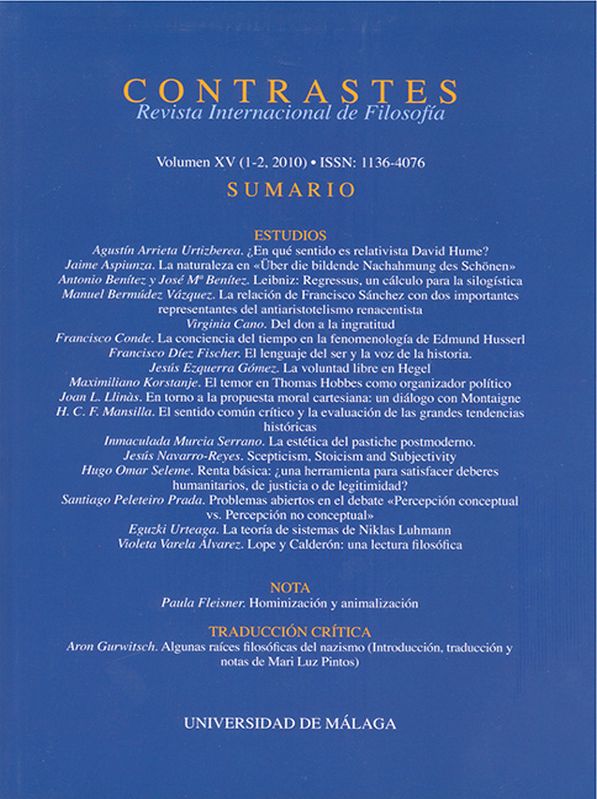
La teoría de sistemas de Niklas Luhmann
DOI:
https://doi.org/10.24310/Contrastescontrastes.v15i0.1341Abstract
Resumen
Sociólogo alemán profundamente original y difícilmente clasificable, Niklas Luhmann (1927- 1998) ha elaborado una teoría ambiciosa y coherente en la que describe la sociedad moderna como un sistema. Constituido, no tanto por individuos sino por comunicación, se diferencia en subsistemas funcionales cerrados a través de códigos especializados: los sistemas político, económico, religioso, artístico o jurídico. Inspirándose en autores, teorías y disciplinas muy diferentes, Niklas Luhmman ha construido una de las obras más fecundas y singulares del siglo XX. De manera más precisa, el objetivo de este artículo es analizar su teoría de los sistemas.
Palabras clave
Luhmann, teoría, sistema, subsistema, diferenciación
Abstract The original and hardly classifiable German sociologist Niklas Luhmann (1927-1998) elaborated an ambitious and coherent theory which describes modern society as a system. Constituted, not so much of individuals but of communication, it is divided in closed functional subsystems through specializing codes: the political, economic, religious, artistic or juridical systems. Inspired by authors, theories and very different disciplines, Niklas Luhmman constructed one of the most fecund and singular works of the XX century. More precisely, the target of this article is to analyze his systems theory.
Keywords
Luhmann, theory, system, subsystem, differentiation
Downloads
References
Downloads
Published
Dimensions
Citations




Issue
Section
License
This journal provides immediate free access to its content under the principle of making research freely available to the public. All content published in Contrastes. Revista Internacional de Filosofía, are subject to the Creative Commons Attribution-NonCommercial-ShareAlike 4.0 license whose full text can be found at <http://creativecommons.org/licenses/by-nc-sa/4.0>
It is the responsibility of the authors to obtain the necessary permissions of the images that are subject to copyright.
Authors whose contributions are accepted for publication in this journal will retain the non-exclusive right to use their contributions for academic, research and educational purposes, including self-archiving or repository in open access repositories of any kind.
The electronic edition of this magazine is edited by the Editorial Service of the University of Malaga (Uma Editorial), being necessary to cite the origin in any partial or total reproduction.




5.png)