Deconstruction as Critique of Ideology: Paul de Man’s Reading of The Critique of Judgment
DOI:
https://doi.org/10.24310/Contrastescontrastes.v11i0.1455Abstract
Resumen
En este artículo se lleva a cabo una reconstrucción de la deconstrucción que realiza Paul de Man de la célebre distinción kantiana entre la filosofía transcendental y la metafísica, tal y como ésta es expuesta en la Crítica del Juicio. En lugar de considerar que pertenecen a dos esferas separadas, en el artículo se muestra cómo, según de Man, se da una transición entre ellas que sólo se puede explicar bajo la forma de un cortocircuito tropológico o lingüístico que Kant mismo realiza, pero de manera inconsciente. También se pone de relieve que la noción kantiana de lo sublime, escondida bajo la categoría de lo esct Ttético, cumple la función ideológica de reprimir la constitución inherentemente lingüística de todo conocimiento.
Palabras clave Crítica, deconstrucción, estética, ideologÍa
Abstract
This article carefully reconstructs Paul de Man’s deconstruction of Kant’s distinction between transcendental philosophy and metaphysics, as the latter appears in The Critique of Judgment. Instead of posing these two as belonging to two separate spheres, the paper shows how, according to de Man, there is a transition between them that can only be accounted for in terms of a tropological or linguistic trick that Kant himself realizes, yet unaware of it. The paper also discusses that Kant’s notion of the sublime has an ideological function disguised under the category of the aesthetic, and which amounts to a denial of the inherently linguistic constitution of all knowledge.
Key words
Critique, deconstruction, aesthetics, ideology
Downloads
References
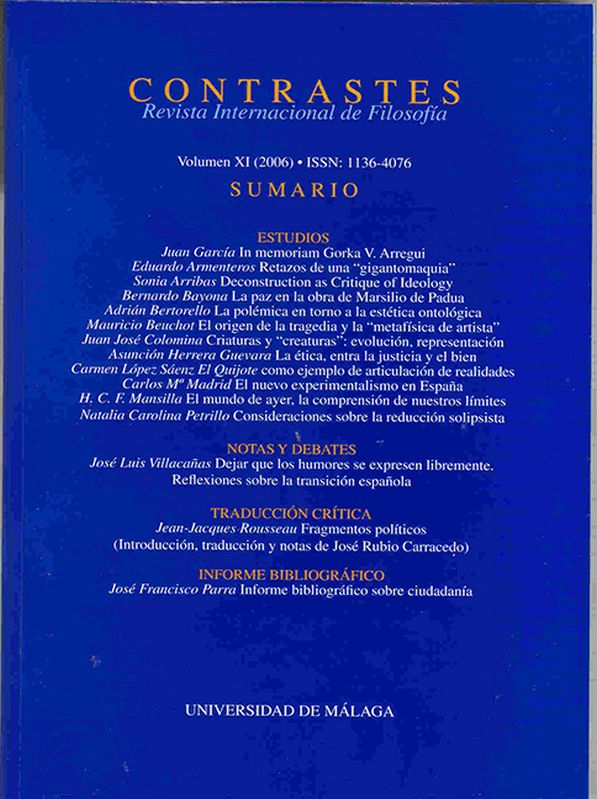
Downloads
Dimensions
Citations




Issue
Section
License
This journal provides immediate free access to its content under the principle of making research freely available to the public. All content published in Contrastes. Revista Internacional de Filosofía, are subject to the Creative Commons Attribution-NonCommercial-ShareAlike 4.0 license whose full text can be found at <http://creativecommons.org/licenses/by-nc-sa/4.0>
It is the responsibility of the authors to obtain the necessary permissions of the images that are subject to copyright.
Authors whose contributions are accepted for publication in this journal will retain the non-exclusive right to use their contributions for academic, research and educational purposes, including self-archiving or repository in open access repositories of any kind.
The electronic edition of this magazine is edited by the Editorial Service of the University of Malaga (Uma Editorial), being necessary to cite the origin in any partial or total reproduction.




5.png)
