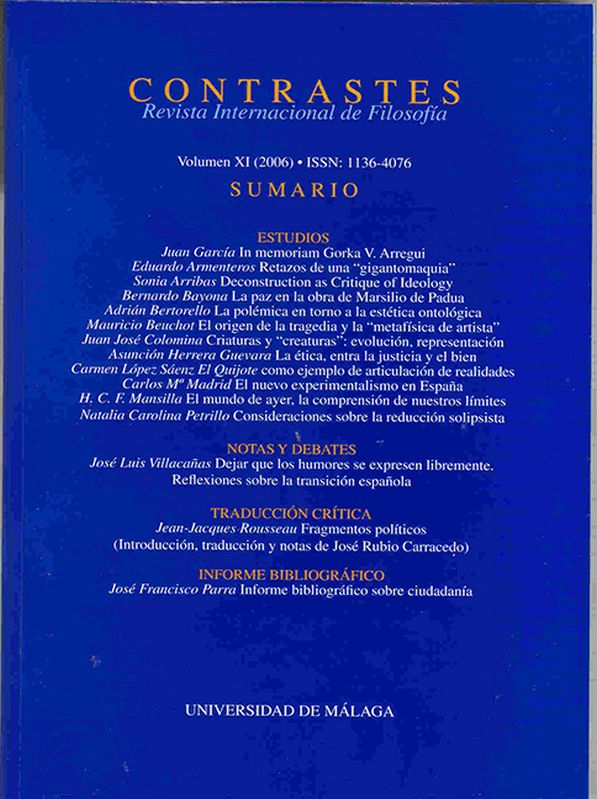
La polémica en torno a la estética ontológica de Heidegger: Schapiro, Schaeffer y Derrida
DOI:
https://doi.org/10.24310/Contrastescontrastes.v11i0.1457Abstract
Resumen
El trabajo se propone, por un lado, presentar los argumentos que M. Shapiro y J. M. Schaffer hicieron contra la interpretación heideggeriana del cuadro de van Gogh. Y, por otro, someter a un análisis crítico cada una de las objeciones. La idea central es presentar la polémica que produjo la recepción del texto de Heidegger Der Ursprung des Kusntwerkes y mostrar que dicha recepción se funda en un desconocimiento del pensamiento heideggeriano -tal como sucede en el caso de M. Shapiro- y en una incorrecta descripción de la producción del sentido –tal es el caso de J. M. Schaffer-.
Conceptos Clave:
Significado, Referente, Obra de Arte, Estética
Abstract The study aims, on one hand, at submitting the objections that M. Shapiro and J.M: Schaffer made against Heidegger´s interpretation of Van Gogh´s painting, and, on the other hand, at making a critical analysis of every objection. The main idea consists in presenting the controversy created by the reception of Heidegger´s Der Ursprung des Kusntwerkes and showing that said reception is based on the ignorance of Heidegger´s thought – as in the case of M. Shapiro – and on the improper description of the production of meaning – as in the case of J.M. Schaffer.
Key concepts:
Meaning, Referent, Work of Art, Aesthetics
Downloads
References
Downloads
Dimensions
Citations




Issue
Section
License
This journal provides immediate free access to its content under the principle of making research freely available to the public. All content published in Contrastes. Revista Internacional de Filosofía, are subject to the Creative Commons Attribution-NonCommercial-ShareAlike 4.0 license whose full text can be found at <http://creativecommons.org/licenses/by-nc-sa/4.0>
It is the responsibility of the authors to obtain the necessary permissions of the images that are subject to copyright.
Authors whose contributions are accepted for publication in this journal will retain the non-exclusive right to use their contributions for academic, research and educational purposes, including self-archiving or repository in open access repositories of any kind.
The electronic edition of this magazine is edited by the Editorial Service of the University of Malaga (Uma Editorial), being necessary to cite the origin in any partial or total reproduction.




5.png)
