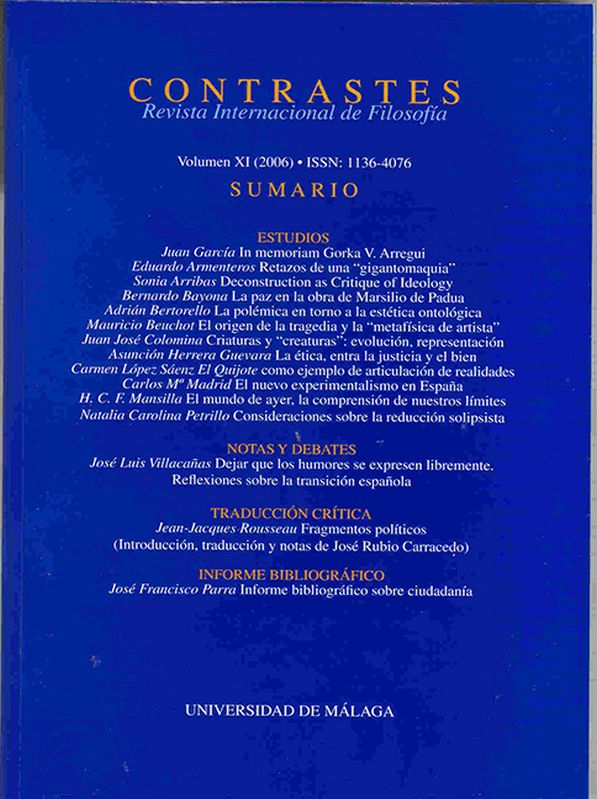
El Nuevo Experimentalismo en España: entre Ian Hacking y Gustavo Bueno
DOI:
https://doi.org/10.24310/Contrastescontrastes.v11i0.1462Abstract
Resumen
El nuevo experimentalismo todavía no es muy conocido en España. Sin embargo, este artículo propone que el filósofo español Gustavo Bueno mantiene bastantes ideas comunes con el filósofo experimentalista Ian Hacking. Ambos centran su atención sobre la propia práctica experimental. En realidad, ambos conciben la ciencia como intervención o manipulación (criterio del uso experimental) y, en consecuencia, critican el estatuto científico de la Astrofísica y la Cosmología. Finalmente, se muestra que el realismo materialista de Bueno guarda una posición paralela a la del realismo experimental de Hacking.
Palabras Clave
Nuevo Experimentalismo, realismo científico, realismo de entidades
Abstract
The new experimentalist movement is not widely known as yet in Spain. However this paper suggests that the spanish philosopher Gustavo Bueno has many ideas in common with the experimentalist philosopher Ian Hacking. Both focus their attention upon experimental practice itself. Actually, they conceive science as intervention or manipulation (criterion of experimental use) and therefore they criticize the scientific role of Astrophysics and Cosmology. Finally, it is shown that Bueno’s point of view of materialist realism parallels the position held by Hacking about experimental realism.
Keywords
New Experimentalism, scientific realism, entity-realism
Downloads
References
Downloads
Dimensions
Citations




Issue
Section
License
This journal provides immediate free access to its content under the principle of making research freely available to the public. All content published in Contrastes. Revista Internacional de Filosofía, are subject to the Creative Commons Attribution-NonCommercial-ShareAlike 4.0 license whose full text can be found at <http://creativecommons.org/licenses/by-nc-sa/4.0>
It is the responsibility of the authors to obtain the necessary permissions of the images that are subject to copyright.
Authors whose contributions are accepted for publication in this journal will retain the non-exclusive right to use their contributions for academic, research and educational purposes, including self-archiving or repository in open access repositories of any kind.
The electronic edition of this magazine is edited by the Editorial Service of the University of Malaga (Uma Editorial), being necessary to cite the origin in any partial or total reproduction.




5.png)