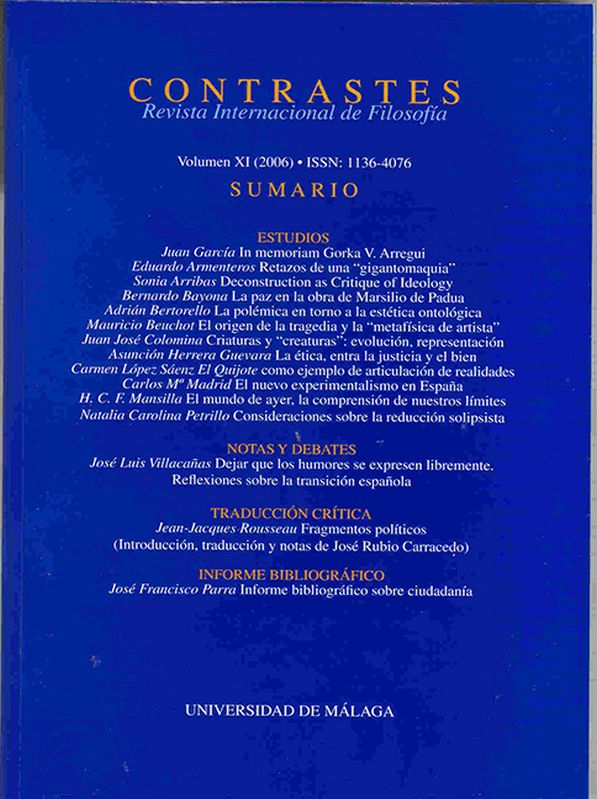
Dejar que los humores se expresen libremente. Reflexiones sobre la transición española a la democracia y sus enseñanzas
DOI:
https://doi.org/10.24310/Contrastescontrastes.v11i0.1586Abstract
RESUMEN
Este artículo desea defender la plena legitimidad del proceso constituyente español que condujo a la Constitución de 1978. Para ello muestro cuáles son los requisitos suficientes de un proceso constituyente y subrayo cuáles parecen prescindibles. Cifro lo propio de un proceso constituyente en que el pueblo sea plenamente autoconsciente al iniciarlo y hable de manera inequívoca y libre al aprobarlo. El primero excluye procesos sobrevenidos. El segundo va contra una representación soberana. ambas condiciones constituyentes sólo se han dado en España en relación con la Constitución de 1978. Mi interpretación es que incluso el PNV habló de manera inequívoca en este asunto. Por eso no considero legitimadas sus ambigüedades políticas.
PALABRAS CLAVE
PODER CONSTITUYENTE, LEGITIMIDAD, CONCIENCIA POLÍTICA, DECISIÓN, ESTATUTOS, AUTONOMÍA.
ABSTRACT
This article is a defence of the full legitimacy of the Spanish constituent process which led to the Constitution of 1978. In it I show which are the necessary elements of a constituent process and which would seem to be unnecessary. I also propose that an appropriate constituent process is one in which the people are fully self-aware when they initiate the process and express themselves freely and unequivocally when they ratify it. The former excludes processes which were not initially foreseen. The latter does not permit of sovereign representation. These two constituent onditions have only been satisfied in Spain at the time of the 1978 Constitution. In my view, even the PNV expressed itself unequivocally in this matter. For this reason I do not consider its political ambiguities to be legitimate.
KEYWORDS
CONSTITUENT POWER, LEGITIMACY, POLITICAL CONSCIENCE, DECISION, AUTONOMOUS STATUES
Downloads
References
Downloads
Dimensions
Citations




Issue
Section
License
This journal provides immediate free access to its content under the principle of making research freely available to the public. All content published in Contrastes. Revista Internacional de Filosofía, are subject to the Creative Commons Attribution-NonCommercial-ShareAlike 4.0 license whose full text can be found at <http://creativecommons.org/licenses/by-nc-sa/4.0>
It is the responsibility of the authors to obtain the necessary permissions of the images that are subject to copyright.
Authors whose contributions are accepted for publication in this journal will retain the non-exclusive right to use their contributions for academic, research and educational purposes, including self-archiving or repository in open access repositories of any kind.
The electronic edition of this magazine is edited by the Editorial Service of the University of Malaga (Uma Editorial), being necessary to cite the origin in any partial or total reproduction.




5.png)