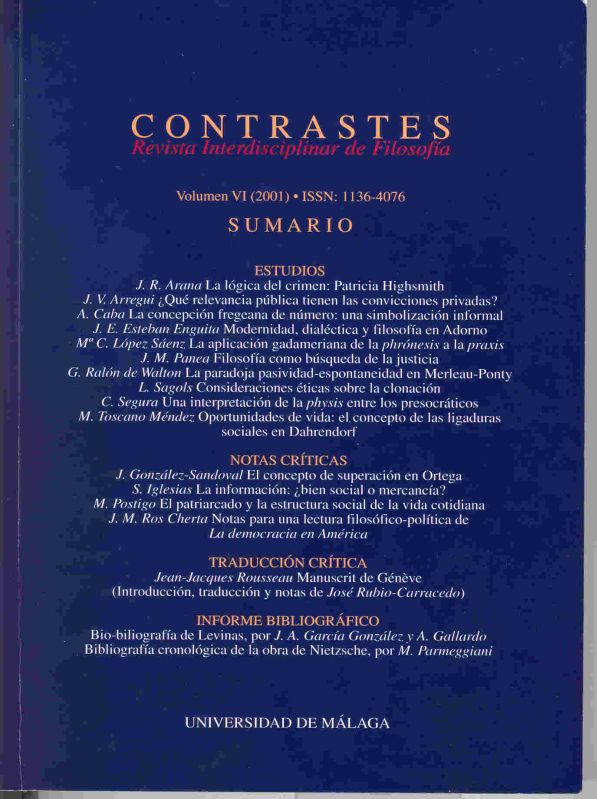
¿Qué relevancia pública tienen las convicciones privadas?
DOI:
https://doi.org/10.24310/Contrastescontrastes.v0i0.1621Keywords:
PLURALISMO, MORAL PÚBLICA, CONVICCIONES PRIVADASAbstract
RESUMEN
El artículo discute la distinción tajante entre la moral pública y la privada establecida por Rawls o Rorty. Sostiene que, auqnue ha de defenderse la especificidad de la moralidad que rige las acciones públicas, tal distinción (que es un producto histórico fruto de una precisa tradición) no puede entenderse como tajante manteniendo que sólo algunas morales onicomprensivas privadas permiten afirmar el pluralismo en términos de valor moral, y no sólo de hecho includible; que las morales omnicomprensivas privadas actúan como límite de las actuaciones públicas; y que las convicciones personales pueden ejercer un papel estabilizador de la vida política.
PALABRAS CLAVE
PLURALISMO-MORAL PÚBLICA-CONVICCIONES PRIVADAS
ABSTRACT
This papers questions the separation between private and public morality as argued by Rawls or Rorty. Although it recognizes the specificity of the morality of public actions, it holds that this distinction (a historical product of the liberal tradition) fails to show other aspects of their relation can support moral pluralism, that the provide the limit to public actions, and, finally, that personal convictions can play a stabilizing role in political life.
KEYWORDS
MORAL PLURALISM-PUBLIC MORALITY-PRIVATE MORALITY
Downloads
References
Downloads
Dimensions
Citations




Issue
Section
License
This journal provides immediate free access to its content under the principle of making research freely available to the public. All content published in Contrastes. Revista Internacional de Filosofía, are subject to the Creative Commons Attribution-NonCommercial-ShareAlike 4.0 license whose full text can be found at <http://creativecommons.org/licenses/by-nc-sa/4.0>
It is the responsibility of the authors to obtain the necessary permissions of the images that are subject to copyright.
Authors whose contributions are accepted for publication in this journal will retain the non-exclusive right to use their contributions for academic, research and educational purposes, including self-archiving or repository in open access repositories of any kind.
The electronic edition of this magazine is edited by the Editorial Service of the University of Malaga (Uma Editorial), being necessary to cite the origin in any partial or total reproduction.




5.png)
