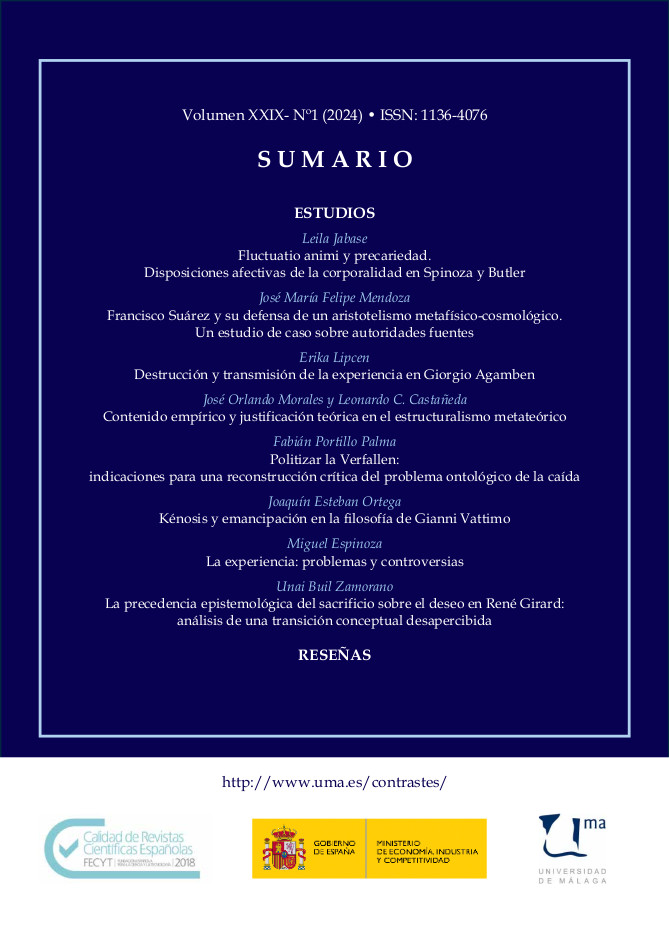
La precedencia epistemológica del sacrificio sobre el deseo en René Girard
Análisis de una transición conceptual desapercibida
DOI:
https://doi.org/10.24310/contrastes.29.1.2024.16648Keywords:
mimetic desire, sacrifice, mediation, trascendenceAbstract
In the context of most studies about René Girard’s thought, it is commonly assumed that mimetic desire is Girard’s original idea about human desire as such. In this sense, mimetic desire would be Girard’s first discovery chronologically speaking. Likewise, it is also widely believed that Girard’s Anthropology and his theory about religion would later emerge from what he discovered as mimetic desire. However, an alternative interpretation is offered in this article. Certainly, what Girard finally defined as ‘mimetic desire’ was found in a second moment, thanks to his anthropological insights as well as from his research about ancient religions. Therefore, I sustain the idea that mimetic desire is not Girard’s primitive stance on human órexis, but the outcome of an unnoticed metamorphosis of his original intuitions (which he ended up abandoning) as they were explained in his first book, Deceit, desire and the novel.
Downloads
References
Downloads
Published
Dimensions
Citations




Issue
Section
License
This journal provides immediate free access to its content under the principle of making research freely available to the public. All content published in Contrastes. Revista Internacional de Filosofía, are subject to the Creative Commons Attribution-NonCommercial-ShareAlike 4.0 license whose full text can be found at <http://creativecommons.org/licenses/by-nc-sa/4.0>
It is the responsibility of the authors to obtain the necessary permissions of the images that are subject to copyright.
Authors whose contributions are accepted for publication in this journal will retain the non-exclusive right to use their contributions for academic, research and educational purposes, including self-archiving or repository in open access repositories of any kind.
The electronic edition of this magazine is edited by the Editorial Service of the University of Malaga (Uma Editorial), being necessary to cite the origin in any partial or total reproduction.




5.png)