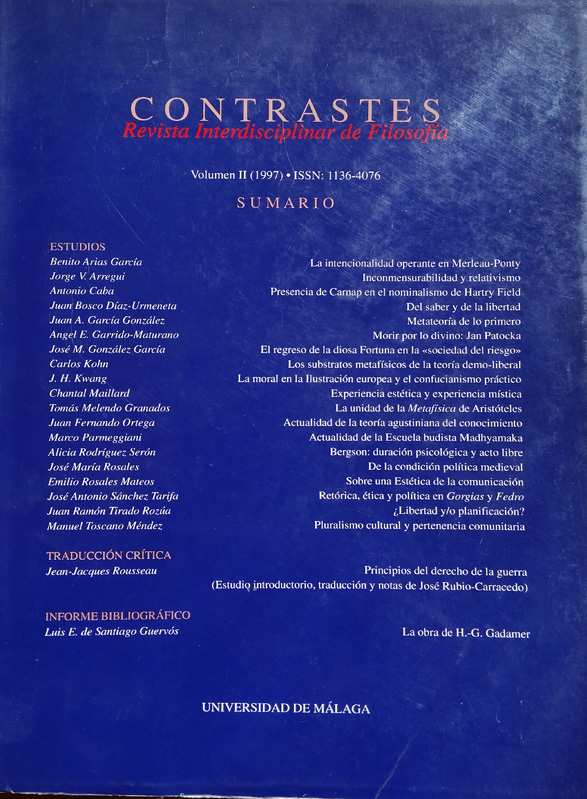
Morir por lo divino: Jan Patocka
DOI:
https://doi.org/10.24310/Contrastescontrastes.v2i0.1753Abstract
RESUMEN
El artículo se ocupa de la cuestión de Dios y la muerte en el pensamiento de Patocka. Comienza analizando los dos primeros movimientos del mundo de la vida, para centrarse en el tercero: «el descubrimiento del sí». Luego procura mostrar cómo, a través de la divinización del tiempo al cual debemos sacrificar la propia vida, la filosofía de Patocka consuma la subordinación de la problemática ética al renovarse de la temporalidad como sentido del ser. En este contexto se analiza la relación entre la muerte como sacrificio por un lado y el ser, lo Divino y la temporalidad por el otro.
PALABRAS CLAVE
PATOCKA-DIOS-MUERTE-TIEMPO.
ABSTRACT
The article is about God's question and death in Patocka's thought. It starts analysing the first two movements in the world of life, to focus on the third one: «the discovery of oneself». Then, it sets out to show how, throught time divinity, to wich we have to sacifice our own life, Patocka's philosophy consummates the subordination of the ethic problem when renewing the temporality as sense of being. In this context it is analysed the relationship between death and sacrifice, on one side, and divinity and temporality, on the other
KEYWORDS
PATOCKA-GOD-DEATH-TIME
Downloads
References
Downloads
Dimensions
Citations




Issue
Section
License
This journal provides immediate free access to its content under the principle of making research freely available to the public. All content published in Contrastes. Revista Internacional de Filosofía, are subject to the Creative Commons Attribution-NonCommercial-ShareAlike 4.0 license whose full text can be found at <http://creativecommons.org/licenses/by-nc-sa/4.0>
It is the responsibility of the authors to obtain the necessary permissions of the images that are subject to copyright.
Authors whose contributions are accepted for publication in this journal will retain the non-exclusive right to use their contributions for academic, research and educational purposes, including self-archiving or repository in open access repositories of any kind.
The electronic edition of this magazine is edited by the Editorial Service of the University of Malaga (Uma Editorial), being necessary to cite the origin in any partial or total reproduction.




5.png)