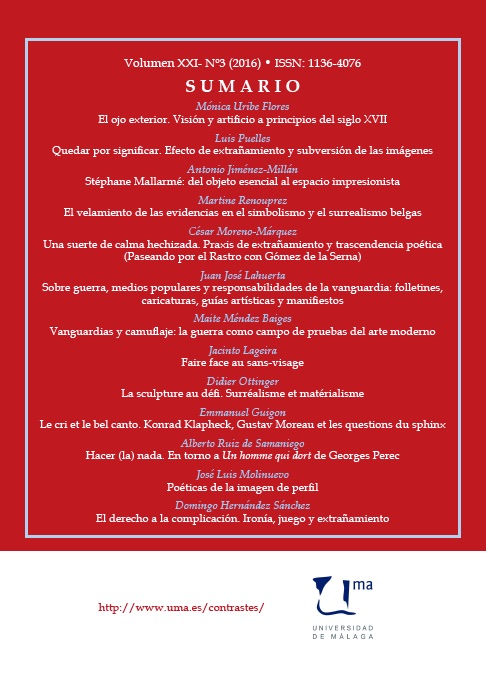
The outer eye. Vision and artificein the early seventeenth century
DOI:
https://doi.org/10.24310/Contrastescontrastes.v21i3.2426Keywords:
Descartes, Camera Obscura, Modern Optics, PaintingAbstract
Early in the seventeenth-century Kepler studied the human eye as an optical instrument. Some decades later, Descartes proposed an experiment to approach the eye as an object, totally separated from the body. The exterior eye, assumed as an analogy of the camera obscura, would help to understand vision, to explain refraction, and to model better optical devices. That same exterior eye would broaden as well the aesthetic observation and exploration of light. The objectified eye, detached from the body, became a subject matter for an observer still totally embodied. In this strangeness, the technical eye and the organic eye look at each other and model one another.Downloads
References
Downloads
Published
Dimensions
Citations




Issue
Section
License
This journal provides immediate free access to its content under the principle of making research freely available to the public. All content published in Contrastes. Revista Internacional de Filosofía, are subject to the Creative Commons Attribution-NonCommercial-ShareAlike 4.0 license whose full text can be found at <http://creativecommons.org/licenses/by-nc-sa/4.0>
It is the responsibility of the authors to obtain the necessary permissions of the images that are subject to copyright.
Authors whose contributions are accepted for publication in this journal will retain the non-exclusive right to use their contributions for academic, research and educational purposes, including self-archiving or repository in open access repositories of any kind.
The electronic edition of this magazine is edited by the Editorial Service of the University of Malaga (Uma Editorial), being necessary to cite the origin in any partial or total reproduction.




5.png)
