The Cambrian explosion
DOI:
https://doi.org/10.24310/enbio.27.190.2025.21881Abstract
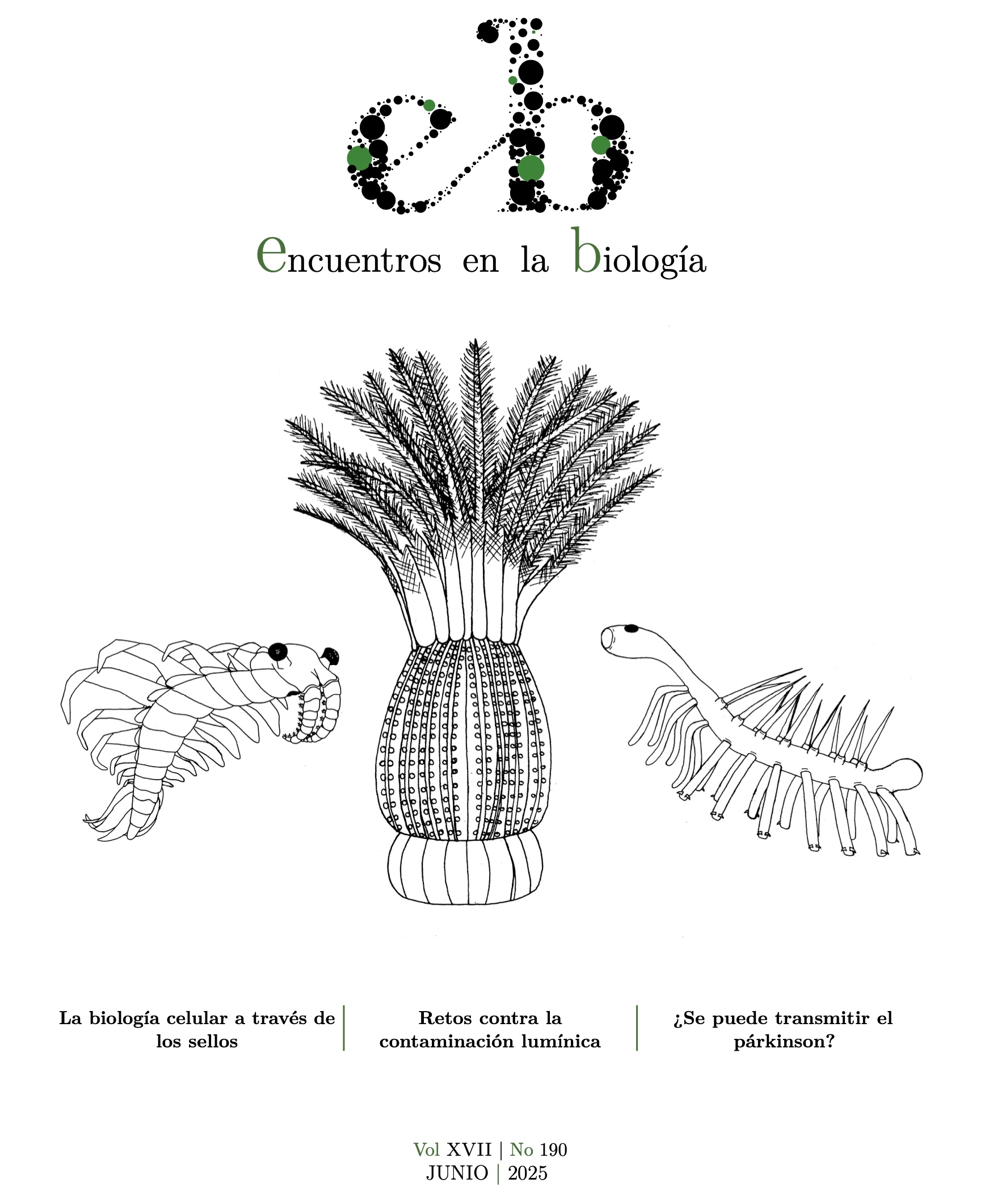
The Cambrian explosion is an evolutionary radiation that took place in the early Cambrian, which began approximately 538 million years ago. It is one of the most remarkable in the history of biota, since in 10 million years most of the body plans present in the present groups of animals developed, although several of their original forms did not reach the present day. The first mineralized skeletons appeared, which facilitated the fossilization process. On the other hand, the increase of oxygen in the atmosphere promoted the growth of body structures, and global warming and rising sea levels created favorable habitats. In Cambrian sediments, such as the Burgess Shale in Canada and the Chenjiang Formation in China, countless fossils from this period were found, some of them represented in this illustration: The genera Anomalocaris (1), Tamisiocaris (2), Opabinia (3), Hallucigenia (4), Marrella (5), Pikaia (6), the class Trilobites (7), the genus Vetulicola (8), and the species Cotyledion tylodes (9) and Xianguangia sinica (10).
Translated with DeepL.com (free version)
Downloads
References
Downloads
Published
Dimensions
Citations




Issue
Section
License
Esta obra está bajo licencia internacional Creative Commons Reconocimiento-NoComercial-CompartirIgual 4.0.
Esta revista provee acceso libre inmediato a su contenido bajo el principio de hacer disponible gratuitamente la investigación al público. Todos los contenidos publicados en Encuentros en la Bilogía están sujetos a la licencia Creative Commons Reconocimento-NoComercia-Compartirigual 4.0 cuyo texto completo puede consultar en <http://creativecommons.org/licenses/by-nc-sa/4.0>
Se pueden copiar, usar, difundir, transmitir y exponer públicamente, siempre que:
Se cite la autoría y la fuente original de su publicación (revista, editorial y URL de la obra).
No se usen para fines comerciales.
Se mencione la existencia y especificaciones de esta licencia de uso
Los derechos de autor son de dos clases: morales y patrimoniales. Los derechos morales son prerrogativas perpetuas, irrenunciables, intransferibles, inalienables, inembargables e imprescriptibles. De acuerdo con la legislación de derechos de autor, Encuentros en la Biología reconoce y respeta el derecho moral de los autores/as, así como la titularidad del derecho patrimonial, el cual será cedido a la Universidad de Málaga para su difusión en acceso abierto. Los derechos patrimoniales, se refieren a los beneficios que se obtienen por el uso o divulgación de las obras. Encuentros en la Biología se publica en open access y queda autorizada en exclusiva para realizar o autorizar por cualquier medio el uso, distribución, divulgación, reproducción, adaptación, traducción o transformación de la obra.
Es responsabilidad de los autores/as obtener los permisos necesarios de las imágenes que están sujetas a derechos de autor.
Los autores/as cuyas contribuciones sean aceptadas para su publicación en esta revista conservarán el derecho no exclusivo de utilizar sus contribuciones con fines académicos, de investigación y educativos, incluyendo el auto-archivo o depósito en repositorios de acceso abierto de cualquier tipo.
La edición electrónica de esta revista esta editada por la Editorial de la Universidad de Málaga (UmaEditorial), siendo necesario citar la procedencia en cualquier reproducción parcial o total.
