Alfabetización digital tecnológica: formación de voluntariado
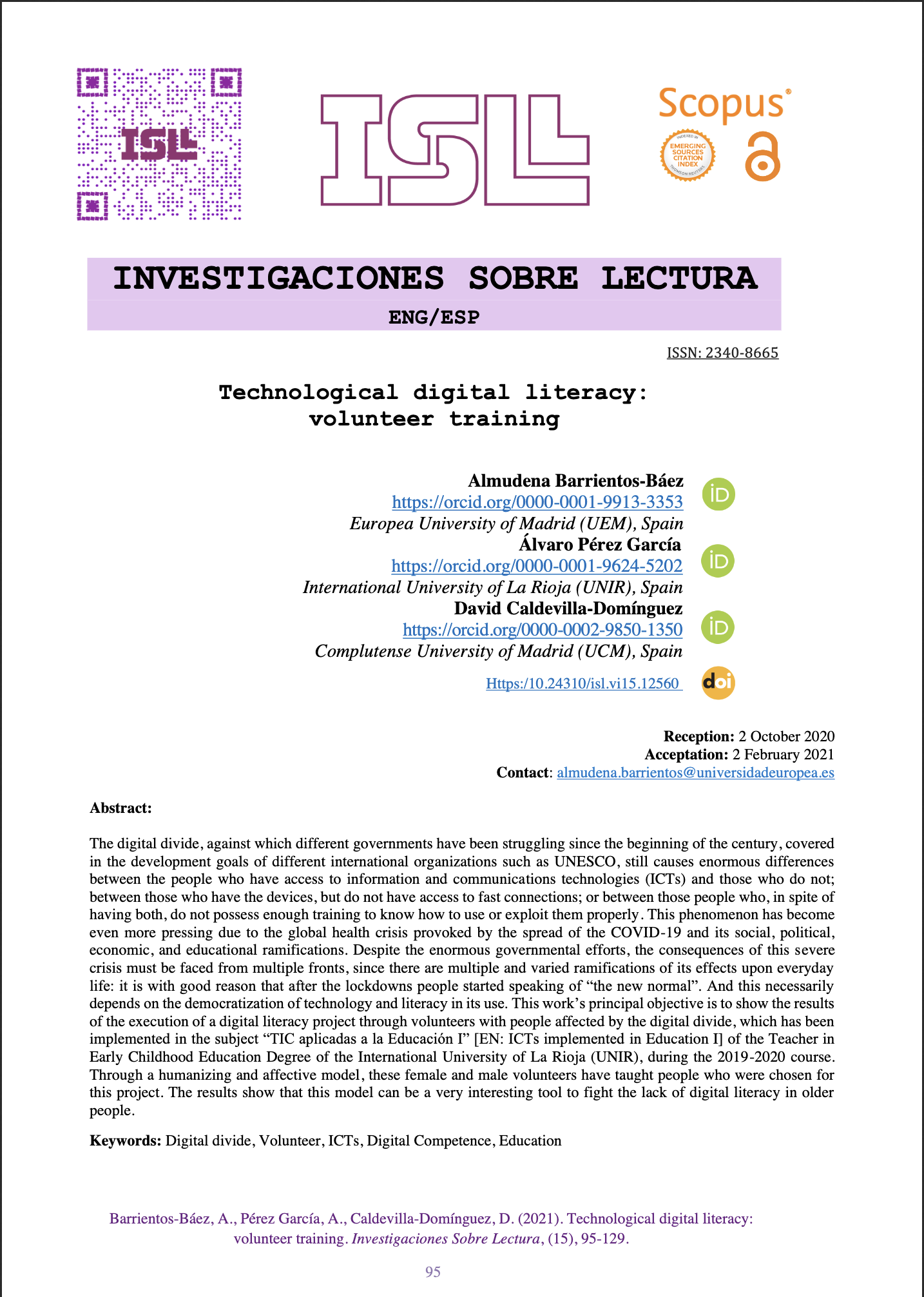
Technological digital literacy: volunteer training
DOI:
https://doi.org/10.24310/isl.vi15.12560Keywords:
Digital divide, Volunteer, ICTs, Digital Competence, EducationAbstract
The digital divide, against which different governments have been struggling since the beginning of the century, covered in the development goals of different international organizations such as UNESCO, still causes enormous differences between the people who have access to information and communications technologies (ICTs) and those who do not; between those who have the devices, but do not have access to fast connections; or between those people who, in spite of having both, do not possess enough training to know how to use or exploit them properly. This phenomenon has become even more pressing due to the global health crisis provoked by the spread of the COVID-19 and its social, political, economic, and educational ramifications. Despite the enormous governmental efforts, the consequences of this severe crisis must be faced from multiple fronts, since there are multiple and varied ramifications of its effects upon everyday life: it is with good reason that after the lockdowns people started speaking of “the new normal”. And this necessarily depends on the democratization of technology and literacy in its use. This work’s principal objective is to show the results of the execution of a digital literacy project through volunteers with people affected by the digital divide, which has been implemented in the subject “TIC aplicadas a la Educación I” [EN: ICTs implemented in Education I] of the Teacher in Early Childhood Education Degree of the International University of La Rioja (UNIR), during the 2019-2020 course. Through a humanizing and affective model, these female and male volunteers have taught people who were chosen for this project. The results show that this model can be a very interesting tool to fight the lack of digital literacy in older people.
Downloads
References
Abad Alcalá L. (2016). La alfabetización digital como instrumento de e-inclusión de las personas mayores. Revista Prisma Social, 16, 156-204.
Astudillo Torres, M. P., Chévez Ponce, F. y Oviedo Vargas, Y. (2019). La exclusión social y las Tecnologías de la Información y la Comunicación: una visión estadística de su relación en la educación superior. LiminaR Estudios Sociales y Humanísticos, 18(1), 177-193. https://doi.org/10.29043/liminar.v18i1.721
Barrientos-Báez, A., Barquero-Cabrero, M. y Rodríguez-Terceño, J. (2019). La educación emocional como contenido transversal para una nueva política educativa: el caso del grado de turismo. Revista Utopía y Praxis Latinoamericana, 24(4), 147-165.
Cabero-Almenara, J., y Palacios-Rodríguez, A. (2020). Marco Europeo de Competencia Digital Docente «DigCompEdu» y cuestionario «DigCompEdu Check-In». EDMETIC, Revista de Educación Mediática y TIC, 9(1), 213-234. https://doi.org/10.21071/edmetic.v9i1.12462
Caldevilla-Domínguez, D., Rodríguez-Terceño, J. y Barrientos-Báez, A. (2019). El malestar social a través de las nuevas tecnologías: Twitter como herramienta política. Revista Latina de Comunicación Social, 74, 1264-1290. https://doi.org/10.4185/RLCS-2019-1383-66
Cantero de Julián, J. I., Calvo Rubio, L. M. y Benedicto Solsona, M. A. (2020). La tenue apuesta por los vídeos en 360º en las estrategias transmedia de las televisiones autonómicas españolas. Revista Latina de Comunicación Social, 75, 415-433. https://www.doi.org/10.4185/RLCS-2020-1433
Castañeda, L. (2019). Debates regarding Technology and Education: contemporary pathways and pending conversations. RIED. Revista Iberoamericana de Educación a Distancia, 22(1), 29-39. http://dx.doi.org/10.5944/ried.22.1.23020
Consejo de la Unión Europea (30 de Mayo, 2016). Conclusiones del Consejo de la Unión Europea sobre el desarrollo de la alfabetización mediática y el pensamiento crítico a través de la educación y la formación. [Comunicado de prensa]. Recuperado de https://www.consilium.europa.eu/es/press/press-releases/2016/05/30/eycs-conclusions-developing-media-literacy/
Declaración de principios. Cumbre Mundial de la sociedad de la información (2004). Recuperado el 3 septiembre de 2020, de: https://www.itu.int/net/wsis/docs/geneva/official/dop-es.html#:~:text=Nosotros%2C%20los%20representantes%20de%20los,Informaci%C3%B3n%20centrada%20en%20la%20persona%2C
Díaz Rosabal, E. M., Díaz Vidal, J. M., Vázquez, A. E., Sánchez Martínez, Y., Riverón Rodríguez, G. y Santiesteban Reyes, D. C. (2020). La dimensión didáctica de las tecnologías de la información y las comunicaciones. RITI Journal, 8, 8-15. https://doi.org/10.36825/RITI.08.15.002
Fedele, M. y García-Muñoz, N. (2010). El consumo adolescente de la ficción seriada. Revista de Comunicación Vivat Academia, 111, 48-65. https://doi.org/10.15178/va.2010.111.47-64
García-Umaña, A., Ulloa, M. C. y Córdoba Pillajo, E. F. (2020). La era digital y la deshumanización a efectos de las TIC. ReiDoCrea: Revista electrónica de investigación y docencia creativa, 9, 11-20.
Goleman, D. (1996). Inteligencia Emocional. Kairós.
Hernández-Sánchez, A. M. y Ortega-Maldonado, A. (2015). Hacia la personalización del e-Learning: la afectividad y su repercusión en el bienestar subjetivo. Revista Lasallista de Investigación, 12(2), 194-203.
INTEF (2017). Marco Común de Competencia Digital Docente. MECD.
Jiménez, E. (2018). La inteligencia emocional como predictor del hábito lector y la competencia lectora en universitarios. Investigaciones Sobre Lectura, 10, 30-54.
Labio-Bernal, A., Romero-Domínguez, L. R., García-Orta, M. J. y García-Prieto, V. (2020). Competencia digital informacional, alfabetización mediática y periodismo. Un análisis de caso a través del proyecto “La Prensa en las escuelas”. Icono 14, 18(2), 58-83. https://doi.org/10.7195/ri14.v18i1.1387
Marín, V., Vázquez, A. I., Llorente, M. C. y Cabero, J. (2012). La alfabetización digital del docente universitario en el Espacio Europeo de Educación Superior. Edutec, Revista Electrónica de Tecnología Educativa, 39.
Ortega Navas, C. (2009). Dimensión formativa de la alfabetización tecnológica. En Ortega Sánchez, I. y Ferrás Sexto, C. (Coords.), Alfabetización Tecnológica y desarrollo regional [monográfico en línea]. Revista Electrónica Teoría de la Educación: Educación y Cultura en la Sociedad de la Información, 10(2).
Ortega Sánchez, I. (2009). La Alfabetización tecnológica. En Ortega Sánchez, I. y Ferrás Sexto, C. (Coords.), Alfabetización Tecnológica y el desarrollo regional. Revista Electrónica Teoría de la Educación: Educación y Cultura en la Sociedad de la Información, 10(2).
Parra-López, E., Barrientos-Báez, A., y Martínez-González, J. A. (2020). La transformación digital del turismo. Revista de Occidente, 464. 52-66.
Pérez-Tornero, J. M., Giraldo-Luque, S., Tejedor-Calvo, S. y Portalés-Oliva, M. (2018). Propuesta de indicadores para evaluar las competencias de alfabetización mediática en las administraciones públicas. El Profesional de la Información, 27(3), 521-536. https://doi.org/10.3145/epi.2018.may.06
Salaverría, R. (2019). Digital journalism: 25 years of research. Review article. El Profesional de la Información, 28(1), 1-26. https://doi.org/10.3145/epi.2019.ene.01
Salovey, P. y Mayer, J. (1990). Emotional Intelligence. Imagination, Cognition, and Personality, 9, 185-211.
Sánchez-Claros, J. P. (2016). Nuevas alfabetizaciones en un entorno multimodal: nuevas necesidades lectoras para un entorno textual múltiple. Investigaciones Sobre Lectura, 6, 51-57.
Ziegler Delgado, M. M. (2020). El tiempo de las Humanidades Digitales: entre la Historia del Arte, el Patrimonio Cultural, la ciudadanía global y la educación en competencias digitales. Revista de Comunicación de la SEECI, 52, 29-47. http://doi.org/10.15198/seeci.2020.52.29-47
Downloads
Published
Dimensions
Citations




Issue
Section
License
All contents published in Investigaciones sobre Lectura are protected under the Creative Commons Attribution-NonCommercial-ShareAlike 4.0 International (CC BY-NC-SA 4.0) license. All about this license is available in the following link: <http://creativecommons.org/licenses/by-nc-sa/4.0>
Users can copy, use, redistribute, share and exhibit publicly as long as:
- The original source and authorship of the material are cited (Journal, Publisher and URL of the work).
- It is not used for comercial purposes.
- The existence of the license and its especifications are mentioned.
There are two sets of authors’ rights: moral and property rights. Moral rights are perpetual prerogatives, unrenounceable, not-transferable, unalienable, imprescriptible and inembargable. According to authors’ rights legislation, Investigaciones sobre Lectura recognizes and respects authors moral rights, as well as the ownership of property rights, which will be transferred to University of Malaga in open access. The property rights are referred to the benefits that are gained by the use or the dissemination of works. Investigaciones sobre Lectura is published in an open access form and it is exclusively licenced by any means for doing or authorising distribution, dissemination, reproduction, , adaptation, translation or arrangement of works.
Authors are responsable for obtaining the necessary permission to use copyrighted images.






31.png)