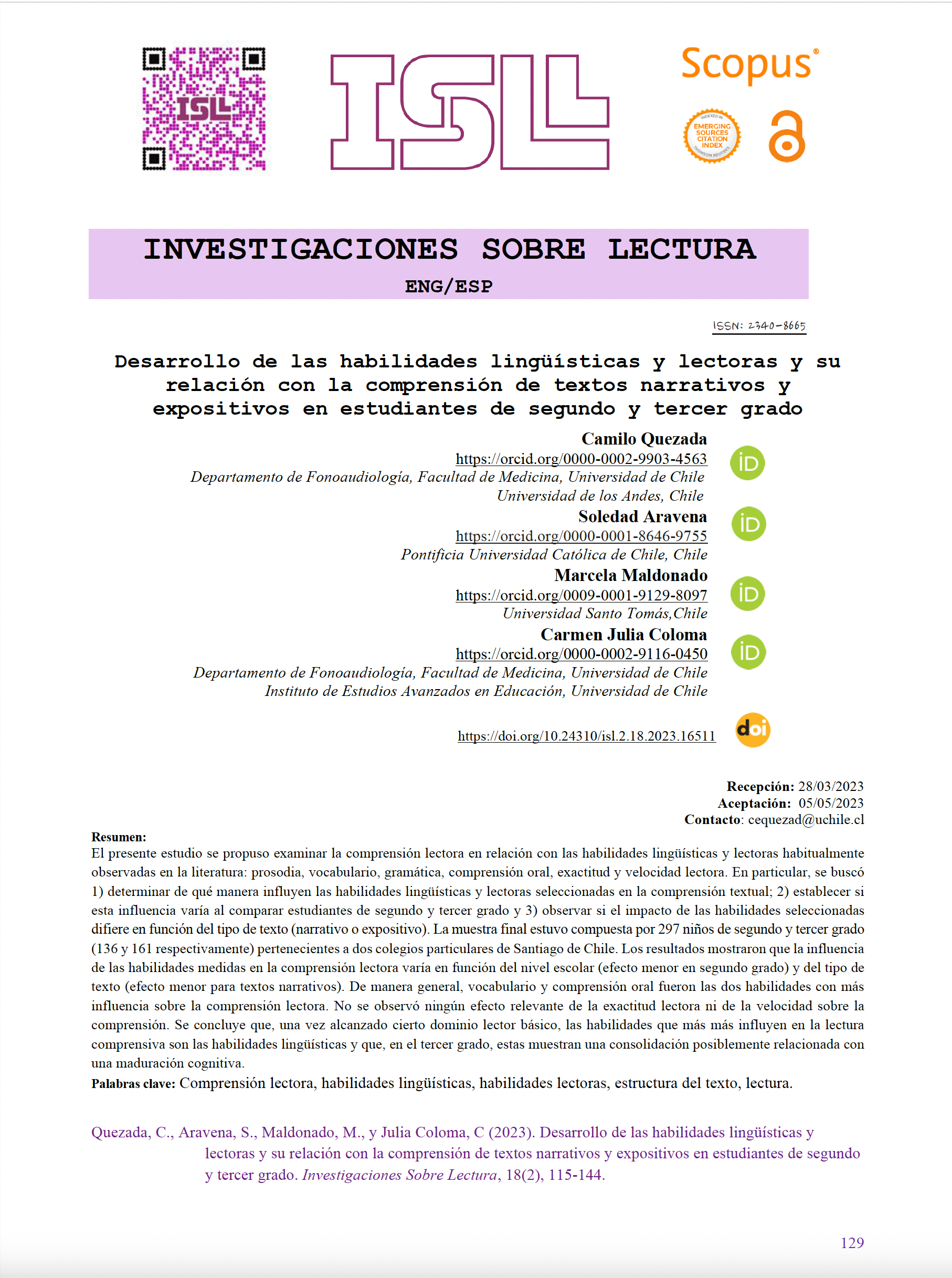
Development of linguistic and reading skills and their relationship with the comprehension of narrative and expository texts in second and third grade students
DOI:
https://doi.org/10.24310/isl.2.18.2023.16511Keywords:
reading comprehension – language skills – reading skills – narrative text – expository textAbstract
The study aimed at examining the links between reading comprehension and the most commonly observed language and reading skills in literature: prosody, vocabulary, grammar, listening comprehension, reading accuracy and reading speed. Specifically, objectives were 1) to determine how selected linguistic and reading skills influence textual comprehension; 2) to establish whether this influence varies when comparing second and third grade students and 3) to observe whether the impact of the selected skills varies depending on the type of text (narrative or expository). The final sample consisted of 297 children (136 second graders and 161 third graders) belonging to two private schools from Santiago, Chile. Results showed that the relationship between reading comprehension and the measured skills varies according to grade (smaller effect in 2nd grade) and type of text (smaller effect for narrative texts). In general, vocabulary and listening comprehension were the two skills most influencing reading comprehension. No relevant effects of reading accuracy or speed on reading comprehension were observed. t is concluded that, once a certain basic reading proficiency is reached, the skills that most influence reading comprehension are linguistic skills and that, in the third grade, these show a consolidation possibly related to cognitive maturation.
Downloads
References
Andrés, M. L., Canet, L. & García, A. (2010). Conciencia sintáctica en niños de 5 a 8 años de edad: Diseño de un instrumento y evaluación de sus propiedades psicométricas. Avaliação Psicológica, 9(2), 199-210.
Álvarez-Cañizo, M., Cueva, E., Cuetos, F., & Suárez-Coalla, P. (2020). Reading fluency and reading comprehension in Spanish secondary students. Psicothema, 32(1), 75-83.
Aznárez, L., Hossain, I. M., & Cuadro, A. (2021). Desarrollo prosódico en lectura de textos en voz alta de niños uruguayos de 8, 10 y 12 años de edad (Proyecto), FMV_3_2018_1_148928, ANII, Uruguay.
Baker, D. L., Alberto, P. C., Macaya, M. M., García, I., & Gutiérrez-Ortega, M. (2022). Relation Between the Essential Components of Reading and Reading Comprehension in Monolingual Spanish-Speaking Children: a Meta-analysis. Educational Psychology Review, 1-36.
Balbi, A., Cuadro, A., & Trías, D. (2009). Comprensión lectora y reconocimiento de palabras. Ciencias Psicológicas, 3(2), 153-160.
Bizama, M., Arancibia, B., Sáez, K., y Loubiès, L. (2017). Conciencia sintáctica y comprensión de lectura en niñez vulnerable. Revista Latinoamericana de Ciencias Sociales, Niñez y Juventud, 15(1), 219-232.
Cain, K. (1996). Story knowledge and comprehension skill. In C. Cornoldi & J. Oakhill (Eds.), Reading comprehension difficulties: Processes and intervention (pp. 176–192). Lawrence Erlbaum Associates.
Cadime, I., Rodrigues, B., Santos, S., Viana, F.L., Chaves-Sousa, S., Céu Cosme, M., & Ribeiro, I. (2017). The role of word recognition, oral reading fluency and listening comprehension in the simple view of reading: a study in an intermediate depth orthography. Reading and Writing, 30, 591-611. DOI 10.1007/s11145-016-9691-3
Calet, N., Gutiérrez-Palma, N., Simpson, I., González-Trujillo, M.C., & Defior, S. (2015). Suprasegmental Phonology Development and Reading Acquisition: A Longitudinal Study. Scientific Studies of Reading, 19, 51-71.
Clinton, V., Taylor, T., Bajpayee, S., Davison, M. L., Carlson, S. E., & Seipel, B. (2020). Inferential comprehension differences between narrative and expository texts: a systematic review and meta-analysis. Reading and Writing, 33(9), 2223-2248.
Cohen J. (1992). A power primer. Psychological bulletin, 112(1), 155–159. https://doi.org/10.1037//0033-2909.112.1.155
Cromley, J. G., & Azevedo, R. (2007). Testing and refining the direct and inferential mediation model of reading comprehension. Journal of Educational Psychology, 99(2), 311-325. https://doi.org/10.1037/0022-0663.99.2.311
Cuetos, F., Rodríguez, B., Ruano, E. & Arribas, D. (2014). PROLEC-R. Batería de Evaluación de los Procesos Lectores, revisada (5ª ed.). TEA Ediciones.
De Mier, M.V., Borzone, A.M., y Cupani, M. (2012). La fluidez lectora en los primeros grados: relación entre habilidades de decodificación, características textuales y comprensión. Un estudio piloto con niños hablantes de español. Revista Neuropsicología Latinoamericana, 4(1), 18-33.
De Mier, V., Borzone, A. M., Sánchez Abchi, V. y Benítez, M. E. (2013). Habilidades de comprensión y factores textuales en los primeros grados. Revista Peruana de Psicología y Trabajo Social, 2(1), 89-106.
Diakidoy, I.N. (2014). The effects of familiarization with oral expository text on listening and reading comprehensionlevels. Reading Psychology, 35(7), 622-643. https://doi.org/10.1080/02702711.2013.790327
Diakidoy, I. N., Stylianou, P., Karefillidou, C., & Papageorgiou, P. (2005). The relationship between listening and reading comprehension of different types of text at increasing grade levels. Reading Psychology, 26, 55-80.
Duke, N. K. (2000). 3.6 minutes per day: The scarcity of informational texts in first grade. Reading Research Quarterly, 35, 202-224.
Echeverría, M., Herrera, M. A., y Segure, J.T. (2009). TEVI-R. Test de Vocabulario en Imágenes. Universidad de Concepción.
Ehren, B. J., Murza, K. A., & Malani, M. D. (2012). Disciplinary literacy from a speech–language pathologist’s perspective. Topics in Language Disorders, 32(1), 85-98. https://doi.org/10.1097/ TLD.0b013e318244e8d4
Ferroni, M., y Jaichenco, V. (2022). Comprensión oral y escrita: efectos de la estructura textual. Interdisciplinaria, 39(3), 139-150. https://doi.org/10.16888/interd.2022.39.3.8
Figueroa, S. & Gallego, J. (2021). Relación entre vocabulario y comprensión lectora: Un estudio transversal en educación básica. Revista signos. estudios de lingüística, 54(106) 354-375.
Florit, E., Roch, M., Dicataldo, R., & Levorato, M. C. (2022). The Simple View of Reading in Italian beginner readers: Converging evidence and open debates on the role of the main components. Learning and Individual Differences, 93, 101961.
Friedman, N. P., & Miyake, A. (2017). Unity and diversity of executive functions: Individual differences as a window on cognitive structure. Cortex; a journal devoted to the study of the nervous system and behavior, 86, 186–204. https://doi.org/10.1016/j.cortex.2016.04.023
Graesser, A. C., McNamara, D. S., & Louwerse, M. M. (2003). What do readers need to learn in order to process coherence relations in narrative and expository text? In A. P. Sweet & C. E. Snow (Eds.), Rethinking reading comprehension (pp. 82-98). Guilford.
Jiménez, J., García, E., Estévez, A., Díaz, A., Guzmán, R., Hernández-Valle, I., Ortiz, M.R., Rodrigo, M., y Hernández, S. (2004). Evaluación del procesamiento sintáctico- semántico en la dislexia evolutiva. Revista Electrónica de Investigación Psicoeducativa y Psicopedagógica, 2(2), 127-142.
Kim, Y., & Pallante, D. (2012). Predictors of reading skills for kindergartners and first grade students in Spanish: A longitudinal study. Read Write, 25(1), 2-22.
Kim, Y. S., & Wagner, R. K. (2015). Text (Oral) Reading Fluency as a Construct in Reading Development: An Investigation of its Mediating Role for Children from Grades 1 to 4. Scientific studies of reading : the official journal of the Society for the Scientific Study of Reading, 19(3), 224–242. https://doi.org/10.1080/10888438.2015.1007375
Kuhn, M., Jackson, S., & Cimentada, J. (2020). Correlations in R. R Package Version 0.4, 3, https://CRAN.R-project.org/package=corrr
Leslie, L., & Caldwell, J. S. (2017). Assessments of reading comprehension: Challenges and directions. In S. Israel (Ed.), Handbook of research on reading comprehension (pp. 219-271). Guilford.
López-Escribano, C., Elosúa de Juan, M. R., Gómez-Veiga, I., & García-Madruga, J. A. (2013). A predictive study of reading comprehension in third-grade Spanish student. Psicothema, 25(2), 199-20.
Lundine, J.P., Harnish, S.M., McCauley, R.J., Blackett, D.S., Zezinka, A., Chen, W., & Fox, R.A. (2018). Adolescent Summaries of Narrative and Expository Discourse: Differences and Predictors. Language, Speech, and Hearing Services in Schools, 49, 551-568.
Lynch, J., van den Broek, P., Kremer, K, Kendeou, P., White, M. J. & Lorch, E. (2008). The development of narrative comprehension and its relation to other early reading skills. Reading Psychology, 29, 327-365.
Mar, R. A., Li, J., Nguyen, A.T. & Ta, C.P. (2021). Memory and comprehension of narrative versus expository texts: A meta-analysis. Psychonomic Bulletin & Review, 28(3), 732-749.
McNamara, D. S., Floyd, R. G., Best, R., & Louwerse, M. (2004). World knowledge driving comprehension difficulties. In Y. B. Kafai, W. A. Sandoval, N. Enyedy, & A. S. Nixon (Eds.), Proceedings of the 6th International Conference of the Learning Sciences (pp. 326–333). Lawrence Erlbaum Associates.
Montesinos, M. M. T., Salceda, J. C. R., Alonso, G. A., & Joshi, R. M. (2022). Simple view of reading in Spanish: A longitudinal study. Revista de Logopedia, Foniatría y Audiología.
Nippold, M. A. (2014). Language intervention at the middle school: Complex talk reflects complex thought. Language, Speech, and Hearing Services in Schools, 45(2), 153-156. https://doi.org/ 10.1044/2014_LSHSS-14-0027.
Perfetti, C. A. (1985). Reading ability. Oxford University Press.
R Core Team (2022). R: A language and environment for statistical computing. R Foundation for Statistical Computing, Vienna, Austria. URL https://www.R-project.org/
Recio-Pineda, S. (2017). Prosodia y comprensión lectora en Educación Primaria [Tesis Doctoral, Universidad de Barcelona]. https://www.tdx.cat/handle/10803/454820?locale-attribute=en#page=1
Riffo, B., Caro, N., y Sáez, K. (2018). Conciencia lingüística, lectura en voz alta y comprensión lectora. Revista de Lingüística Teórica y Aplicada, 56(2), 175-198.
Ripoll-Salceda, J. C., Tapia Montesinos, M., & Aguado-Alonso, G. (2020). Reading rate in Spanish- speaking students: A meta-analysis. Revista de Psicodidáctica, 25(2), 158–165.
Rosas, R., Espinoza, V., Martínez, C., & Santa-Cruz, C. (2022). Playful Testing of Executive Functions with Yellow-Red: Tablet-Based Battery for Children between 6 and 11. Journal of Intelligence, 10(4), 125. https://doi.org/10.3390/jintelligence10040125
Schwanenflugel, P.J., & Benjamin, R.G. (2017). Lexical prosody as an aspect of oral reading fluency. Reading and Writing, 30, 143–162. https://doi.org/10.1007/s11145-016-9667-3
Shah, A. D., Bartlett, J. W., Carpenter, J., Nicholas, O., & Hemingway, H. (2014). Comparison of random forest and parametric imputation models for imputing missing data using MICE: a CALIBER study. American journal of epidemiology, 179(6), 764–774. https://doi.org/10.1093/aje/kwt312
Snyder, L. & Caccamise (2010). Comprehension Processes for Expository Text: Building. In M.A. Nippol & C.M. Scott (Eds.), Expository Discourse in Children, Adolescents, and Adults. Development and Disorders (pp. 32-68). Psychology Press.
Tabullo, A.J., Wainselboim, A.J. & París, L.A. (2022). La comprensión de textos expositivos y narrativos y su relación con el vocabulario. la eficacia lectora y el control inhibitorio en niños de cuarto grado. Traslaciones. Revista Latinoamericana de Lectura y Escritura, 9(17), 39-59.
Tighe, E. L., Spencer, M., & Schatschneider, C. (2015). Investigating Predictors of Listening Comprehension in Third-, Seventh-, and Tenth-Grade Students: A Dominance Analysis Approach. Reading psychology, 36(8), 700–740. https://doi.org/10.1080/02702711.2014.963270
Vergara, D., Strasser, K. & Del Río, M. (2016). Más que palabras por minuto: Las otras habilidades que afectan la comprensión en primero básico. Calidad en la Educación, 4, 46-67.
Zevallos, D., Arcos, N., & Ripoll, J. C. (2017). La concepción simple de la lectura en alumnos de cuarto de primaria de una escuela fiscal de Quito. Alteridad, 12(1), 115-122.
Downloads
Published
Versions
- 2024-01-02 (3)
- 2023-12-22 (2)
- 2023-12-22 (1)
Dimensions
Citations




Issue
Section
License
Copyright (c) 2023 Camilo Quezada Gaponov, Soledad Aravena, Marcela Maldonado, Carmen Julia Coloma
All contents published in Investigaciones sobre Lectura are protected under the Creative Commons Attribution-NonCommercial-ShareAlike 4.0 International (CC BY-NC-SA 4.0) license. All about this license is available in the following link: <http://creativecommons.org/licenses/by-nc-sa/4.0>
Users can copy, use, redistribute, share and exhibit publicly as long as:
- The original source and authorship of the material are cited (Journal, Publisher and URL of the work).
- It is not used for comercial purposes.
- The existence of the license and its especifications are mentioned.
There are two sets of authors’ rights: moral and property rights. Moral rights are perpetual prerogatives, unrenounceable, not-transferable, unalienable, imprescriptible and inembargable. According to authors’ rights legislation, Investigaciones sobre Lectura recognizes and respects authors moral rights, as well as the ownership of property rights, which will be transferred to University of Malaga in open access. The property rights are referred to the benefits that are gained by the use or the dissemination of works. Investigaciones sobre Lectura is published in an open access form and it is exclusively licenced by any means for doing or authorising distribution, dissemination, reproduction, , adaptation, translation or arrangement of works.
Authors are responsable for obtaining the necessary permission to use copyrighted images.






31.png)