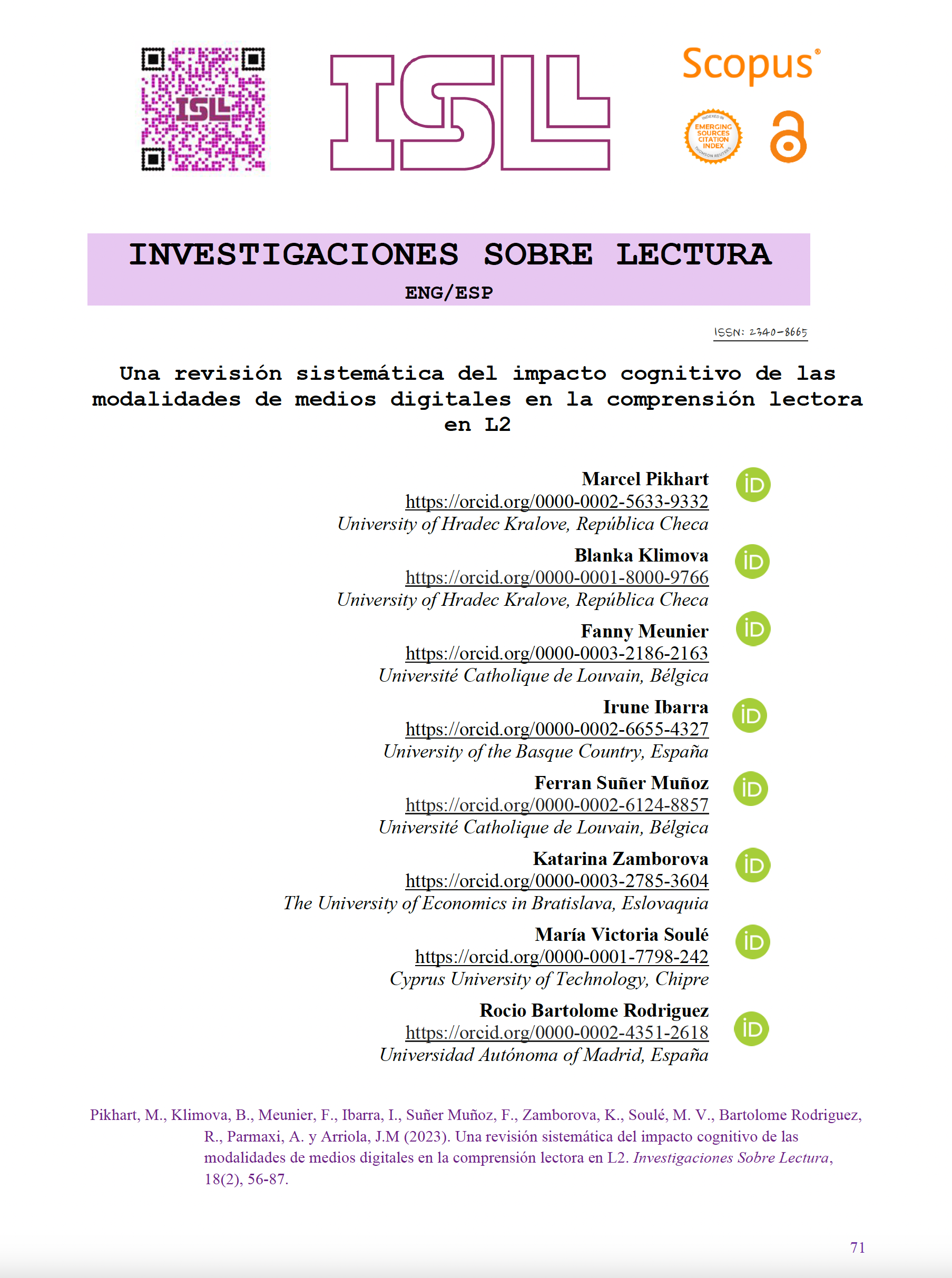
A Systematic Review of the Cognitive Impact of Digital Media Modalities on Reading Comprehension in L2
DOI:
https://doi.org/10.24310/isl.2.18.2023.16655Keywords:
second language acquisition, monolingual versus plurilingual, foreign languages, foreign language learning, applied linguistics, cognitive linguistics, psycholinguistics, ICT, technology, digital media, internet, social media, print mediaAbstract
The current affordances of ICT have – in the past decade – dramatically increased the exposure of students to the number of various digital texts they use or are exposed to when acquiring an additional language. The print media has been supplemented or even sometimes substituted by the digital media at all levels of education, including higher education and university curricula. Various research has recently been conducted into the role of digital media in L2 acquisition and this paper attempts to systematically summarize the results of this research, with a specific focus on reading comprehension. This systematic review follows the PRISMA guidelines (Page et al., 2021). The 2010-2021 studies from Scopus and the Web of Science dealing with the topic have been collected and analysed. Only experimental studies in peer-reviewed research journal papers have been included in the search. By applying this protocol review, 15 papers were selected for a synthesis. The results were classified as: (a) effect of media on reading comprehension, (b) pedagogical implications, (c) future research directions. The study concludes with some discussion and implications for researchers and practitioners from two perspectives: basic or fundamental Second Language Acquisition (FSLA) and instructed Second Language acquisition (ISLA).
Downloads
References
Ahmadi, D., y Reza, M. (2018). The use of technology in English language learning: A literature review. International Journal of Research in English Education, 3(2), 115-125.
Akbar, F. S., y Chen, C. A. (2015). Technology Assistance in Second Language Acquisition: Potentials and Limitations. Working Papers in Applied Linguistics and TESOL, 11(2), i-iii.
Al-shehri, S., y Gitsaki, Ch. (2010). Online reading: a preliminary study of the impact of integrated and split-attention formats on L2 students’ cognitive load. ReCALL, 22(3), 356-375.
Baron, N. (2015). Words Onscreen: The Fate of Reading in a Digital World. Oxford University Press.
Cain, K., y Oakhill, J. (Eds.). (2007). Children's comprehension problems in oral and written language: A cognitive perspective. The Guilford Press.
Cain, K., Oakhill, J., y Bryant, P. (2004). Children’s reading comprehension ability: Concurrent prediction by working memory, verbal ability, and component skills. Journal of educational psychology, 96(1), 31-42.
Chang, Y.H., Liu, T.C., y Paas, F. (2018). Cognitive resources allocation in computer-mediated dictionary assisted learning: From word meaning to inferential comprehension. Computers and Education, 127, 113-129.
Chang. M., y Lin, M. (2019). Experimental Study on Strategy-Oriented Web-Based English Instruction for EFL Students. Journal of Educational Computing Research, 56(8), 1238-1257.
Delgado, P., Vargas, C., Ackerman, R., y Salmerón, L. (2018). Don't throw away your printed books: A meta-analysis on the effects of reading media on reading comprehension. Educational Research Review, 25, 23-38.
Elgort, I., Brysbaert, M., Stevens, M., y Assche, E. (2018). Contextual word learning during reading in a second language. An eye-movement study. Studies in Second Language Acquisition, 40(2), 341-366.
Fajardo, I., Ávila, V., Ferrer, A., Tavares, G., Gómez, M., y Hernández, A. (2013). Easy-to-read Texts for Students with Intellectual Disability: Linguistic Factors Affecting Comprehension. Journal of Applied Research in Intellectual Disabilities, 27(3), 212-225. https://doi.org/10.1111/jar.12065
Fisher, D., Lapp, D., y Wood, K. (2011). Reading for details in online and printed text: A prerequisite for deep reading. Middle School Journal, 42(3), 58-63.
Furenes, M. I., Kucirkova, N., y Bus, A. G. (2021). A Comparison of Children’s Reading on Paper Versus Screen: A Meta-Analysis. Review of Educational Research, 91(4), 483–517. https://doi.org/10.3102/0034654321998074
Garrett-Rucks, P., Howles, L., y Lake, W. M. (2015). Enhancing L2 Reading Comprehension with Hypermedia Texts: Student Perceptions. CALICO Journal, 32(1), 26-51.
Greenfield, S. (2015). Mind Change: How Digital Technologies Are Leaving Their Mark on Our Brains. Random House.
Han, Z-H. (2016). A "reimagined SLA" or an expanded SLA? A rejoinder to the Douglas Fir Group (2016). The Modern Language Journal, 100(4), 736-740.
Hee, P., y Hyunwoo, K. (2017). Second language acquisition and processing of Korean locative constructions by Chinese speakers. Acta Koreana, 20(2), 591-614.
Kaban, A., y Karadeniz, S. (2021). Children’s Reading Comprehension and Motivation on Screen Versus on Paper. SAGE Open, 11(1). https://doi.org/10.1177/2158244020988849
Kazazoğlu, S. (2020). Is printed-text the best choice? A mixed-method case study on reading comprehension. Journal of Language and Linguistic Studies, 16(1), 458-473.
Kendeou, P., van den Broek, P., Helder, A., y Karlsson, J. (2014). A cognitive view of reading comprehension: Implications for reading difficulties. Learning disabilities research y practice, 29(1), 10-16.
Kuligowska, K, Kisielewicz, P., y Wlodarz, A. (2018). Speech synthesis systems: disadvantages and limitations. International Journal of Engineering y Technology, 7(2.28), 234-239.
Leu, D. J., Forzani, E., y Kennedy, C. (2015). Income inequality and the online reading gap: Teaching our way to success with online research and comprehension. Reading Teacher, 68(6), 422-427. https://doi.org/10.1002/trtr.1328
Leu, D. J., Forzani, E., Maykel, C., y Kulikowich, J. (2013). The new literacies of online research and comprehension: Assessing and preparing students for the 21st century with Common Core Standards. In S. B. Neuman and L. B. Gambrell (Eds.), Quality Reading Instruction in the Age of Common Core Standards (pp. 219-236). International Reading Association.
Leu, D. J., Kiili, C., y Forzani, E. (2016). Individual differences in the new literacies of online research and comprehension. In P. Afflerbach (Ed.), Handbook of Individual Differences in Reading: Reader, Text, and Context (pp. 259-272). Routledge.
Lim, J., Whitehead, G. E., y Choi, Y., (2021). Interactive e-book reading vs. paper-based reading: Comparing the effects of different mediums on middle school students’ reading comprehension, System, 97(4), 102434.
Linderholm, T., y van den Broek, P. (2002). The effects of reading purpose and working memory capacity on the processing of expository text. Journal of Educational Psychology, 94(4), 778-784.
Mayer, R. E. (2005). Cognitive theory of multimedia learning. In R.E. Mayer (Ed.), The Cambridge Handbook of Multimedia Learning. Cambridge University Press.
Marzban, A. (2011). Investigating the role of multimedia annotations in EFL reading comprehension. Procedia - Social and Behavioral Sciences, 28, 72-77.
Miyake, A., y Friedman, N. P. (2012). The Nature and Organization of Individual Differences in Executive Functions: Four General Conclusions. Current Directions in Psychological Science, 21(1), 8-14. https://doi.org/10.1177/0963721411429458
Mulder, E., van de Ven, M., Segers, E., Krepel, A., Bree, E., van der Mass, H., Jong, P., y Verhoeven, L. (2021). Serious game-based word-to-text integration intervention effects in English as a second language. Contemporary Educational Psychology, 65.
Nassaji, H. (2014). The role and importance of lower-level processes in second language reading. Language Teaching, 47(1), 1-37.
Nation, I. S. P. (2009). En Wei, Li y Cook, V. (eds.). New roles for L2 vocabulary. Contemporary applied linguistics, 1, 99-116.
Nomura, M., Nielsen, G. S., y Tronbacke, B. (2010). Guidelines for easy-to-read materials. IFLA.
OECD. (2011). PISA 2009 results: Students on line: Digital technologies and performance. (Volumen VI). http://dx.doi.org/10.1787/9789264112995-en.
Onieva, J. L., Maqueda, E., Felipe, A., y García, M. A. (2021). Estudio neurocientífico sobre el proceso de lectura en estudiantes de educación primaria con libros de texto en papel y digital. Investigaciones Sobre Lectura, 16, 1-31. https://doi.org/10.24310/isl.vi16.13683
Page, M. J., McKenzie, J. E., Bossuyt, P. M., Boutron, I., Hoffmann, T. C., Mulrow, C. D., et al. (2021). The PRISMA 2020 statement: an updated guideline for reporting systematic reviews. BMJ 372(71). https://doi.org/10.1136/bmj.n71
Pellicer-Sánchez, A. (2016). Incidental L2 Vocabulary Acquisition from and while Reading. An Eye-Tracking Study. Studies in Second Language Acquisition, 38(1), 97-130.
Perfetti, C. A., y Hart, L. (2002). The lexical quality hypothesis. In L. Vehoeven. C. Elbro, y P. Reitsma (Eds.), Precursors of functional literacy (pp. 189-213). John Benjamins.
Ratminingsih, N. M., y Budasi, I. G. (2020). Printed Media versus Digital Media: Which One is More Effective? In 3rd International Conference on Innovative Research Across Disciplines (ICIRAD 2019) (pp. 49-55). Atlantis Press.
Sadeghi, K. y Ahmadi, N. (2012). The effect of gloss type and mode on Iranian EFL learners’ reading comprehension. English Language Teaching, 5(12), 23-49.
Sadeghi, K., Khezrlou, S., y Modirkhameneh, S. (2017). Calling Iranian learners of L2 English: effect of gloss type on lexical retention and reading performance under different learning conditions. Journal of Research in Reading, 40(S1), 66-86.
Sánchez, S., y Pascual, M. A. (2022). Effectiveness of a Digital Serious Game in Improving Reading Comprehension and Academic Performance. Investigaciones Sobre Lectura, 1(17), 40-66. https://doi.org/10.24310/isl.vi17.14325
Sayers, D., Sousa-Silva, R., Höhn, S., et al. (2021). The Dawn of the Human-Machine Era: A forecast of new and emerging language technologies. Report for EU COST Action CA19102 ‘Language in The Human-Machine Era’. https://doi.org/10.17011/jyx/reports/20210518/1
Shang, H. F. (2015). An investigation of scaffolded reading on EFL hypertext comprehension. Australasian Journal of Educational Technology, 31(3), 293-312.
Small, G. W., Moody, T. D., Siddarth, P., y Bookheimer, S. Y. (2009). Your Brain on Google: Patterns of Cerebral Activation during Internet Searching. The American Journal of Geriatric Psychiatry, 17(2), 116-126.
Stodden, R. A., Roberts, K. D., Takahashi, K., Park, H. J., y Stodden, N. J. (2012). Use of Text-to-speech Software to Improve Reading Skills of High School Struggling Readers. Procedia Computer Science, 14, 359-362. https://doi.org/10.1016/J.PROCS.2012.10.041
Usó, E., y Ruiz-Madrid, M. N. (2009). Reading printed versus online texts. A study of EFL learners strategic reading behavior. International Journal of English Studies, 9(2), 59-79.
van den Broek, P., Risden, K., y Husebye-Hartmann, E. (1995). The role of readers’ standards for coherence in the generation of inferences during reading. En R. F. Lorch y E. J. O’Brien (Eds.), Sources of coherence in reading (pp. 353-374). Lawrence Erlbaum Associates Publishers.
Wang, Y. H. (2016). Reading strategy use and comprehension performance of more successful and less successful readers: A think-aloud study. Educational Sciences: Theory y Practice, 16(5), 1789-1813.
Westera, W. (2013). The Digital Turn. How the Internet Transforms Our Existence. Authorhouse.
Yow, W. Q. (2019). Computerised Electronic Features Direct Children’s Attention to Print in Single- and Dual-Language e-Books. AERA Open, 5(3), 1-15.
Zhang, R., y Zou, D. (2022). Types, purposes, and effectiveness of state-of-the-art technologies for second and foreign language learning. Computer Assisted Language Learning, 35(2), 1-47
Downloads
Published
Versions
- 2024-01-02 (4)
- 2023-12-22 (3)
- 2023-12-22 (2)
- 2023-12-22 (1)
Dimensions
Citations




Issue
Section
License
Copyright (c) 2023 Marcel Pikhart, Blanka Klimova, Fanny Meunier, Irune Ibarra, Ferran Suñer Muñoz, Katarina Zamborova, María Victoria Soulé, Rocío Bartolomé Rodríguez, Antigoni Parmaxi
All contents published in Investigaciones sobre Lectura are protected under the Creative Commons Attribution-NonCommercial-ShareAlike 4.0 International (CC BY-NC-SA 4.0) license. All about this license is available in the following link: <http://creativecommons.org/licenses/by-nc-sa/4.0>
Users can copy, use, redistribute, share and exhibit publicly as long as:
- The original source and authorship of the material are cited (Journal, Publisher and URL of the work).
- It is not used for comercial purposes.
- The existence of the license and its especifications are mentioned.
There are two sets of authors’ rights: moral and property rights. Moral rights are perpetual prerogatives, unrenounceable, not-transferable, unalienable, imprescriptible and inembargable. According to authors’ rights legislation, Investigaciones sobre Lectura recognizes and respects authors moral rights, as well as the ownership of property rights, which will be transferred to University of Malaga in open access. The property rights are referred to the benefits that are gained by the use or the dissemination of works. Investigaciones sobre Lectura is published in an open access form and it is exclusively licenced by any means for doing or authorising distribution, dissemination, reproduction, , adaptation, translation or arrangement of works.
Authors are responsable for obtaining the necessary permission to use copyrighted images.






31.png)