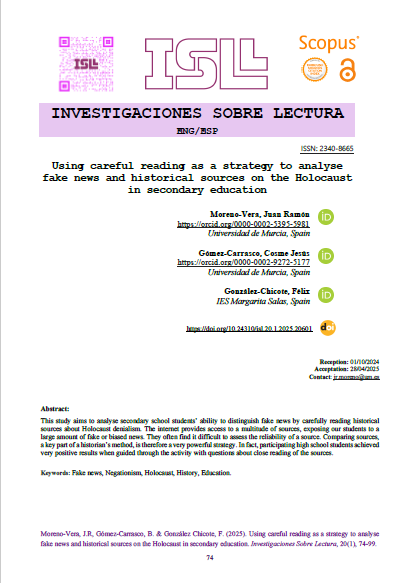
Close reading strategy to analize fake news and historical evidences about the Holocaust in Secondary Education
DOI:
https://doi.org/10.24310/isl.20.1.2025.20601Keywords:
Fake news, negationism, Holocaust, history, educationAbstract
The study aims to analyse the ability of high school students to distinguish fake news through the careful reading of historical sources, in this case, about Holocaust denialism. Access to a multitude of sources via the internet has meant that our students are also exposed to a large amount of fake or biased news. It is often difficult for them to assess the reliability of a source, and comparing sources, which is part of the historian's method, becomes a very powerful strategy. In fact, the participating high school students showed very positive results when the activity is guided by the questions of close reading of the sources.
Downloads
References
Artola, M. (1981). La burguesía revolucionaria (1808-1874). Alianza
Digital Inquiry Group. (2023). Home | Civic Online Reasoning. https://cor.stanford.edu
Gadamer, H. (1979). The Problem of Historical Consciousness. In P. Rabinow & W. Sullivan (Ed.), Interpretive Social Science: A Reader (pp. 103-160). University of California Press. https://doi.org/10.1525/9780520340343-005
Gómez Carrasco, C. J., Monteagudo, J., Moreno-Vera, J. R., & Sáinz, M. (2020). Evaluation of a gamification and flipped-classroom program used in teacher training: Perception of learning and outcome. PLoS One, 15(10), e0241892. https://doi.org/10.1371/journal.pone.0241892 PMID:33119687
González-Bailón, S., Lazer, D., Barberá, P., Zhang, M., Hunt Allcott, T., Crespo-Tenorio, A., Freelon, D., Gentzkow, M., Guess, A., Iyengar, S., Mie Kim, Y., Malhorta, N., Moehler, D., Nyhan, B., Pan, J., Velasco Rivera, C., Settle, J., Thorson, E., Tromble, R., Wilkins, A., Wojcieszak, M., De Jonge, C., Franco, A., Mason, W., Stroud, N. & Tucker, J. (2023). Asymmetric ideological segregation in exposure to political news on Facebook. Science, 381, 392-398. https://doi.org/10.1126/science.ade7138
Huber, G. L. (2013). AQUAD7-Analysis of Qualitative Data. University of Tübingen.
Mayor Ferrándiz, M.T. (2012). Los negacionistas del Holocausto. Revista de claseshistoria, 4. p. 5.
McGrew, S., Breakstone, J., Ortega, T., Smith, M., & Wineburg, S. (2018). Can students evaluate online sources? Learning from assessments of civic online reasoning. Theory & Research in Social Education, 46, 165-193. https://doi.org/10.1080/00933104.2017.1416320
McGrew, S., & Byrne, V. (2022). Conversations after lateral reading: Supporting teachers to focus on process, not content. Computers & Education, 185, 104519.
Moreno-Vera, J.R., Monteagudo-Fernández, J. & Gómez-Carrasco, C.J. (2023). Teaching history to face the world today. Socially-conscious approaches, activity proposals and historical thinking competencies. Peter Lang. https://doi.org/10.3726/b20699
Moreno-Vera, J. R., & Ponsoda López de Atalaya, S. (2021). Competencias clave y patrimonio en educación primaria. Un análisis de la concepción del profesorado en formación. Revista Interuniversitaria De Formación Del Profesorado. Continuación De La Antigua Revista De Escuelas Normales, 96, 29–46. https://doi.org/10.47553/rifop.v96i35.3.91039
Moreno-Vera, J.R. & Martínez-Leguizamo, J. (2022). Welcome Refugees! The use of cultural heritage to teach democratic values. Sustainability, 14(20), 13466. https://doi.org/10.3390/su142013466
Piqueras, J.A. (2011). Slave in Spain. Los Libros de la Catarata.
Reisman, A. (2012). Reading like a Historian: A document-based history curriculum intervention in urban high schools. Cognition and Instruction, 30(1), 86-112. https://doi.org/10.1080/07370008.2011.634081
Reisman, A., & Fogo, B. (2016). Contributions of educative document-based curricular materials to quality of historical instruction. Teaching and Teacher Education, 59, 191-202.
Rodrigo y Alharilla, M. (ed.) (2022). Del olvido a la memoria. La esclavitud en la España contemporánea. Icaria.
Świebocki, T. y Swiebocki, H. (2007). Auschwitz: residence of death. Biały Kruk.
Suárez, E. (2009). Interview with David Irving, Diario El Mundo, 5 September 2009 (not available on the internet).
United States Holocaust Memorial Museum. (2024). The ‘Night of Broken Glass’, Holocaust Encyclopedia, disponible en https://encyclopedia.ushmm.org/content/en/article/the-night-of-broken-glass , accedido el 19 de julio de 2024.
Viana, I. (2021). The ignored study of 1826 that overturned the black legend that Spain exterminated slaves in America, Diario ABC, 2 Febrero 2021: www.abc.es/historia/abci-ignorado-estudio-sobre-esclavitud-america-tumbo-leyenda-negra-contra-espana-hace-siglos-202102021846_noticia.html , consultado el 14 de julio de 2024.
Wineburg, S. (2018). Why Learn History (When It’s Already on Your Phone). The University of Chicago Press. https://doi.org/10.7208/chicago/9780226357355.001.0001
Wineburg S., & McGrew, S. (2019). Lateral reading and the nature of expertise: Reading less and learning more when evaluating digital information. Teachers College Record, 121(11).
Wineburg, S., Breakstone, J., McGrew, S., Smith, M. D., & Ortega, T. (2022). Lateral reading on the open Internet: A district-wide field study in high school government classes. Journal of Educational Psychology, 114(5), 893–909. https://doi.org/10.1037/edu0000740
Downloads
Published
Dimensions
Citations




Issue
Section
License
Copyright (c) 2025 Juan Ramón Moreno-Vera, Cosme Jesús Gómez-Carrasco, Félix ´González-Chicote
All contents published in Investigaciones sobre Lectura are protected under the Creative Commons Attribution-NonCommercial-ShareAlike 4.0 International (CC BY-NC-SA 4.0) license. All about this license is available in the following link: <http://creativecommons.org/licenses/by-nc-sa/4.0>
Users can copy, use, redistribute, share and exhibit publicly as long as:
- The original source and authorship of the material are cited (Journal, Publisher and URL of the work).
- It is not used for comercial purposes.
- The existence of the license and its especifications are mentioned.
There are two sets of authors’ rights: moral and property rights. Moral rights are perpetual prerogatives, unrenounceable, not-transferable, unalienable, imprescriptible and inembargable. According to authors’ rights legislation, Investigaciones sobre Lectura recognizes and respects authors moral rights, as well as the ownership of property rights, which will be transferred to University of Malaga in open access. The property rights are referred to the benefits that are gained by the use or the dissemination of works. Investigaciones sobre Lectura is published in an open access form and it is exclusively licenced by any means for doing or authorising distribution, dissemination, reproduction, , adaptation, translation or arrangement of works.
Authors are responsable for obtaining the necessary permission to use copyrighted images.





31.png)