
Prácticas alfabetizadoras y motivación lectora en familias con hijos e hijas en Educación Infantil
DOI :
https://doi.org/10.24310/isl.20.1.2025.20602Mots-clés :
Familia, Alfabetización, Lectura, Hijos, HogarRésumé
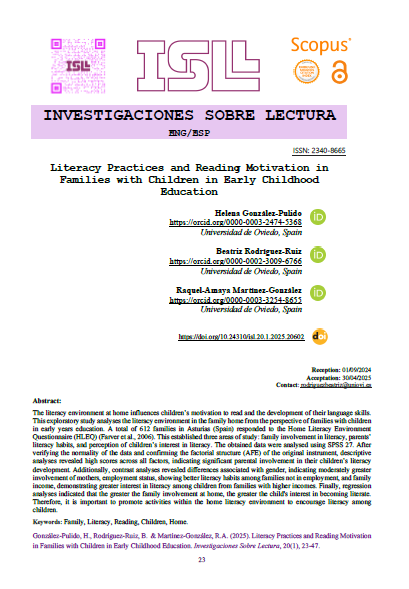
El entorno alfabetizador del hogar es un factor influyente en la motivación lectora y en el desarrollo de las destrezas lingüísticas de los niños y las niñas. El presente estudio exploratorio analiza el entorno de alfabetización en el hogar familiar desde la perspectiva de las familias con hijos e hijas en Educación Infantil. Los participantes han sido 612 familias de Asturias (España) que han respondido al cuestionario Home Literacy Environment Questionnaire (Farver et al., 2006) estableciendo tres dimensiones de estudio: Implicación familiar en la alfabetización, Hábitos de alfabetización de padres y madres y Percepción del interés del niño y la niña por la alfabetización, analizando los datos obtenidos con SPSS.27. Tras comprobar la normalidad de los datos y confirmar la estructura factorial (AFE) de la versión original del instrumento, los análisis descriptivos mostraron valores altos en todos los factores, sugiriendo una alta implicación familiar en el proceso alfabetizador de sus hijos e hijas. Además, los análisis de contrastes señalaron diferencias asociadas al sexo, implicación moderadamente mayor de las madres; la situación laboral, mejores hábitos de alfabetización de las familias que no están en activo; y los ingresos familiares, mayor interés por alfabetizarse de los hijos e hijas de familias con mayores ingresos. Finalmente, los análisis de regresión señalaron que, a mayor implicación de las familias en el hogar, mayor es el interés de los hijos y las hijas por alfabetizarse. Con ello, resulta interesante potenciar acciones en el entorno alfabetizador del hogar para promover a alfabetización de niños y niñas.
Téléchargements
Métriques
##plugins.generic.pfl.publicationFactsTitle##
##plugins.generic.pfl.reviewerProfiles## SO
##plugins.generic.pfl.authorStatements##
##plugins.generic.pfl.indexedIn##
-
##plugins.generic.pfl.indexedList##
- ##plugins.generic.pfl.editorAndBoard##
- ##plugins.generic.pfl.profiles##
- ##plugins.generic.pfl.academicSociety##
- SO
- ##plugins.generic.pfl.publisher##
- EduVerso, Universidad de Málaga

##plugins.generic.pfl.informationFooter## 
##plugins.generic.pfl.maintainedByPKP##
Références
Abdelwahab, M. M., Abonazel, M. R., Hammad, A. T., y El-Masry, A. M. (2024). Modified Two-Parameter Liu Estimator for Addressing Multicollinearity in the Poisson Regression Model. Axiomas, 13, 46. https://doi.org/10.3390/axioms13010046
Artola, T., Sastre, S., y Barraca, J. (2016). Diferencias de género en actitudes e intereses lectores: una investigación con alumnos españoles de primaria. Bordón. Revista de Pedagogía, 69(1), 11-26. https://doi.org/10.13042/Bordon.2016.37925
Belsley, D. A. (1991). Conditioning diagnostics: Collinearity and weak data in regression. John Wiley & Sons.
Burgess, S., Hecht, S., y Lonigan, C. (2002). Relations of the Home Literacy Environment (HLE) to the Development of Reading-Related Abilities: A One-Year Longitudinal Study. Reading Research Quarterly, 37(4), 408-426. http://dx.doi.org/10.1598/RRQ.37.4.4
Çalışkan, E.F., y Ulas, A.H. (2022). The Effect of Parent-involved Reading Activities on Primary School Students’ Reading Comprehension Skills, Reading Motivation, and Attitudes towards Reading. International Electronic Journal of Elementary Education, 14(4), 509-524. https://doi.org/10.26822/iejee.2022.260
Campos, I.O., y Tabernero, R. (2024). Influencia de la familia como contexto alfabetizador en el Desarrollo de la motivación lectora. Perfiles Educativos, XLVI(185), 46-68. https://doi.org/10.22201/iisue.24486167e.2024.185.61421
Carballo, A. y Portero, M. (2018). 10 ideas clave. Neurociencia y educación. Aportaciones para el Aula. Graó.
Choi, N., Sheo, J., Jung, S., y Jisu, C. (2022). Lectura de periódicos en familias con niños en edad escolar: relación entre la interacción entre padres e hijos en el uso del periódico, la motivación para la lectura y el rendimiento académico. International Journal of Environmental Research and Public Health, 19(21), 14423. https://doi.org/10.3390/ijerph192114423
Cohen, J. (1973). Eta-squared and Partial Eta-squared in Communication Science. Human Communication Research, 28, 473-490.
Cohen, J. (1988). Statistical power analysis for the behavioral sciences. Lawrence Earlbaum Associates.
De-La-Pena, C., Parra-Bolaños, N., y Fernández-Medina, J.M. (2018). Análisis de la alfabetización inicial en función del tipo de familia. Ocnos, 17(1), 7-20. https://doi.org/10.18239/ocnos_2018.17.1.1336
Delgado, M.D., Méndez, I., y Ruiz, C. (2020). Comprensión y motivación lectora en educación infantil a través de la luz. Investigaciones Sobre Lectura, 17(2), 93-109. https://doi.org/10.24310/isl.vi18.14399
Delgado, M.D., Méndez, I., y Ruiz, C. (2020). Motivación hacia la lectura en el alumnado de Educación Infantil y Primaria. European Journal of Education and Psychology, 13(2), 177-186. https://doi.org/10.30552/EJEP.V13I2.359
Dong, Y., Xiao-Ying, S., Wi-Yang, D., y Tang, Y. (2020). The Effects of Home Literacy Environment on Children´s Reading Comprehension Development: A Meta-analysis. Educational Sciences: Theory and Practice, 20(2), 63-82. http://dx.doi.org/10.12738/jestp.2020.2.005
Dynia, J., Purtell, K., Justice, L., Pratt, A., y Hijlkema, M. (2019). Home Literacy Environments in Maya Communities in the Yucatán Peninsula. Early Education and Development 31(3), 411-425. https://doi.org/10.1080/10409289.2019.1651813
Dynia, J.M., Lawton, K., Logan, J.A.R., y Justice, L.M. (2014). Comparación de las habilidades de alfabetización emergentes y el entorno de alfabetización en el hogar de los niños con autismo y sus pares. Temas de Educación Especial en la Primera Infancia, 34(3), 142–153. https://doi.org/10.1177/0271121414536784
Farver, Jo., Xu, Y., Eppe, S., y Lonigan, C. (2006). Home environments and Young Latino children´s school readiness. Early Childhood Research Quarterly 21(2), 196-212. https://doi.org/10.1016/j.ecresq.2006.04.008
Fernández-Alonso, R., Cuesta, M., Woitschach, P., y Álvarez, M. (2019). La implicación familiar en la educación: una herramienta de cambio. Observatorio Social de “La Caixa”.
Fernández-Freire, L., Rodríguez-Ruiz, B., y Martínez-González, R.A. (2019). Padres y madres ante las tareas escolares: la visión del profesorado. Aula Abierta, 48(1), 77-84. https://doi.org/10.17811/rifie.48.1.2019.77-84
Finch, H. (2006). Comparison of the performance of varimax and promax rotations: Factor structure recovery for dichotomous items. Journal of Educational Measurement, 43(1), 39-52. https://doi.org/10.1111/j.1745-3984.2006.00003.x
Förster, C., y Rojas-Barahona, C. (2014). Disadvantaged preschool children from rural areas: the importance of home practices and nursery attendance in the development of early literacy skills. Cultura y Educación, 26(3), 476-504. https://doi.org/10.1080/11356405.2014.973668
Foster, T., Froyen, L., Skibbe, L., Bowles, R., y Decker, K. (2016). Fathers´ and mothers´ home learning environments and children´s early academic outcomes. Reading and Writing, 29(9), 1845-1863. https://doi.org/10.1007/s11145-016-9655-7
Friedlander, E. (2020). The home literacy ecology in rural Rwanda and its relationships to early grade reading. Scientific Studies of Reading, 24(2), 123-140. https://doi.org/10.1080/10888438.2019.1642894
Gillen, J., y Hall, N. (2013). The emergence of early childhood literacy. En J. Marsh y J. Larson (Eds.), The SAGE handbook of early childhood literacy, (pp. 3–17). London: SAGE.
Guo, Y., Puranik, C., Kelcey, B., Sun, J., Schneider-Dinnesen, M y Breit-Smith, A. (2020): The Role of Home Literacy Practices in Kindergarten Children’s Early Writing Development: A One-Year Longitudinal Study. Early Education and Development, 32(2), 209-227. https://doi.org/10.1080/10409289.2020.1746618
Gutiérrez-Fresneda, R. (2017). Efecto de la lectura compartida y las habilidades prelectoras en el aprendizaje lector. Ocnos, 16(2), 17-26. http://dx.doi.org/10.18239/ocnos_2017.16.2.1356
Guzmán, F., Gil-Flores, J., y Pacheco-Costa, A. (2020). Home literacy environment and Reading comprehension in Spanish primary education. Journal of Research in Reading, 43(2), 229-247. http://dx.doi.org/10.1111/1467-9817.12299
Hair, J. F., Black, W. C., Babin, B. J., Anderson, R. E., y Tatham, R. L. (2006). Multivariate data analysis (Vol. 6). Pearson Prentice Hall.
Hamilton, L., Hayiou-Thomas, M., Hulme, C., y Snowling, M. (2016). The home literacy environment as a predictor of the early literacy development of children at family-risk of dyslexia. Scientific Studies of Reading, 20(5), 401–419. https://doi.org/10.1080%2F10888438.2016.1213266
Harvey, A. (2016). Improving family literacy practices. SAGE Open, 6(3). https://doi.org/10.1177/2158244016669973
Hofslundsengen, H., Gustafsson, J.E., y Hagtvet, B.E. (2018). Contributions of the Home Literacy Environment and Underlying Language Skills to Preschool Invented Writing. Scandinavian Journal of Educational Research, 63(5), 653-669. https://doi.org/10.1080/00313831.2017.1420686
Incognito, O., y Pinto, G. (2021). Longitudinal effects of family and school context on the development of emergent literacy skills in preschoolers. Curr. Psychol, 42, 9819-9829. https://doi.org/10.1007/s12144-021-02274-6
Jarrett, R., y Coba-Rodríguez, S. (2017). “We keep the education goin’ at home all the time”: Family literacy in low-income African American families of preschoolers. Journal of Education for Students Placed at Risk, 22(2), 57-76. https://doi.org/10.1080/10824669.2017.1295861
Jeong, U. y Hofferth, S. (2016). Parental involvement, child effort, and the development of immigrant boys ‘and girls ‘reading and mathematics skills: A latent difference score growth model. Learning and Individual Differences, 47, 136-144. https://doi.org/10.1016/j.lindif.2016.01.001
Kim, S., Im, H., y Kwon, K. A. (2015). The role of home literacy environment in toddlerhood in development of vocabulary and decoding skills. Child Youth Care Forum, 44, 835–852. https://doi.org/10.1007/s10566-015-9309-y
Kleinbaum, D. G., Kupper, L. L., Muller, K. E., y Nizam, A. (1988). Applied regression analysis and other multivariable methods (Vol. 601). Duxbury press.
Kline, R. B. (2023). Principles and practice of structural equation modeling. Guilford publications.
Laganovska, E., y Margevica, I. (2024). Home-based early writing activities: the perspective of parents in a latvian context. Society Integration Education, 2, 37-47. https://doi.org/10.17770/sie2024vol2.7909
Lawley, D. N., y Maxwell, A. E. (1971). Factor analysis as a statistical method (Vol. 18). Butterworths.
Little, R. J. (1988). A test of missing completely at random for multivariate data with missing values. Journal of the American statistical Association, 83(404), 1198-1202.
Liu, C., y Chung, K. (2022). Effects of fathers’ and mothers’ expectations and home literacy involvement on their children's cognitive–linguistic skills, vocabulary, and word reading. Early Childhood Research Quarterly, 60, 1-12. https://doi.org/10.1016/j.ecresq.2021.12.009
Llamazares, M.T., y Alonso-Cortés, M.D. (2016). Lectura compartida y estrategias de compresión lectora en Educación Infantil. Revista Iberoamericana de Educación, 71(1), 151-171. http://dx.doi.org/10.35362/rie7109
López-Escribano, C., Escudero, A., y Pérez-López, R. (2021). An Exploratory Study about Patterns of Parental Home Literacy Activities during the COVID-19 Confinement among Spanish Families. Early Education and Development, 32(6), 812-829. https://doi.org/10.1080/10409289.2021.1916184
Manolitsis, G., Georgiou, G., y Tziraki, N. (2013). Examining the effects of home literacy and numeracy environment on early reading and math acquisition. Early Childhood Research Quarterly, 28(4), 692–703. http://dx.doi.org/10.1016/j.ecresq.2013.05.004
Martini, F., y Sénéchal, M. (2012). Learning literacy skills at home: Parent teaching, expectations, and child interest. Canadian Journal of Behavioural Science/Revue Canadienne Des Sciences Du Comportement, 44(3), 210–221. http://dx.doi.org/10.1037/a0026758
McGinnity, F., McMullin, P., Murray, A., Russell, H., y Smyth, E. (2022). Understanding differences in children´s reading ability by social origin and gender: The role of parental reading and pre-and primary school exposure in Ireland. Research in Social Stratification and Mobility, 81, 100729. https://doi.org/10.1016/j.rssm.2022.100729
McMillan, J. H., y Schumacher, S. (2005). Investigación educativa: una introducción conceptual. Pearson Education.
Moreno-Morilla, C., Guzmán-Simón F., y García-Jiménez, E. (2018). Literacy practices of primary education children in Andalusia (Spain): A family-based perspective. British Educational Research Journal, 45(1), 117-136. https://doi.org/10.1002/berj.3487
Muñoz, C., y Frez-Aróstica, N. (2021). Creencias y prácticas parentales en torno al desarrollo de la alfabetización emergente. Revista Electrónica de Investigación Educativa, 23(11), 1-13. https://doi.org/10.24320/redie.2021.23.e11.3455
Muñoz, L., Prieto, L., y Rodríguez, L. (2018). El cuento como herramienta didáctica para potencializar el vínculo entre padres e hijos. En E. Serna (Ed.), Revolución en la Formación y la Capacitación para el sigo XXI (pp. 506-511). Editorial Instituto Antioqueño de Investigación.
Neuman, S. (2014). Explaining and Understanding Early Literacy. Investigaciones Sobre Lectura, 2, 7-14. http://dx.doi.org/10.37132/isl.v0i2.1
Neumann, M. (2016). A socioeconomic comparison of emergent literacy and home literacy in Australian preschoolers. European Early Childhood Education Research Journal, 24(4), 555–566. https://doi.org/10.1080/1350293X.2016.1189722
Niklas, F., & Schneider, W. (2013). Home literacy environment and the beginning of reading and spelling. Contemporary Educational Psychology, 38(1), 40–50. http://dx.doi.org/10.1016/j.cedpsych.2012.10.001
Pfost, M., y Heyne, N. (2023). Lectura conjunta de libros, visitas a bibliotecas y enseñanza por correspondencia en familias: relaciones con la educación de los padres y la conducta lectora de los niños. Read Writ 36, 2627–2647. https://doi.org/10.1007/s11145-022-10389-w
Pinkham, A.M., y Neuman, S.B. (2012). Early literacy development. En B. Wasik (Ed.), Handbook of family literacy, (pp. 23–37). New York: Routledge.
Puglisi, M., Hulme, C., Hamilton, L., y Snowling, M. (2017). The Home Literacy Environment Is a Correlate, but Perhaps Not a Cause, of Variations in Children’s Language and Literacy Development. Scientific Studies of Reading, 21(6), 498-514. https://doi.org/10.1080/10888438.2017.1346660
Puranik, C., Phillips, B., Lonigan, C., y Gibson, E. (2018). Home literacy practices and preschool children’s emergent writing skills: An initial investigation. Early Childhood Research Quarterly, 42, 228-238. https://doi.org/10.1016/j.ecresq.2017.10.004
Reynolds, G., y Wefel, K. (2020). Home Literacy Environment and Emergent Skills in Preschool Children with hearing loss. Journal of Deaf and Deaf Education, 25(1), 68-70. https://doi.org/10.1093/deafed/enz025
Sénéchal, M., y LeFevre, J.A. (2002). Parental involvement in the development of children’s reading skill: A five-year longitudinal study. Child Development, 73(2), 445–460. https://doi.org/10.1111/1467-8624.00417
Sénéchal, M., y Lefevre, J. (2014). Continuity and change in the home literacy environment as predictors of growth in vocabulary and reading. Child Development, 85(4), 1552–1568. http://dx.doi.org/10.1111/cdev.12222
Siegenthaler, R., Abellán, L., Badenes-Gasset, A., y Mercader, J. (2019). Motivación temprana hacia el aprendizaje y rendimiento: estudio longitudinal. International Journal of Developmental and Educational Psychology, 3(1), 381-390. https://doi.org/10.17060/ijodaep.2019.n1.v3.1507
Silinskas, G., Lerkkanen, M., Tolvanen, A., Niemi, P., Poikkeus, A., y Nurmi, J. (2012). The frequency of parents’ reading-related activities at home and children’s reading skills during kindergarten and Grade 1. Journal of Applied Developmental Psychology, 33(6), 302–310. https://doi.org/10.1016/j.appdev.2012.07.004
Strang, T., y Piasta, S. (2016). Socioeconomic differences in code-focused emergent literacy skills. Read Writ, 29, 1337-1362. https://doi.org/10.1007/s11145-016-9639-7
Swain, J., y Cara, O. (2017). Changing the home literacy environment through participation in family literacy programmes. Journal of Early Childhood Literacy, 19(4), 431–458. http://dx.doi.org/10.1177/1468798417745118
Tabernero, R., Campos, I.O., y Briz-Villanueva, E. (2022). Exploración de la intervención de variables individuales y contextuales en la motivación lectora del alumnado preadolescente. Investigaciones Sobre Lectura, 17(2), 110-132. https://doi.org/10.24310/isl.vi18.14656
Torppa, M., Vasalampi, K., Eklund, K., y Niemi, P. (2022). Long-term effects of the home literacy environment on reading development: Familial risk for dyslexia as a moderator. Journal of Experimental Child Psychology, 215, 105314. https://doi.org/10.1016/j.jecp.2021.105314
van Bergen, E., van Zuijen, T., Bishop, D. y de Jong, P. (2017). Why are home literacy environment and children’s reading skills associated? What parental skills reveal. Reading Research Quarterly, 52(2), 147–160. https://doi.org/10.1002/rrq.160
Vicente-Yangüe, M.I., y González, M. (2019). Análisis de panorama metodológico interdisciplinar en Educación Infantil para el fomento de la lectura. Revista Complutense de Educación, 30(2), 493-508. http://dx.doi.org/10.5209/RCED.57738
Weigel, D., Martin, S., y Lowman, J. (2017). Assessing the early literacy skills of toddlers: The development of four foundational measures. Early Child Development and Care, 187(3-4), 744-755. https://doi.org/10.1080/03004430.2016.1236089
Wildova, R., y Kropáčková, J. (2015). Early childhood pre-reading literacy development. Procedia-Social and Behavioral Sciences, 191, 878-883. https://doi.org/10.1016/j.sbspro.2015.04.418
Worthington, R. L., y Whittaker, T. A. (2006). Scale development research: A content analysis and recommendations for best practices. The Counseling Psychologist, 34(6), 806-838.
Zgourou, E., Bratsch-Hines, M., y Vernon-Feagans, L. (2021). Home literacy practices in relation to language skills of children living in low-wealth rural communities. Reading and Writing. https://doi.org/10.1002/icd.2201
Zhang, S., Inoue, T., y Georgiou, G. (2023). Examining the relations between mothers’ reading skills, home literacy environment, and Chinese children’s word reading across contexts. Reading and Writing. https://doi.org/10.1007/s11145-023-10475-7
Zucker, T., Conradi, K., y Baker-Finck, J. (2022). Acceso a libros y motivación para la lectura de estudiantes de primaria de bajos ingresos. Psicología de la Lectura, 43(3-4), 250-276. https://doi.org/10.1080/02702711.2022.2094040
Zuilkowski, S., McCoy, D., Jonason, C., y Dowd, A. (2019). Relationships among home literacy behaviors, materials, socioeconomic status, and early literacy outcomes across 14 low-and middle-income countries. Journal of Cross-Cultural Psychology, 50(4), 539-555. https://doi.org/10.1177/002202211983736
Guevara, Y., y Rugerio, J. (2017). Interacciones profesor-alumnos durante lectura de cuentos en escuelas preescolares mexicanas. Revista Mexicana de Investigación Educativa, 22(74), 729-749.
Téléchargements
Publiée
Comment citer
Numéro
Rubrique
Licence
(c) Tous droits réservés Helena González-Pulido, Beatriz Rodriguez Ruiz, Raquel-Amaya Martínez-González 2025

Ce travail est disponible sous licence Creative Commons Attribution - Pas d’Utilisation Commerciale - Partage dans les Mêmes Conditions 4.0 International.
Todos los contenidos publicados en Investigaciones sobre la Lectura están sujetos a la licencia Creative Commons Reconocimento-NoComercia-Compartirigual 4.0 cuyo texto completo puede consultar en <http://creativecommons.org/licenses/by-nc-sa/4.0>
Se pueden copiar, usar, difundir, transmitir y exponer públicamente, siempre que:
- Se cite la autoría y la fuente original de su publicación (revista, editorial y URL de la obra).
- No se usen para fines comerciales.
- Se mencione la existencia y especificaciones de esta licencia de uso.
Los derechos de autor son de dos clases: morales y patrimoniales. Los derechos morales son prerrogativas perpetuas, irrenunciables, intransferibles, inalienables, inembargables e imprescriptibles. De acuerdo con la legislación de derechos de autor, Investigaciones sobre la Lectura reconoce y respeta el derecho moral de los autores/as, así como la titularidad del derecho patrimonial, el cual será cedido a la Universidad de Málaga para su difusión en acceso abierto. Los derechos patrimoniales, se refieren a los beneficios que se obtienen por el uso o divulgación de las obras. Investigaciones sobre la Lectura se publica en open access y queda autorizada en exclusiva para realizar u autorizar por cualquier medio el uso, distribución, divulgación, reproducción, adaptación, traducción o transformación de la obra.
Es responsabilidad de los autores/as obtener los permisos necesarios de las imágenes que están sujetas a derechos de autor.













30.png)