
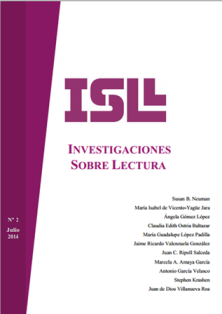
Explaining and Understanding Early Literacy
DOI:
https://doi.org/10.24310/revistaisl.vi2.10946Palabras clave:
alfabetización, infancia, lenguajeResumen
The last decade has brought a growing consensus on the range of skills that serve as the foundation for reading and writing ability (Neuman & Dickinson, 2011). To become a skilled reader, children need a rich language and conceptual knowledge base, a broad and deep vocabulary, and verbal reasoning abilities to understand messages that are conveyed through print. Children also must develop code-related skills, an understanding that spoken words are composed of smaller elements of speech (phonological awareness); the idea that letters represent these sounds (the alphabetic principle), the many systematic correspondences between sounds and spellings, and a repertoire of highly familiar words that can be easily and automatically recognized.But to attain a high level of skill, young children need opportunities to develop these strands, not in isolation, but interactively. Meaning, not sounds or letters, motivates children’s earliest experiences with print. Consequently, it is important to recognize that in practice, children acquire
these skills in coordination and interaction with meaningful experiences. Given the tremendous attention that early literacy has received recently and the increasing diversity of the child population in most countries, it is important and timely to take stock of these critical dimensions as well as the strengths and gaps in our ability to measure these skills effectively. In the following sections, I describe the critical dimensions of early literacy and the implications for high quality practices in the early childhood setting.
Descargas
Métricas
Publicación Facts
Perfil de revisores N/D
Información adicional autores
Indexado: {$indexList}
-
Indexado en
- Perfil de director y equipo editorial
- ##plugins.generic.pfl.profiles##
- Sociedad Académica/Grupo
- N/D
- Editora:
- EduVerso, Universidad de Málaga

Para obtener más información sobre un dato, haga clic

##plugins.generic.pfl.maintainedByPKP##
Descargas
Publicado
Cómo citar
Número
Sección
Licencia
Todos los contenidos publicados en Investigaciones sobre la Lectura están sujetos a la licencia Creative Commons Reconocimento-NoComercia-Compartirigual 4.0 cuyo texto completo puede consultar en <http://creativecommons.org/licenses/by-nc-sa/4.0>
Se pueden copiar, usar, difundir, transmitir y exponer públicamente, siempre que:
- Se cite la autoría y la fuente original de su publicación (revista, editorial y URL de la obra).
- No se usen para fines comerciales.
- Se mencione la existencia y especificaciones de esta licencia de uso.
Los derechos de autor son de dos clases: morales y patrimoniales. Los derechos morales son prerrogativas perpetuas, irrenunciables, intransferibles, inalienables, inembargables e imprescriptibles. De acuerdo con la legislación de derechos de autor, Investigaciones sobre la Lectura reconoce y respeta el derecho moral de los/las autores/as, así como la titularidad del derecho patrimonial, el cual será cedido a la Universidad de Málaga para su difusión en acceso abierto. Los derechos patrimoniales, se refieren a los beneficios que se obtienen por el uso o divulgación de las obras. Investigaciones sobre la Lectura se publica en open access y queda autorizada en exclusiva para realizar u autorizar por cualquier medio el uso, distribución, divulgación, reproducción, adaptación, traducción o transformación de la obra.
Es responsabilidad de los/las autores/as obtener los permisos necesarios de las imágenes que están sujetas a derechos de autor.
















30.png)