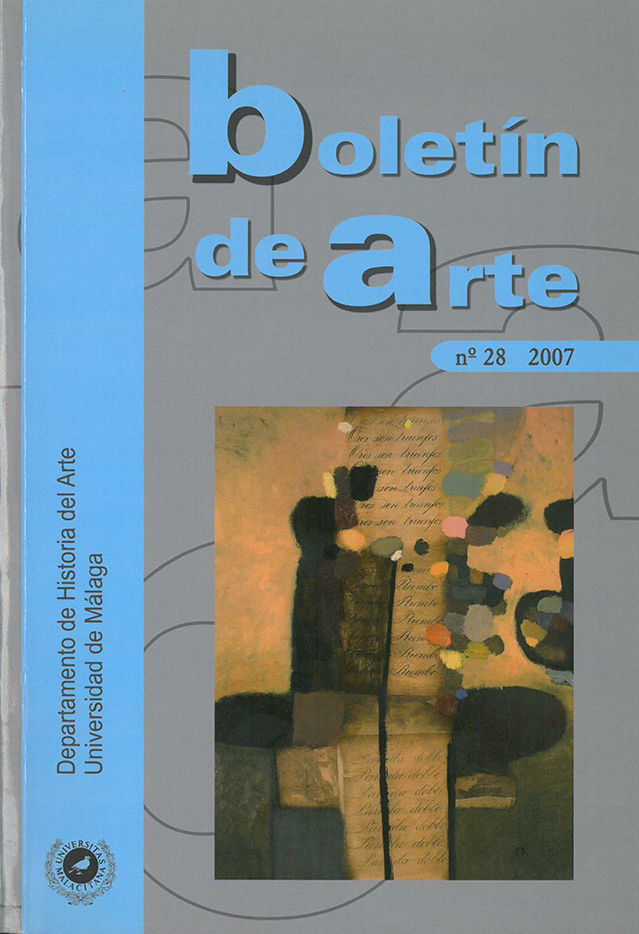
La estética del silencio: iconografía femenina en la época isabelina
DOI:
https://doi.org/10.24310/BoLArte.2007.v0i28.4477Abstract
In 1859, the femininity concept was based on the silence as synonymous of beauty or understanding quality which was also based on the concept of happiness devised by a romantic middle class. This new attitude about happiness which was shown in that time, is related to the idea of progress and contemporary, to the role given to the family and the work and all the theoretical mechanism that the middle class, early at the XVIII century and after the XX century, had created to consolidate its position and perpetuate its social, economic, politic and ideological intervention.
Downloads
Metrics
Publication Facts
Reviewer profiles N/A
Author statements
Indexed in
-
—
- Editor & editorial board
- profiles
- Academic society
- N/A
- Publisher
- Universidad de Málaga.

To learn about these publication facts, click 
PF is maintained by the Public Knowledge Project
Downloads
Published
How to Cite
Issue
Section
License
Todos los contenidos publicados en la revista Boletín de Arte están sujetos a la licencia Creative Commons Reconocimento-NoComercia-Compartirigual 4.0 cuyo texto completo puede consultar en <http://creativecommons.org/licenses/by-nc-sa/4.0>

Los/as autores/as cuyas contribuciones sean aceptadas para su publicación en esta revista conservarán el derecho no exclusivo de utilizar sus contribuciones con fines académicos, de investigación y educativos, incluyendo el auto-archivo o depósito en repositorios de acceso abierto de cualquier tipo.
La edición electrónica de esta revista esta editada por la Editorial de la Universidad de Málaga (UmaEditorial), siendo necesario citar la procedencia en cualquier reproducción parcial o total.









4.png)